
Multifunctional fiber-optic theranostic probe for closed-loop tumor photothermal therapy
IF 23.4
Q1 OPTICS
引用次数: 0
Abstract
The combination of optical fiber and phototheranostic agents has emerged as a promising strategy to address the challenges of limited light penetration depth and systemic toxicity of nanomaterials. However, the multiplexing potential of fiber-optic probes remains underrated, resulting in enlarged incisions, repeated invasive procedures, and a lack of real-time therapeutic feedback. Herein, we propose a scheme for single‑fiber multifunctional integration leveraging wavelength division multiplexing technology. As a proof-of-concept, by co-immobilizing pH indicator, temperature indicator, and photothermal agent with non-overlapped excitation bands onto tapered optical fiber surface, a fiber-optic theranostic probe enabling closed-loop tumor photothermal therapy was developed. Pre-treatment, the probe can achieve tumor edge identification through revealing the tumor pH gradient. Intra-treatment, the photothermal agent can convert optical energy into heat for photothermal therapy, while simultaneous temperature monitoring enables precise thermal dose control. Post-treatment, rapid efficacy assessment can be achieved via real-time monitoring of the reversal of acidic tumor microenvironment. Animal experiments validate the excellent therapeutic efficacy and biocompatibility of the probe. This research opens new avenues for multifunctional fiber-optic theranostic platforms, where modular wavelength assignment enables customizable minimally invasive interventions and feedback monitoring, holding significant promise for both clinical practice and mechanistic exploration.
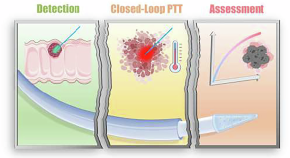
用于肿瘤闭环光热治疗的多功能光纤治疗探头
光纤和光治疗剂的结合已成为解决纳米材料有限的光穿透深度和全身毒性挑战的一种有前途的策略。然而,光纤探针的多路复用潜力仍然被低估,导致切口扩大,重复侵入性手术,缺乏实时治疗反馈。本文提出了一种利用波分复用技术实现单光纤多功能集成的方案。作为概念验证,通过在锥形光纤表面共固定pH指示剂、温度指示剂和具有非重叠激发带的光热剂,开发了一种可实现闭环肿瘤光热治疗的光纤治疗探针。预处理前,探头通过揭示肿瘤pH梯度实现肿瘤边缘识别。在治疗过程中,光热剂可以将光能转化为热能进行光热治疗,同时进行温度监测,实现精确的热剂量控制。治疗后,通过实时监测肿瘤酸性微环境逆转情况,实现快速疗效评估。动物实验证实该探针具有良好的治疗效果和生物相容性。这项研究为多功能光纤治疗平台开辟了新的途径,其中模块化波长分配使可定制的微创干预和反馈监测成为可能,在临床实践和机制探索中都具有重要的前景。
本文章由计算机程序翻译,如有差异,请以英文原文为准。
求助全文
约1分钟内获得全文
求助全文
来源期刊
Light-Science & Applications
数理科学, 物理学I, 光学, 凝聚态物性 II :电子结构、电学、磁学和光学性质, 无机非金属材料, 无机非金属类光电信息与功能材料, 工程与材料, 信息科学, 光学和光电子学, 光学和光电子材料, 非线性光学与量子光学
自引率
0.00%
发文量
803
审稿时长
2.1 months
 求助内容:
求助内容: 应助结果提醒方式:

 京公网安备 11010802042870号


