
Near-term fermionic simulation with subspace noise tailored quantum error mitigation
IF 8.3
1区 物理与天体物理
Q1 PHYSICS, APPLIED
引用次数: 0
Abstract
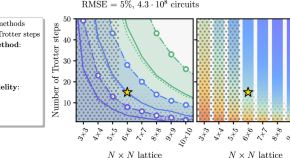
Quantum error mitigation (QEM) has emerged as a powerful tool for the extraction of useful quantum information from quantum devices. Here, we introduce the Subspace Noise Tailoring (SNT) algorithm, which efficiently combines the cheap cost of Symmetry Verification (SV) and low bias of Probabilistic Error Cancellation (PEC) QEM techniques. We study the performance of our method by simulating the Trotterized time evolution of the spin-1/2 Fermi-Hubbard model (FHM) using a variety of local fermion-to-qubit encodings, which define a computational subspace through a set of stabilizers, the measurement of which can be used to post-select noisy quantum data. We study different combinations of QEM and encodings and uncover a rich state diagram of optimal combinations, depending on the hardware performance, system size and available shot budget. We then demonstrate how SNT extends the reach of current noisy quantum computers in terms of the number of fermionic lattice sites and the number of Trotter steps, and quantify the required hardware performance beyond which a noisy device may compete with current state-of-the-art classical computational methods.
近期费米子模拟与子空间噪声定制的量子误差缓解
量子误差缓解(QEM)已成为从量子器件中提取有用量子信息的有力工具。在此,我们介绍了子空间噪声裁剪(SNT)算法,该算法有效地结合了对称验证(SV)的低成本和概率误差抵消(PEC) QEM技术的低偏差。我们通过使用多种局部费米子-量子比特编码来模拟自旋-1/2费米-哈伯德模型(FHM)的trotter化时间演化来研究我们的方法的性能,这些编码通过一组稳定器定义了计算子空间,其测量可用于后选噪声量子数据。我们研究了QEM和编码的不同组合,并揭示了最优组合的丰富状态图,这取决于硬件性能,系统大小和可用的镜头预算。然后,我们展示了SNT如何在费米子点位的数量和Trotter步骤的数量方面扩展当前噪声量子计算机的范围,并量化了所需的硬件性能,超出该性能,噪声设备可能与当前最先进的经典计算方法竞争。
本文章由计算机程序翻译,如有差异,请以英文原文为准。
求助全文
约1分钟内获得全文
求助全文
来源期刊

npj Quantum Information
Computer Science-Computer Science (miscellaneous)
CiteScore
13.70
自引率
3.90%
发文量
130
审稿时长
29 weeks
期刊介绍:
The scope of npj Quantum Information spans across all relevant disciplines, fields, approaches and levels and so considers outstanding work ranging from fundamental research to applications and technologies.
 求助内容:
求助内容: 应助结果提醒方式:

 京公网安备 11010802042870号


