
Dynamic Hydrogen-Bond Networks Enable Long-Lived Ionic Thermoelectric Materials With High Power Density
IF 19
1区 材料科学
Q1 CHEMISTRY, MULTIDISCIPLINARY
引用次数: 0
Abstract
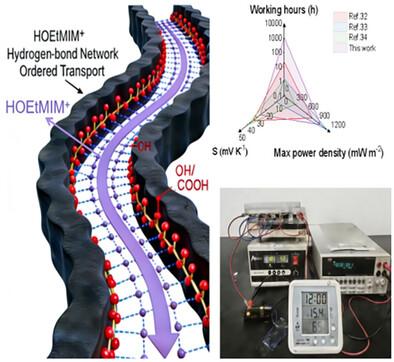
Achieving a balance between high power density and long-term operational stability remains a major challenge for ionic thermoelectric materials, with reported stable operation typically limited to under a week. To overcome this limitation, here we present a hydrogen-bond network approach to regulate ion transport. By impregnating a hydroxyl-functionalized ionic liquid (HOEtMIM:Cl) into a porous carbon scaffold, we fabricate a composite featuring a dynamic hydrogen-bond network. This network not only facilitates ordered cation migration through carbon channels, markedly enhancing thermoelectric current and power density, but also effectively traps water molecules to improve environmental stability. Notably, the composite achieves a high thermopower of 26.9 mV K−1 and a peak power density of 0.95 W m−2 under a 20 K temperature difference. And it sustains stable operation for over 46 days without external energy storage. An integrated device built from this material can directly power small electronics such as thermohygrometers, demonstrating its practical potential for low-grade waste-heat recovery. This study establishes a new design paradigm for high-performance, long-lived ionic thermoelectric materials.
动态氢键网络使长寿命离子热电材料具有高功率密度
实现高功率密度和长期运行稳定性之间的平衡仍然是离子热电材料面临的主要挑战,据报道,离子热电材料的稳定运行通常限制在一周内。为了克服这一限制,我们提出了一种调节离子传输的氢键网络方法。通过将羟基功能化离子液体(HOEtMIM:Cl)浸渍到多孔碳支架中,我们制备了具有动态氢键网络的复合材料。该网络不仅促进阳离子有序迁移通过碳通道,显著提高热电电流和功率密度,而且有效地捕获水分子,提高环境稳定性。值得注意的是,在20 K的温差下,该复合材料的热功率高达26.9 mV K−1,峰值功率密度为0.95 W m−2。无需外接储能,可稳定运行46天以上。由这种材料制成的集成设备可以直接为小型电子设备供电,如温度计,这表明了它在低品位废热回收方面的实际潜力。本研究建立了高性能、长寿命离子热电材料的新设计范式。
本文章由计算机程序翻译,如有差异,请以英文原文为准。
求助全文
约1分钟内获得全文
求助全文
来源期刊
Advanced Functional Materials
工程技术-材料科学:综合
CiteScore
29.50
自引率
4.20%
发文量
2086
审稿时长
2.1 months
期刊介绍:
Firmly established as a top-tier materials science journal, Advanced Functional Materials reports breakthrough research in all aspects of materials science, including nanotechnology, chemistry, physics, and biology every week.
Advanced Functional Materials is known for its rapid and fair peer review, quality content, and high impact, making it the first choice of the international materials science community.
 求助内容:
求助内容: 应助结果提醒方式:

 京公网安备 11010802042870号


