
Eco-Engineered Perovskite Solar Cell Technology: Scalable Fabrication, Lifecycle and Field Ready Renewable Innovations
IF 6.3
2区 材料科学
Q2 CHEMISTRY, PHYSICAL
引用次数: 0
Abstract
Perovskite materials have emerged as a promising alternative to conventional silicon in solar cell technology due to their outstanding optoelectronic properties, tunable bandgap, low-temperature processability, and suitability for lightweight and flexible device architectures. This review provides a comprehensive and critical evaluation of the perovskite-based solar cell landscape, with particular emphasis on eco-friendly fabrication approaches, crystallization control, defect passivation, and compositional engineering which influence device efficiency and operational stability. Recent progress in green solvent systems, scalable deposition methods, and interface engineering is systematically examined in relation to large-area manufacturing feasibility and practical device integration. Beyond performance enhancement, the review also highlights key challenges, including long-term operational stability, environmental impact, lead toxicity, and degradation pathways. In addition, life cycle assessment, recycling methods, and circular economy-based recovery strategies are discussed to identify sustainable routes for large-scale deployment. The role of predictive design approaches, including theoretical modeling and data-driven materials discovery, is also explored as a powerful means to accelerate the development of efficient and environmentally responsible perovskite solar cells. Overall, this review consolidates recent advancements and outlines critical future directions for transitioning perovskite solar cells from laboratory-scale research to commercially viable and sustainable energy technologies.
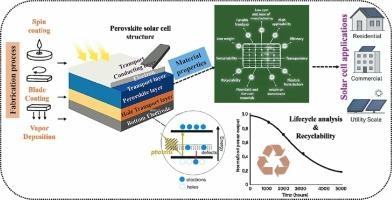
生态工程钙钛矿太阳能电池技术:可扩展制造、生命周期和现场可再生创新
钙钛矿材料由于其出色的光电性能、可调的带隙、低温可加工性以及轻量化和柔性器件架构的适用性,在太阳能电池技术中已成为传统硅的有前途的替代品。本文对钙钛矿基太阳能电池的发展进行了全面和批判性的评价,特别强调了生态友好的制造方法、结晶控制、缺陷钝化和影响器件效率和运行稳定性的成分工程。绿色溶剂系统、可扩展沉积方法和界面工程方面的最新进展与大面积制造可行性和实际设备集成有关。除了性能提升之外,该综述还强调了主要挑战,包括长期运行稳定性、环境影响、铅毒性和降解途径。此外,还讨论了生命周期评估、回收方法和基于循环经济的回收策略,以确定大规模部署的可持续路线。预测设计方法的作用,包括理论建模和数据驱动的材料发现,也被探索为加速高效和环保的钙钛矿太阳能电池的发展的有力手段。总的来说,这篇综述总结了最近的进展,并概述了钙钛矿太阳能电池从实验室规模的研究过渡到商业上可行和可持续的能源技术的关键未来方向。
本文章由计算机程序翻译,如有差异,请以英文原文为准。
求助全文
约1分钟内获得全文
求助全文
来源期刊
Journal of Alloys and Compounds
工程技术-材料科学:综合
CiteScore
11.10
自引率
14.50%
发文量
5146
审稿时长
67 days
期刊介绍:
The Journal of Alloys and Compounds is intended to serve as an international medium for the publication of work on solid materials comprising compounds as well as alloys. Its great strength lies in the diversity of discipline which it encompasses, drawing together results from materials science, solid-state chemistry and physics.
 求助内容:
求助内容: 应助结果提醒方式:

 京公网安备 11010802042870号


