
Thermomechanical engineering of nano-twin and dislocation structures for strength-ductility synergy in metastable high-entropy alloys
IF 14.3
1区 材料科学
Q1 MATERIALS SCIENCE, MULTIDISCIPLINARY
引用次数: 0
Abstract
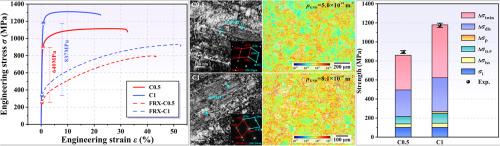
Achieving an excellent strength-ductility synergy remains a central challenge for metastable face-centered cubic (FCC) high-entropy alloys (HEAs). In this study, a thermomechanical processing route consisting of warm rolling followed by annealing was employed to introduce pre-designed defect architectures into two metastable HEAs: a transformation-induced plasticity Cr20Mn20Fe20Co34.5Ni5C0.5 HEA and a transformation- and twinning-induced plasticity Cr20Mn20Fe20Co34Ni5C1 HEA. This processing produces unrecrystallized microstructures containing high densities of nano-twins and dislocations, leading to substantial yield strength enhancement while retaining good ductility compared with fully recrystallized counterparts. The C1 HEA achieves a higher yield strength of 1174 MPa with a total elongation of 22.2%, whereas the C0.5 HEA exhibits a lower yield strength of 894 MPa but a higher total elongation of 31.9%. Differences in mechanical response are associated with distinct deformation-induced microstructural evolution during tensile loading. In the C0.5 HEA, a higher fraction of deformation-induced martensite with multiple variants is developed, whereas in the C1 HEA, the transformation is more limited and predominantly involves single-variant martensite, which is associated with lower strain hardenability. These results demonstrate that tailoring defect structures via thermomechanical processing provides an effective pathway for optimizing the strength-ductility synergy in metastable FCC HEAs.
亚稳高熵合金中纳米孪晶和位错结构强度-延性协同效应的热力学工程
实现优异的强度-延性协同仍然是亚稳面心立方(FCC)高熵合金(HEAs)面临的主要挑战。在本研究中,采用热轧后退火的热处理路线,将预先设计的缺陷结构引入到两个亚稳态HEA中:相变诱导塑性Cr20Mn20Fe20Co34.5Ni5C0.5 HEA和相变和孪晶诱导塑性Cr20Mn20Fe20Co34Ni5C1 HEA。这种处理产生含有高密度纳米孪晶和位错的非再结晶微结构,与完全再结晶的材料相比,在保持良好延展性的同时,屈服强度大幅提高。C1 HEA的屈服强度为1174 MPa,总伸长率为22.2%;C0.5 HEA的屈服强度为894 MPa,总伸长率为31.9%。力学响应的差异与拉伸加载期间不同的变形引起的微观结构演变有关。在C0.5 HEA中,形变诱导马氏体的多变体比例较高,而在C1 HEA中,转变更有限,主要是单变体马氏体,这与较低的应变淬透性有关。这些结果表明,通过热机械加工定制缺陷结构为优化亚稳态FCC HEAs的强度-塑性协同效应提供了有效途径。
本文章由计算机程序翻译,如有差异,请以英文原文为准。
求助全文
约1分钟内获得全文
求助全文
来源期刊
Journal of Materials Science & Technology
工程技术-材料科学:综合
CiteScore
20.00
自引率
11.00%
发文量
995
审稿时长
13 days
期刊介绍:
Journal of Materials Science & Technology strives to promote global collaboration in the field of materials science and technology. It primarily publishes original research papers, invited review articles, letters, research notes, and summaries of scientific achievements. The journal covers a wide range of materials science and technology topics, including metallic materials, inorganic nonmetallic materials, and composite materials.
 求助内容:
求助内容: 应助结果提醒方式:

 京公网安备 11010802042870号


