
Carbon supported iron-single atoms/ultrafine atom clusters mediated electron-proton coupling transfer for enhanced anaerobic digestion
IF 10
1区 环境科学与生态学
Q1 ENGINEERING, ENVIRONMENTAL
Journal of Cleaner Production
Pub Date : 2026-04-27
Epub Date: 2026-04-19
DOI:10.1016/j.jclepro.2026.148295
引用次数: 0
Abstract
Anaerobic digestion (AD) represents a high-efficiency approach for resource recovery from organic wastewater. The metabolic imbalance and sluggish electron transfer between syntrophic anaerobic microorganisms is the key limiting factor for methanogenesis in AD process. To better address this issue, a carbonized Fe-based metal-organic framework (CMIL-800) was strategically developed in this study. The CMIL-800 was characterized by the integration of uniformly dispersed Fe single atoms and their ultrafine clusters with the carbon substrate, which fundamentally minimized the interfacial charge-transfer resistance and established localized potential differences on the interface to actively drive interspecies electron transfer in AD process. Furthermore, the exceptional charge capacity and proton-conduction capability of CMIL-800 can provide multiple-mediatory pathways for maintaining microbial metabolic equilibrium and accelerating methane conversion. Experimental results showed that the AD efficiency was effectively improved via the addition of CMIL-800. Kinetic isotope effect (KIE) tests and extracellular polymeric substances (EPS) structural evolution results provided powerful evidence for a simultaneous enhancement in electron and proton transfer rates within the AD system. Moreover, a significant increase in the abundance of genes associated with methanogenesis, proton transfer, and electron transport was also observed, further confirming the multi-dimensional regulatory effects of CMIL-800 on metabolic imbalances among syntrophic anaerobes. In summary, this work provided a novel and efficient strategy for optimizing AD performance.
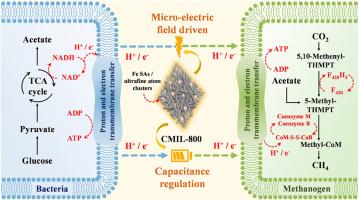
碳负载铁单原子/超细原子团簇介导的电子-质子耦合转移增强厌氧消化
厌氧消化(AD)是一种高效的有机废水资源化方法。合成气厌氧微生物之间的代谢失衡和电子传递缓慢是AD过程中产甲烷的关键限制因素。为了更好地解决这一问题,本研究战略性地开发了碳化铁基金属有机框架(CMIL-800)。CMIL-800的特点是将均匀分散的Fe单原子及其超细团簇与碳衬底相结合,从根本上降低了界面电荷转移阻力,并在界面上建立了局域电位差,积极驱动AD过程中的种间电子转移。此外,CMIL-800卓越的电荷容量和质子传导能力为维持微生物代谢平衡和加速甲烷转化提供了多介质途径。实验结果表明,CMIL-800的加入有效地提高了AD效率。动力学同位素效应(KIE)测试和胞外聚合物(EPS)结构演化结果为AD系统中电子和质子转移速率的同时增强提供了有力的证据。此外,还观察到与甲烷生成、质子转移和电子传递相关的基因丰度显著增加,进一步证实了CMIL-800对合养厌氧菌代谢失衡的多维调控作用。总之,这项工作为优化AD性能提供了一种新颖有效的策略。
本文章由计算机程序翻译,如有差异,请以英文原文为准。
求助全文
约1分钟内获得全文
求助全文
来源期刊
Journal of Cleaner Production
环境科学-工程:环境
CiteScore
20.40
自引率
9.00%
发文量
4720
审稿时长
111 days
期刊介绍:
The Journal of Cleaner Production is an international, transdisciplinary journal that addresses and discusses theoretical and practical Cleaner Production, Environmental, and Sustainability issues. It aims to help societies become more sustainable by focusing on the concept of 'Cleaner Production', which aims at preventing waste production and increasing efficiencies in energy, water, resources, and human capital use. The journal serves as a platform for corporations, governments, education institutions, regions, and societies to engage in discussions and research related to Cleaner Production, environmental, and sustainability practices.
 求助内容:
求助内容: 应助结果提醒方式:

 京公网安备 11010802042870号


