
Dual-functional self-assembled nanosystems with enhanced protease resistance: Promoting bacterial aggregation and immune activation for multidrug-resistant bacterial infection
IF 11.9
1区 医学
Q1 PHARMACOLOGY & PHARMACY
Asian Journal of Pharmaceutical Sciences
Pub Date : 2026-04-01
Epub Date: 2026-03-03
DOI:10.1016/j.ajps.2026.101145
引用次数: 0
Abstract
Multidrug-resistant bacterial infections are increasing globally and posing a greater threat to human health. The application of direct bactericidal agents can induce secondary infections and treatment failures. The antibacterial strategy of the innate immune system brings inspiration. Here, we developed highly stable bacterial-aggregating peptides with immunoregulatory function. These peptides were designed to capture multidrug-resistant bacteria, prevent their dissemination, and activate the antibacterial immune response of the host. Among these peptides, the central-bola amphiphile R2F4R2 highly captured bacteria without directly killing them. R2F4R2 was believed to self-assemble through the lateral connection of peptide chains. The tetra-Phe segments formed a hydrophobic core of nanoparticle, with Arg residues appearing on the surface. Notably, R2F4R2 enhanced chemotactic response and phagocytic ability of macrophages, supported a transition to M2-macrophage phenotype to combat bacterial infection. Transcriptome sequencing and molecular docking analyses revealed that R2F4R2 regulated the gene expression associated with immunoregulatory functions and modulated calcium-Rap1 signaling pathways. Finally, R2F4R2 exhibited exceptional stability against proteolytic degradation and effectively entrapped invading pathogenic bacteria Escherichia coli to alleviate skin infections and intestinal inflammation. Overall, the bacterial-aggregating peptides represent a novel and effective strategy to combat multidrug-resistant infections.

具有增强蛋白酶抗性的双功能自组装纳米系统:促进多重耐药细菌感染的细菌聚集和免疫激活
全球耐多药细菌感染正在增加,对人类健康构成更大威胁。直接使用杀菌剂可引起继发感染和治疗失败。先天免疫系统的抗菌策略带来启示。在这里,我们开发了具有免疫调节功能的高度稳定的细菌聚集肽。这些肽被设计用来捕获耐多药细菌,阻止其传播,并激活宿主的抗菌免疫反应。在这些多肽中,中央曲线两亲体R2F4R2高度捕获细菌而不直接杀死它们。R2F4R2被认为通过肽链的横向连接进行自组装。四苯丙氨酸片段形成纳米粒子疏水核,表面出现精氨酸残基。值得注意的是,R2F4R2增强了巨噬细胞的趋化反应和吞噬能力,支持向m2巨噬细胞表型过渡以对抗细菌感染。转录组测序和分子对接分析显示,R2F4R2调控免疫调节功能相关基因表达,调控钙- rap1信号通路。最后,R2F4R2对蛋白水解降解表现出优异的稳定性,并有效捕获入侵的致病菌大肠杆菌,以减轻皮肤感染和肠道炎症。总的来说,细菌聚集肽代表了一种对抗多药耐药感染的新型有效策略。
本文章由计算机程序翻译,如有差异,请以英文原文为准。
求助全文
约1分钟内获得全文
求助全文
来源期刊
Asian Journal of Pharmaceutical Sciences
Pharmacology, Toxicology and Pharmaceutics-Pharmaceutical Science
CiteScore
18.30
自引率
2.90%
发文量
11
审稿时长
14 days
期刊介绍:
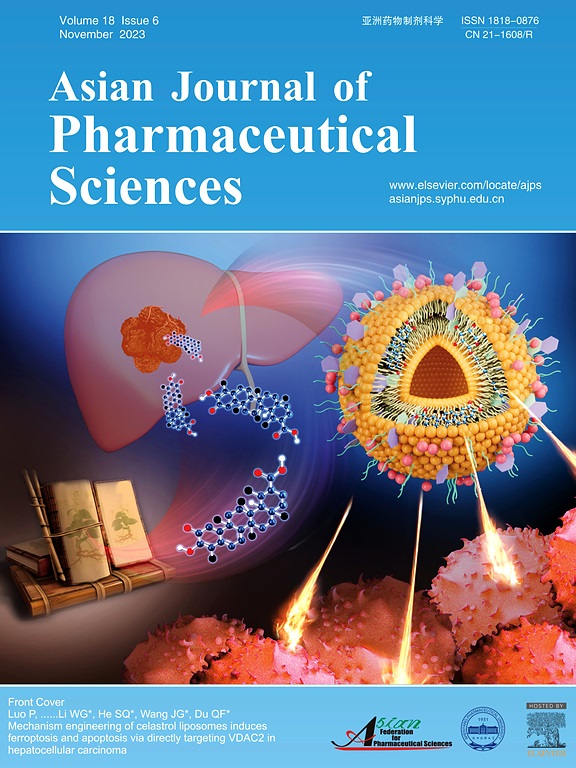
The Asian Journal of Pharmaceutical Sciences (AJPS) serves as the official journal of the Asian Federation for Pharmaceutical Sciences (AFPS). Recognized by the Science Citation Index Expanded (SCIE), AJPS offers a platform for the reporting of advancements, production methodologies, technologies, initiatives, and the practical application of scientific knowledge in the field of pharmaceutics. The journal covers a wide range of topics including but not limited to controlled drug release systems, drug targeting, physical pharmacy, pharmacodynamics, pharmacokinetics, pharmacogenomics, biopharmaceutics, drug and prodrug design, pharmaceutical analysis, drug stability, quality control, pharmaceutical engineering, and material sciences.
 求助内容:
求助内容: 应助结果提醒方式:

 京公网安备 11010802042870号


