{"title":"Modeling reflection of plane waves in bio-thermoplastic diffusion with initial stress and temperature dependence via the MGT equation","authors":"P. Vikas Singh, Rajneesh Kumar, E. Rama","doi":"10.1140/epjp/s13360-026-07635-3","DOIUrl":null,"url":null,"abstract":"<div><p>This work explores how initial stresses, temperature-dependent material parameters, and impedance conditions affect the propagation and reflection of plane waves in a bio-thermoelastic diffusion half-space described by the Moore–Gibson–Thompson (MGT) heat conduction theory. The governing equations for a two-dimensional setting are nondimensionalized and reformulated using potential functions. By applying the reflection technique, it is shown that the medium supports four interacting longitudinal waves along with a single transverse mode, each traveling at different speeds. Expressions for the amplitude ratios of the reflected longitudinal (P), thermal (T), chemical potential (Pₒ), and shear vertical (SV) waves are obtained as functions of the incident angle under impedance boundary conditions. The effects of initial stress, thermal dependence of material properties, and impedance parameters on these amplitude ratios are illustrated through graphical results and interpreted in detail. Several limiting cases are also analyzed to verify the formulation. The findings contribute to a deeper understanding of wave behavior in bio-engineered materials, seismic environments, and broader thermoelastic wave propagation applications.</p></div>","PeriodicalId":792,"journal":{"name":"The European Physical Journal Plus","volume":"141 4","pages":""},"PeriodicalIF":2.9000,"publicationDate":"2026-04-15","publicationTypes":"Journal Article","fieldsOfStudy":null,"isOpenAccess":false,"openAccessPdf":"","citationCount":"0","resultStr":null,"platform":"Semanticscholar","paperid":null,"PeriodicalName":"The European Physical Journal Plus","FirstCategoryId":"4","ListUrlMain":"https://link.springer.com/article/10.1140/epjp/s13360-026-07635-3","RegionNum":3,"RegionCategory":"物理与天体物理","ArticlePicture":[],"TitleCN":null,"AbstractTextCN":null,"PMCID":null,"EPubDate":"","PubModel":"","JCR":"Q2","JCRName":"PHYSICS, MULTIDISCIPLINARY","Score":null,"Total":0}
引用次数: 0
Abstract
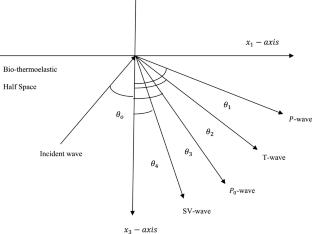
This work explores how initial stresses, temperature-dependent material parameters, and impedance conditions affect the propagation and reflection of plane waves in a bio-thermoelastic diffusion half-space described by the Moore–Gibson–Thompson (MGT) heat conduction theory. The governing equations for a two-dimensional setting are nondimensionalized and reformulated using potential functions. By applying the reflection technique, it is shown that the medium supports four interacting longitudinal waves along with a single transverse mode, each traveling at different speeds. Expressions for the amplitude ratios of the reflected longitudinal (P), thermal (T), chemical potential (Pₒ), and shear vertical (SV) waves are obtained as functions of the incident angle under impedance boundary conditions. The effects of initial stress, thermal dependence of material properties, and impedance parameters on these amplitude ratios are illustrated through graphical results and interpreted in detail. Several limiting cases are also analyzed to verify the formulation. The findings contribute to a deeper understanding of wave behavior in bio-engineered materials, seismic environments, and broader thermoelastic wave propagation applications.
期刊介绍:
The aims of this peer-reviewed online journal are to distribute and archive all relevant material required to document, assess, validate and reconstruct in detail the body of knowledge in the physical and related sciences.
The scope of EPJ Plus encompasses a broad landscape of fields and disciplines in the physical and related sciences - such as covered by the topical EPJ journals and with the explicit addition of geophysics, astrophysics, general relativity and cosmology, mathematical and quantum physics, classical and fluid mechanics, accelerator and medical physics, as well as physics techniques applied to any other topics, including energy, environment and cultural heritage.

 求助内容:
求助内容: 应助结果提醒方式:

 京公网安备 11010802042870号


