
Homoleptic and Heteroleptic Borylones L1-B(Ph)-L2

IF 16.9 1区 化学 Q1 CHEMISTRY, MULTIDISCIPLINARY
Qin Ma, Wei Li, Ya Hu, Lili Zhao, Gernot Frenking
{"title":"Homoleptic and Heteroleptic Borylones L1-B(Ph)-L2","authors":"Qin Ma, Wei Li, Ya Hu, Lili Zhao, Gernot Frenking","doi":"10.1002/anie.8833549","DOIUrl":null,"url":null,"abstract":"Quantum chemical calculation using density functional theory at the BP86-D3(BJ)/def2-TZVPP level and ab initio theory at the CCSD(T)/def2-TZVPP level have been carried out for the homoleptic and heteroleptic borylones L1-B(Ph)-L2 with the ligands L1, L2 = PPh<sub>3</sub>, SPh<sub>2</sub>, N<sub>2</sub>, CO, CS, NHC<sup>Me</sup>, CAAC<sup>Me</sup>. The computation of the bond dissociation energy suggests that all borylones considered in this work should be stable enough to be observed experimentally. A surprising result is the finding that the homoleptic borylones B(Ph)(N<sub>2</sub>)<sub>2</sub> and B(Ph)(SPh<sub>2</sub>)<sub>2</sub> have a higher BDE than the corresponding carbones. It seems possible that bis-dinitrogen borylones can be synthesized and structurally characterized under appropriate conditions. The boron-ligand bonds of the heteroleptic borylones L1-B(Ph)-L2 influence each other, so that one bond becomes stronger and the other weaker, but to different degrees. The BDEs do not always show the same trend, as the electronic and geometric relaxation of the fragments can strongly influence the energy change due to bond breaking, which affects the thermodynamic stability of the compounds. The EDA-NOCV results show that Pauli repulsion is often the strongest energy component of the chemical bond, determining the bond strength and bond length.","PeriodicalId":125,"journal":{"name":"Angewandte Chemie International Edition","volume":"45 1","pages":""},"PeriodicalIF":16.9000,"publicationDate":"2026-04-23","publicationTypes":"Journal Article","fieldsOfStudy":null,"isOpenAccess":false,"openAccessPdf":"","citationCount":"0","resultStr":null,"platform":"Semanticscholar","paperid":null,"PeriodicalName":"Angewandte Chemie International Edition","FirstCategoryId":"92","ListUrlMain":"https://doi.org/10.1002/anie.8833549","RegionNum":1,"RegionCategory":"化学","ArticlePicture":[],"TitleCN":null,"AbstractTextCN":null,"PMCID":null,"EPubDate":"","PubModel":"","JCR":"Q1","JCRName":"CHEMISTRY, MULTIDISCIPLINARY","Score":null,"Total":0}
引用次数: 0

Abstract

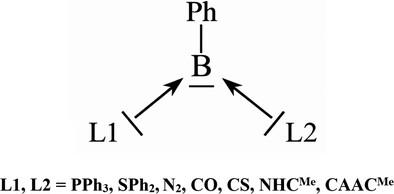
Quantum chemical calculation using density functional theory at the BP86-D3(BJ)/def2-TZVPP level and ab initio theory at the CCSD(T)/def2-TZVPP level have been carried out for the homoleptic and heteroleptic borylones L1-B(Ph)-L2 with the ligands L1, L2 = PPh3, SPh2, N2, CO, CS, NHCMe, CAACMe. The computation of the bond dissociation energy suggests that all borylones considered in this work should be stable enough to be observed experimentally. A surprising result is the finding that the homoleptic borylones B(Ph)(N2)2 and B(Ph)(SPh2)2 have a higher BDE than the corresponding carbones. It seems possible that bis-dinitrogen borylones can be synthesized and structurally characterized under appropriate conditions. The boron-ligand bonds of the heteroleptic borylones L1-B(Ph)-L2 influence each other, so that one bond becomes stronger and the other weaker, but to different degrees. The BDEs do not always show the same trend, as the electronic and geometric relaxation of the fragments can strongly influence the energy change due to bond breaking, which affects the thermodynamic stability of the compounds. The EDA-NOCV results show that Pauli repulsion is often the strongest energy component of the chemical bond, determining the bond strength and bond length.
Abstract Image

同眠性和异眠性硼炔酮L1-B(Ph)-L2
利用BP86-D3(BJ)/def2-TZVPP水平上的密度泛函理论和CCSD(T)/def2-TZVPP水平上的从头算理论,对配体L1、L2 = PPh3、SPh2、N2、CO、CS、NHCMe、CAACMe的同渗和异渗硼酮L1- b (Ph)-L2进行了量子化学计算。键解离能的计算表明,在这项工作中考虑的所有硼炔都应该足够稳定,可以在实验中观察到。一个令人惊讶的结果是发现同感酮B(Ph)(N2)2和B(Ph)(SPh2)2比相应的碳具有更高的BDE。在适当的条件下,双二氮硼隆似乎是可以合成并进行结构表征的。杂电性硼酮的硼配体键L1-B(Ph)-L2相互影响,使一个键变强,另一个键变弱,但程度不同。bde并不总是表现出相同的趋势,因为碎片的电子和几何弛豫会强烈影响由于键断裂而引起的能量变化,从而影响化合物的热力学稳定性。EDA-NOCV结果表明,泡利斥力通常是化学键中最强的能量成分,决定了键的强度和键的长度。
本文章由计算机程序翻译,如有差异,请以英文原文为准。
求助全文
约1分钟内获得全文 求助全文
来源期刊
CiteScore
26.60
自引率
6.60%
发文量
3549
审稿时长
1.5 months
期刊介绍: Angewandte Chemie, a journal of the German Chemical Society (GDCh), maintains a leading position among scholarly journals in general chemistry with an impressive Impact Factor of 16.6 (2022 Journal Citation Reports, Clarivate, 2023). Published weekly in a reader-friendly format, it features new articles almost every day. Established in 1887, Angewandte Chemie is a prominent chemistry journal, offering a dynamic blend of Review-type articles, Highlights, Communications, and Research Articles on a weekly basis, making it unique in the field.

×
引用
GB/T 7714-2015
复制
MLA
复制
APA
复制
导出至
BibTeX EndNote RefMan NoteFirst NoteExpress
×
提示
您的信息不完整,为了账户安全,请先补充。
现在去补充
×
提示
您因"违规操作"
具体请查看互助需知
我知道了
×
提示
确定
请完成安全验证×
copy
已复制链接
快去分享给好友吧!
我知道了
右上角分享
点击右上角分享
0
联系我们:info@booksci.cn Book学术提供免费学术资源搜索服务,方便国内外学者检索中英文文献。致力于提供最便捷和优质的服务体验。 Copyright © 2023 布克学术 All rights reserved.
京ICP备2023020795号-1
ghs 京公网安备 11010802042870号
Book学术文献互助
Book学术文献互助群
群 号:604180095
Book学术官方微信
小红书


