
Multi-zonal anaerobic ammonium oxidation for mainstream municipal wastewater treatment
IF 27.1
1区 环境科学与生态学
Q1 ENVIRONMENTAL SCIENCES
引用次数: 0
Abstract
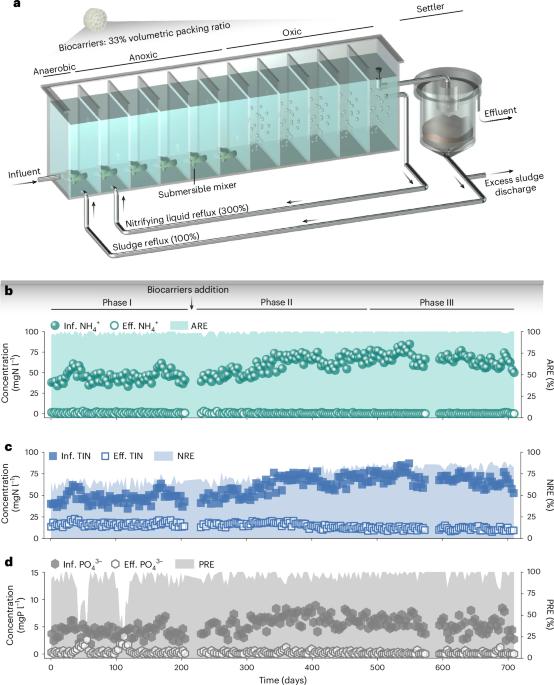
Biological nitrogen removal is a main contributor to the carbon footprint of municipal wastewater treatment plants (MWWTPs). Anaerobic ammonium oxidation (anammox) is key to decarbonizing MWWTPs. However, anammox technology has long been developed following the ‘hotspot’ concept, which spatially confines anammox to specific zones in MWWTPs, leaving its potential underexploited in mainstream treatment. Here we propose a ‘multi-zonal anammox’ concept to expand the anammox process throughout the whole MWWTP mainstream. It allows the implementation of anammox in existing MWWTPs with minimal reconstruction requirements. We evaluated the feasibility of this concept in an anaerobic–anoxic–oxic (A2O) biosystem, which is one of the most widely used processes in MWWTPs. During a 2-year-long operation, anammox bacteria highly self-enriched and contributed to nitrogen removal throughout the mainstream, with relative abundances reaching 4.8%, 5.7–10.0% and 0.2–1.0% in anaerobic, anoxic and oxic zones, respectively. The multi-zonal anammox enhanced nitrogen removal efficiency by 20%, reduced aerating electricity input by 20%, mitigated nitrous oxide emissions by 66% and eliminated the need for supplemental organic carbon. Overall, this work opens a promising avenue for implementing the anammox process, paving the way towards sustainable wastewater management. Anaerobic ammonium oxidation (anammox) has great potential in sustainable wastewater treatment, but its implementation in mainstream wastewater treatment is challenging. This work proposes a ‘multi-zonal anammox’ concept that can be incorporated into existing wastewater treatment plants.
多分区厌氧氨氧化法处理主流城市污水
生物脱氮是城市污水处理厂(MWWTPs)碳足迹的主要贡献者。厌氧氨氧化(anammox)是污水处理厂脱碳的关键。然而,厌氧氨氧化技术长期以来一直遵循“热点”概念发展,该概念将厌氧氨氧化在空间上限制在MWWTPs的特定区域,使其在主流处理中的潜力未得到充分利用。在此,我们提出了一个“多区域厌氧氨氧化”的概念,将厌氧氨氧化过程扩展到整个MWWTP主流。它允许在现有的MWWTPs中以最小的重建要求实施厌氧氨氧化。我们在厌氧-缺氧-缺氧(A2O)生物系统中评估了这一概念的可行性,A2O是MWWTPs中应用最广泛的工艺之一。在2年的运行过程中,厌氧氨氧化菌高度自富并对整个主流的脱氮有一定的贡献,厌氧区、缺氧区和好氧区相对丰度分别达到4.8%、5.7-10.0%和0.2-1.0%。多区厌氧氨氧化提高了20%的脱氮效率,减少了20%的曝气电力投入,减少了66%的氧化亚氮排放,并且消除了补充有机碳的需要。总的来说,这项工作为实施厌氧氨氧化工艺开辟了一条有希望的途径,为可持续废水管理铺平了道路。厌氧氨氧化(anammox)在废水可持续处理中具有巨大的潜力,但在主流废水处理中实施仍面临挑战。这项工作提出了一个“多区域厌氧氨氧化”的概念,可以纳入现有的污水处理厂。
本文章由计算机程序翻译,如有差异,请以英文原文为准。
求助全文
约1分钟内获得全文
求助全文
来源期刊
Nature Sustainability
Energy-Renewable Energy, Sustainability and the Environment
CiteScore
41.90
自引率
1.10%
发文量
159
期刊介绍:
Nature Sustainability aims to facilitate cross-disciplinary dialogues and bring together research fields that contribute to understanding how we organize our lives in a finite world and the impacts of our actions.
Nature Sustainability will not only publish fundamental research but also significant investigations into policies and solutions for ensuring human well-being now and in the future.Its ultimate goal is to address the greatest challenges of our time.
 求助内容:
求助内容: 应助结果提醒方式:

 京公网安备 11010802042870号


