
Catalytic bromine recycling from waste
IF 27.1
1区 环境科学与生态学
Q1 ENVIRONMENTAL SCIENCES
引用次数: 0
Abstract
Bromine (Br), mostly extracted from nature, plays an essential role in the form of organobromides in various goods, including electronics, vehicles and furniture. At the same time, Br is continuously released into the environment in the form of persistent brominated pollutants upon the retirement of those goods, causing severe environmental consequences and loss of resources. Here we propose a catalytic strategy that enables the selective and mild-condition conversion of all organobromides present in wastes into renewed bromides for Br recycling. It employs Ullmann-type reactions enabled by inexpensive Cu(I), simple ligands and hydroxides in DMSO–H2O solvent. This strategy achieved >95% bromide yields at a temperature ≤120 °C for complex real-world Br-laden wastes. It can produce bromide-rich solution amenable to Br2 production, as demonstrated by the inorganicization–evaporation–oxidation process, and recoverable debrominated solids with preserved chemical states. Mechanistic studies revealed a full debromination framework encompassing diverse activated pathways. This work provides a viable approach for Br recycling and potentially facilitates a circular and sustainable anthropogenic Br flow. Bromine (Br) has indispensable roles in manufacturing many products but mostly ends up in waste, leading to both resource loss and environmental pollution. Here the authors proposes a catalytic process to enable Br recycling from real-world Br-laden wastes.
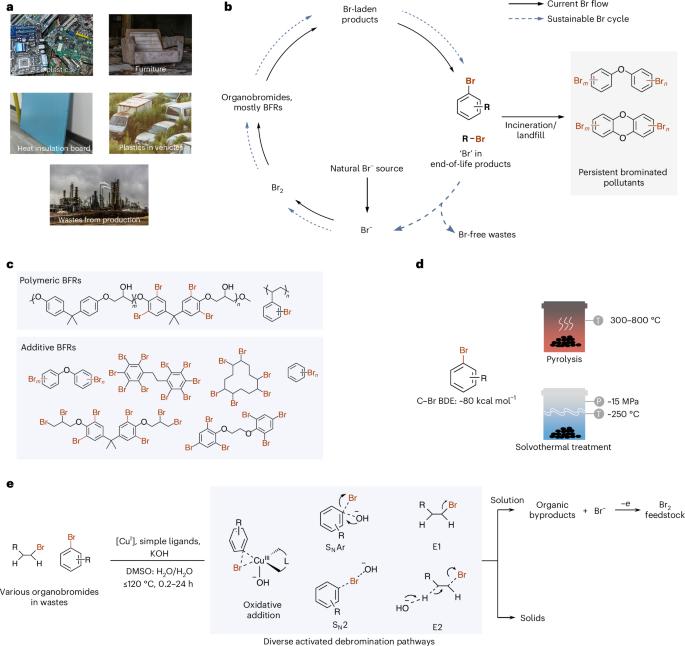
废物催化溴回收
溴(Br)主要从自然界中提取,以有机溴化物的形式在各种商品中起着重要作用,包括电子产品、车辆和家具。同时,这些货物在退役后,Br会以持久性溴化污染物的形式不断释放到环境中,造成严重的环境后果和资源损失。在这里,我们提出了一种催化策略,使所有有机溴化物在选择性和温和的条件下转化为再生溴化物,用于Br回收。它采用乌尔曼型反应,由廉价的Cu(I)、简单的配体和氢氧化物在DMSO-H2O溶剂中实现。该策略在温度≤120°C的情况下实现了95%的溴化物产率。通过无机化-蒸发-氧化过程可以得到适合于Br2生产的富溴溶液,以及保留化学状态的可回收脱溴固体。机制研究揭示了包含多种激活途径的完整脱溴框架。这项工作为Br的回收利用提供了可行的途径,并有可能促进循环和可持续的人为Br流。溴(Br)在许多产品的生产中发挥着不可替代的作用,但大多被丢弃在废物中,造成资源损失和环境污染。在这里,作者提出了一种催化过程,使Br从现实世界的含Br废物回收。
本文章由计算机程序翻译,如有差异,请以英文原文为准。
求助全文
约1分钟内获得全文
求助全文
来源期刊
Nature Sustainability
Energy-Renewable Energy, Sustainability and the Environment
CiteScore
41.90
自引率
1.10%
发文量
159
期刊介绍:
Nature Sustainability aims to facilitate cross-disciplinary dialogues and bring together research fields that contribute to understanding how we organize our lives in a finite world and the impacts of our actions.
Nature Sustainability will not only publish fundamental research but also significant investigations into policies and solutions for ensuring human well-being now and in the future.Its ultimate goal is to address the greatest challenges of our time.
 求助内容:
求助内容: 应助结果提醒方式:

 京公网安备 11010802042870号


