Sneha Mandal, Catherine Tom, Subbiah Alwarappan, Ravi Kumar Pujala, Surendra K. Martha and Vijayamohanan K. Pillai
{"title":"Deciphering solid–electrolyte interface in cellulose-montmorillonite nanocomposites for sodium batteries","authors":"Sneha Mandal, Catherine Tom, Subbiah Alwarappan, Ravi Kumar Pujala, Surendra K. Martha and Vijayamohanan K. Pillai","doi":"10.1039/D6YA00014B","DOIUrl":null,"url":null,"abstract":"<p >Electrolytes and their interphases are critical for emerging battery chemistries such as metal–sulphur and metal–oxygen, especially in the case of solid electrolytes, which offer attractive energy storage possibilities but involve drastic phase transitions and structural challenges. Therefore, developing improved electrolytes and interphases is a key to achieving sustainable battery performance. Here, we introduce a novel polymer composite electrolyte utilising abundant montmorillonite and cellulose nanocrystals (CNC), creating a stable interphase with the Na metal and alleviating common degradation issues. For example, this electrolyte exhibits a stability window of 2.3–5.3 V and a transference number of ∼0.87, although its durability and performance need further improvement. FT-IR spectroscopy, XPS, and Raman spectroscopy provide valuable insights into the interfacial chemistry, as evidenced by a prominent hydroxyl stretching band associated with the CNC. While hydroxyl groups may compromise interfacial stability at the cathode, possibly causing cell degradation, they simultaneously enhance the sodium-ion mobility at the anode by facilitating favourable coordination with sodium metal. This dual function underscores the need for tuning functional groups in electrolyte design.</p>","PeriodicalId":72913,"journal":{"name":"Energy advances","volume":" 4","pages":" 538-549"},"PeriodicalIF":4.3000,"publicationDate":"2026-03-06","publicationTypes":"Journal Article","fieldsOfStudy":null,"isOpenAccess":false,"openAccessPdf":"https://pubs.rsc.org/en/content/articlepdf/2026/ya/d6ya00014b?page=search","citationCount":"0","resultStr":null,"platform":"Semanticscholar","paperid":null,"PeriodicalName":"Energy advances","FirstCategoryId":"1085","ListUrlMain":"https://pubs.rsc.org/en/content/articlelanding/2026/ya/d6ya00014b","RegionNum":0,"RegionCategory":null,"ArticlePicture":[],"TitleCN":null,"AbstractTextCN":null,"PMCID":null,"EPubDate":"","PubModel":"","JCR":"Q2","JCRName":"CHEMISTRY, PHYSICAL","Score":null,"Total":0}
引用次数: 0
Abstract
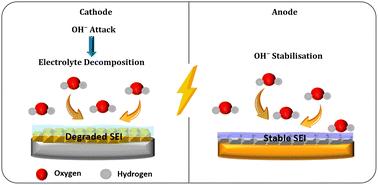
Electrolytes and their interphases are critical for emerging battery chemistries such as metal–sulphur and metal–oxygen, especially in the case of solid electrolytes, which offer attractive energy storage possibilities but involve drastic phase transitions and structural challenges. Therefore, developing improved electrolytes and interphases is a key to achieving sustainable battery performance. Here, we introduce a novel polymer composite electrolyte utilising abundant montmorillonite and cellulose nanocrystals (CNC), creating a stable interphase with the Na metal and alleviating common degradation issues. For example, this electrolyte exhibits a stability window of 2.3–5.3 V and a transference number of ∼0.87, although its durability and performance need further improvement. FT-IR spectroscopy, XPS, and Raman spectroscopy provide valuable insights into the interfacial chemistry, as evidenced by a prominent hydroxyl stretching band associated with the CNC. While hydroxyl groups may compromise interfacial stability at the cathode, possibly causing cell degradation, they simultaneously enhance the sodium-ion mobility at the anode by facilitating favourable coordination with sodium metal. This dual function underscores the need for tuning functional groups in electrolyte design.


 求助内容:
求助内容: 应助结果提醒方式:

 京公网安备 11010802042870号


