K. S. Lebeda, M. S. Makarov, V. S. Naumkin, O. V. Vitovsky
{"title":"Numerical Modeling of Heat Transfer during the Flow of Air and Helium–Xenon Mixture in a Seven-Rod Fuel Assembly","authors":"K. S. Lebeda, M. S. Makarov, V. S. Naumkin, O. V. Vitovsky","doi":"10.1134/S0040601525700831","DOIUrl":null,"url":null,"abstract":"<p>The article presents a study, carried out using numerical methods, of heat transfer during the flow of gas mixtures in a heated seven-rod assembly containing cylindrical fuel elements with spacer grids. The fuel elements were made of thin-walled nichrome tubes; owing to a hollow design of fuel elements, it became possible to determine the wall temperature distribution along the assembly length. The grids were made so that all of its channels had the same hydraulic diameters. Helium–xenon (He‒Xe) mixture with the Prandtl number Pr = 0.23 and air with the Prandtl number Pr = 0.71 were considered as coolant. Data on the distribution of the central fuel element wall temperature were obtained, and the effect the spacer grids had on the local changes in the flow parameter and temperature was analyzed. The RANS modeling results were compared with the data of an experimental wall temperature investigation. The comparison results have shown that the predicted data are in good agreement with the experimental data: the maximal difference was equal to 7 К. It was shown that spacer grids gave rise to vortex connection zones upstream and downstream of them; local narrowing of the flow pass section inside the grid facilitated flow acceleration. When a change occurs in the flow dynamics near the grid, abrupt temperature jumps are observed, and it should be noted that air temperature jumps are higher than those of helium–xenon mixture. Thus, in the case of using He‒Xe mixture with the Prandtl number Pr = 0.23 as coolant, the temperature distribution in the assembly cross section becomes less nonuniform. It is shown that flow acceleration has an influence on the dependence of Nusselt number on the Reynolds number: with high pressure differences between the assembly inlet and outlet, gas accelerates to subsonic velocities, which results in flow core cooling.</p>","PeriodicalId":799,"journal":{"name":"Thermal Engineering","volume":"73 3","pages":"186 - 195"},"PeriodicalIF":1.0000,"publicationDate":"2026-04-22","publicationTypes":"Journal Article","fieldsOfStudy":null,"isOpenAccess":false,"openAccessPdf":"","citationCount":"0","resultStr":null,"platform":"Semanticscholar","paperid":null,"PeriodicalName":"Thermal Engineering","FirstCategoryId":"1085","ListUrlMain":"https://link.springer.com/article/10.1134/S0040601525700831","RegionNum":0,"RegionCategory":null,"ArticlePicture":[],"TitleCN":null,"AbstractTextCN":null,"PMCID":null,"EPubDate":"","PubModel":"","JCR":"Q4","JCRName":"ENERGY & FUELS","Score":null,"Total":0}
引用次数: 0
Abstract
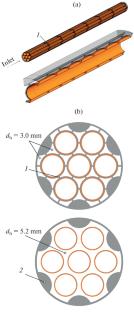
The article presents a study, carried out using numerical methods, of heat transfer during the flow of gas mixtures in a heated seven-rod assembly containing cylindrical fuel elements with spacer grids. The fuel elements were made of thin-walled nichrome tubes; owing to a hollow design of fuel elements, it became possible to determine the wall temperature distribution along the assembly length. The grids were made so that all of its channels had the same hydraulic diameters. Helium–xenon (He‒Xe) mixture with the Prandtl number Pr = 0.23 and air with the Prandtl number Pr = 0.71 were considered as coolant. Data on the distribution of the central fuel element wall temperature were obtained, and the effect the spacer grids had on the local changes in the flow parameter and temperature was analyzed. The RANS modeling results were compared with the data of an experimental wall temperature investigation. The comparison results have shown that the predicted data are in good agreement with the experimental data: the maximal difference was equal to 7 К. It was shown that spacer grids gave rise to vortex connection zones upstream and downstream of them; local narrowing of the flow pass section inside the grid facilitated flow acceleration. When a change occurs in the flow dynamics near the grid, abrupt temperature jumps are observed, and it should be noted that air temperature jumps are higher than those of helium–xenon mixture. Thus, in the case of using He‒Xe mixture with the Prandtl number Pr = 0.23 as coolant, the temperature distribution in the assembly cross section becomes less nonuniform. It is shown that flow acceleration has an influence on the dependence of Nusselt number on the Reynolds number: with high pressure differences between the assembly inlet and outlet, gas accelerates to subsonic velocities, which results in flow core cooling.


 求助内容:
求助内容: 应助结果提醒方式:

 京公网安备 11010802042870号


