K. A. Shtym, T. A. Solov’eva, A. V. Kulik, E. V. Bazilevich
{"title":"Determination of Swirl Flow Characteristics in the Laboratory Model of a Cyclone-Vortex Furnace Extension","authors":"K. A. Shtym, T. A. Solov’eva, A. V. Kulik, E. V. Bazilevich","doi":"10.1134/S0040601525700879","DOIUrl":null,"url":null,"abstract":"<p>The article describes the laboratory model of an air cooled cyclone-vortex furnace extension (CVFE) for a capacity of around 30 kW, which is a reduced copy of a gas and fuel oil fired CVFE for a capacity of 65 MW, and the operation principles of CVFE assemblies and components are considered. One of the laboratory model features is the possibility to carry out experimental investigations during the gaseous fuel combustion in the furnace extension. Systems for adjusting the height of tangential air nozzles and the position of gas nozzle inlets are implemented for the first time. Unlike industry-grade CVFEs, the laboratory CVFE model is made without refractory lining of the combustion chamber (CC). Owing to this solution, it is possible to estimate the influence of the combustion process on the structural elements and heat transfer conditions in different furnace extension operation modes. Numerous investigations carried out on the laboratory model have demonstrated the possibility to ensure a wide range of CVFE loads and operation mode adjustment. The article presents research modes, in which the static and dynamic pressures, velocity vector direction, and swirl flow temperature were determined using the pneumometric method. The study results are given in graphic form. The variation profile of the full velocity tangential component of the flow swirled in the CVFE model is analyzed. The variations over the CC radius of the profiles of dimensionless tangential velocities and the profiles of dimensionless circulations of swirled flow velocity obtained on the laboratory model and on the industry-grade CVFE are compared with each other. The relative Rossby number <span>\\(\\overline {{\\text{Ro}}} \\)</span> of the laboratory and industry-grade CVFEs amounted to 2.67. An analysis of the obtained data of aerodynamic investigations will make it possible to develop new design solutions for the laboratory CVFE model, carry our full-valued fire experiments with it, and in the case of obtaining positive results, introduce the necessary modifications in the industry-grade CVFE.</p>","PeriodicalId":799,"journal":{"name":"Thermal Engineering","volume":"73 3","pages":"168 - 173"},"PeriodicalIF":1.0000,"publicationDate":"2026-04-22","publicationTypes":"Journal Article","fieldsOfStudy":null,"isOpenAccess":false,"openAccessPdf":"","citationCount":"0","resultStr":null,"platform":"Semanticscholar","paperid":null,"PeriodicalName":"Thermal Engineering","FirstCategoryId":"1085","ListUrlMain":"https://link.springer.com/article/10.1134/S0040601525700879","RegionNum":0,"RegionCategory":null,"ArticlePicture":[],"TitleCN":null,"AbstractTextCN":null,"PMCID":null,"EPubDate":"","PubModel":"","JCR":"Q4","JCRName":"ENERGY & FUELS","Score":null,"Total":0}
引用次数: 0
Abstract
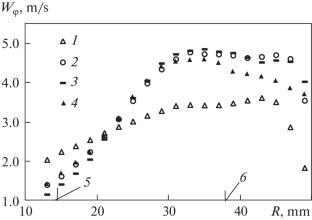
The article describes the laboratory model of an air cooled cyclone-vortex furnace extension (CVFE) for a capacity of around 30 kW, which is a reduced copy of a gas and fuel oil fired CVFE for a capacity of 65 MW, and the operation principles of CVFE assemblies and components are considered. One of the laboratory model features is the possibility to carry out experimental investigations during the gaseous fuel combustion in the furnace extension. Systems for adjusting the height of tangential air nozzles and the position of gas nozzle inlets are implemented for the first time. Unlike industry-grade CVFEs, the laboratory CVFE model is made without refractory lining of the combustion chamber (CC). Owing to this solution, it is possible to estimate the influence of the combustion process on the structural elements and heat transfer conditions in different furnace extension operation modes. Numerous investigations carried out on the laboratory model have demonstrated the possibility to ensure a wide range of CVFE loads and operation mode adjustment. The article presents research modes, in which the static and dynamic pressures, velocity vector direction, and swirl flow temperature were determined using the pneumometric method. The study results are given in graphic form. The variation profile of the full velocity tangential component of the flow swirled in the CVFE model is analyzed. The variations over the CC radius of the profiles of dimensionless tangential velocities and the profiles of dimensionless circulations of swirled flow velocity obtained on the laboratory model and on the industry-grade CVFE are compared with each other. The relative Rossby number \(\overline {{\text{Ro}}} \) of the laboratory and industry-grade CVFEs amounted to 2.67. An analysis of the obtained data of aerodynamic investigations will make it possible to develop new design solutions for the laboratory CVFE model, carry our full-valued fire experiments with it, and in the case of obtaining positive results, introduce the necessary modifications in the industry-grade CVFE.


 求助内容:
求助内容: 应助结果提醒方式:

 京公网安备 11010802042870号


