
Dietary EGCG reshapes metabolic-epigenetic interplay to induce transgenerational host defense
IF 13
1区 综合性期刊
Q1 MULTIDISCIPLINARY SCIENCES
引用次数: 0
Abstract
Introduction
Parental diet is a key determinant of offspring health and immune function, in part through epigenetic regulation. Metabolic and epigenetic networks integrate nutrient sensing with chromatin dynamics to maintain cellular and organismal homeostasis. However, the mechanism by which specific dietary bioactive compounds reshape metabolic-epigenetic networks to drive transgenerational adaptive responses remains poorly understood.Objectives
Here, we investigate whether and how epigallocatechin-3-gallate (EGCG), a well-characterized dietary bioactive compound, modulates heritable host defense through metabolic-epigenetic crosstalk.Methods
To address both physiological relevance and mechanistic insight, we employed mouse and Drosophila melanogaster models. Parental animals were administered EGCG, and offspring were subsequently assessed for immune function upon infection with Escherichia coli, Pseudomonas aeruginosa, or Staphylococcus aureus. By integrating transcriptomics, metabolite analysis, and isotopic tracing, we analyzed metabolism-related pathways and constructed a dynamic network linking metabolic changes to epigenetic modifications in Drosophila.Results
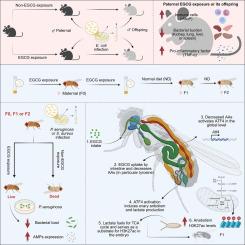
In mice, EGCG administration led to a decrease in Escherichia coli burden across multiple tissues in paternal and male offspring in a sex-specific manner, accompanied by metabolic and pro-inflammatory factor changes. In Drosophila melanogaster, early-life EGCG exposure increased survival upon Pseudomonas aeruginosa or Staphylococcus aureus infection and persisted for two subsequent generations. Mechanistically, EGCG reduced intestinal amino acids, thereby moderately inducing activation of activating transcription factor 4 (ATF4), which in turn enhanced maternal glycolysis and immune adaptation. Tyrosine supplementation abolished the enhanced host defense and metabolic changes. Furthermore, ATF4-induced activation of glycolysis promoted ovarian lactate production, serving as a substrate for increased global H3K27 acetylation in the offspring.Conclusion
Together, these findings suggest that dietary bioactive compounds modulate metabolic and gene regulatory processes, with functional evidence supporting a role for amino acid metabolism and lactate in linking metabolic remodeling to enhanced resistance to infection in the offspring. This work provides mechanistic insight into how diet can shape heritable immune function through metabolic-epigenetic interplay
膳食EGCG重塑代谢-表观遗传相互作用,诱导跨代宿主防御
父母饮食是后代健康和免疫功能的关键决定因素,部分通过表观遗传调控。代谢和表观遗传网络将营养感知与染色质动力学相结合,以维持细胞和生物体的稳态。然而,特定的饮食生物活性化合物重塑代谢-表观遗传网络以驱动跨代适应性反应的机制仍然知之甚少。目的研究表没食子儿茶素-3-没食子酸酯(EGCG)是否以及如何通过代谢-表观遗传串扰调节宿主的遗传防御。方法采用小鼠和黑腹果蝇模型研究生理相关性和机制。给亲代动物注射EGCG,随后对感染大肠杆菌、铜绿假单胞菌或金黄色葡萄球菌的后代进行免疫功能评估。通过整合转录组学、代谢物分析和同位素示踪,我们分析了代谢相关途径,并构建了果蝇代谢变化与表观遗传修饰之间的动态网络。结果在小鼠实验中,EGCG可导致父代和雄性后代多组织中大肠杆菌负荷的减少,并伴有代谢和促炎因子的变化。在黑腹果蝇中,早期暴露于EGCG增加了铜绿假单胞菌或金黄色葡萄球菌感染后的存活率,并持续到随后的两代。在机制上,EGCG减少肠道氨基酸,从而适度诱导激活转录因子4 (ATF4)的激活,从而增强母体糖酵解和免疫适应。补充酪氨酸消除了增强的宿主防御和代谢变化。此外,atf4诱导的糖酵解激活促进了卵巢乳酸的产生,作为后代中H3K27乙酰化增加的底物。综上所述,这些研究结果表明,膳食生物活性化合物调节了代谢和基因调控过程,功能证据支持氨基酸代谢和乳酸代谢在后代代谢重塑与增强感染抵抗力之间的作用。这项工作为饮食如何通过代谢-表观遗传相互作用塑造遗传免疫功能提供了机制见解
本文章由计算机程序翻译,如有差异,请以英文原文为准。
求助全文
约1分钟内获得全文
求助全文
来源期刊
Journal of Advanced Research
Multidisciplinary-Multidisciplinary
CiteScore
21.60
自引率
0.90%
发文量
280
审稿时长
12 weeks
期刊介绍:
Journal of Advanced Research (J. Adv. Res.) is an applied/natural sciences, peer-reviewed journal that focuses on interdisciplinary research. The journal aims to contribute to applied research and knowledge worldwide through the publication of original and high-quality research articles in the fields of Medicine, Pharmaceutical Sciences, Dentistry, Physical Therapy, Veterinary Medicine, and Basic and Biological Sciences.
The following abstracting and indexing services cover the Journal of Advanced Research: PubMed/Medline, Essential Science Indicators, Web of Science, Scopus, PubMed Central, PubMed, Science Citation Index Expanded, Directory of Open Access Journals (DOAJ), and INSPEC.
 求助内容:
求助内容: 应助结果提醒方式:

 京公网安备 11010802042870号


