
Mapping the scientific landscape of Lassa virus: a 55-year bibliometric study (1970–2025)
引用次数: 0
Abstract
Background
Lassa fever is a zoonotic disease, caused by Lassa virus (LASV), that was first reported in 1965. After 55 years, its research landscape remains largely underexplored. Therefore, a bibliometric study is needed to identify LASV research landscape.
Methods
Scopus database was searched and the resulting data was analyzed using VOSviewer (version 1.6.15) for Windows, bibliometrix (version 3.0.0) with Biblioshiny, and R (version 4.5.2) to reveal trends in LASV publications, including keywords, authors’ productivity over time, and collaboration among research institutions and universities.
Results
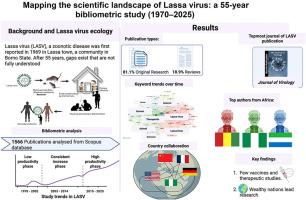
From Scopus, 1566 studies were retrieved, and the trend analysis indicated three distinct phases: a low productivity phase (1970–2002), consistent increase phase (2003–2014), and high productivity phase (2015–2025). The Journal of Virology included the most LASV publications (132 articles). Original research articles dominated the LASV publications with 1270 (81.10%), followed by reviews 296 (18.90%). Keyword analysis revealed evolution over time, with terms used to describe LASV forming the most dominant network across clusters. Factorial analysis revealed keywords absence linked to health and environment role in LASV spread. Among the top 50 authors, 20% were from Africa (Guinea, Mali, Nigeria, and Sierra Leone), indicating minimal locally driven research. Country collaboration network analysis revealed the dominance of the United States, Germany, France, and China, while Nigeria was prominently represented in Africa. The findings further indicate few studies on vaccines and therapeutics, and less involvement of authors from LASV-endemic regions.
Conclusion
Despite significant growth in LASV research, critical gaps in vaccines, therapeutics, and endemic region representation highlight the urgent need for locally driven One Health studies and equitable research partnerships.
绘制拉沙病毒的科学景观:55年文献计量学研究(1970-2025)
拉沙热是由拉沙病毒(LASV)引起的一种人畜共患疾病,于1965年首次报道。55年过去了,它的研究领域在很大程度上仍未得到充分探索。因此,需要文献计量学研究来确定LASV的研究前景。方法对scopus数据库进行检索,并使用Windows平台的VOSviewer(1.6.15版本)、bibliometrix(3.0.0版本)和R(4.5.2版本)对结果进行分析,揭示LASV出版物的趋势,包括关键词、作者生产力随时间的变化以及研究机构和高校之间的合作。结果Scopus共检索1566篇文献,趋势分析显示:低生产力阶段(1970-2002年)、持续增长阶段(2003-2014年)和高生产力阶段(2015-2025年)。《病毒学杂志》收录了最多的LASV出版物(132篇)。LASV出版物中以原创研究论文1270篇(81.10%)为主,其次是综述296篇(18.90%)。关键字分析揭示了进化随着时间的推移,术语用来描述LASV形成最主要的网络跨集群。析因分析显示,关键词缺失与健康和环境在LASV传播中的作用有关。在排名前50位的作者中,20%来自非洲(几内亚、马里、尼日利亚和塞拉利昂),这表明当地驱动的研究很少。国家合作网络分析显示,美国、德国、法国和中国占主导地位,而尼日利亚在非洲占突出地位。研究结果进一步表明,关于疫苗和治疗方法的研究很少,来自lasv流行地区的作者参与较少。结论:尽管LASV研究显著增长,但疫苗、治疗方法和流行地区代表性方面的严重差距突出了迫切需要开展地方驱动的“一个健康”研究和公平的研究伙伴关系。
本文章由计算机程序翻译,如有差异,请以英文原文为准。
求助全文
约1分钟内获得全文
求助全文

 求助内容:
求助内容: 应助结果提醒方式:

 京公网安备 11010802042870号


