
A transgene-free, human peri-gastrulation embryo model presents trilaminar embryonic disc-, amnion- and yolk sac-like structures
IF 19.1
1区 生物学
Q1 CELL BIOLOGY
引用次数: 0
Abstract
Human peri-gastrulation is a critical developmental stage, yet challenging to study directly. Stem cell-based embryo models have emerged as promising tools for probing early human embryogenesis. Here we report a transgene-free human embryo model, namely peri-gastrulation trilaminar embryonic disc (PTED) embryoid, derived exclusively from primed human pluripotent stem cells, recapitulating certain features of peri-gastrulation human development, which include the formation of trilaminar embryonic layers positioned between the dorsal amnion and ventral definitive yolk sac, as well as primitive haematopoiesis. Our lineage tracing showed that, in PTED embryoids, embryonic and extraembryonic mesoderm as well as embryonic and extraembryonic endoderm arise from gastrulating epiblast-like cells, which provides support for extraembryonic lineage potential of peri-gastrulation human epiblast. Notably, active haematopoiesis and blood-cell generation occurred within the definitive yolk sac-like structure of PTED embryoids. Together, PTED embryoids offer a tractable and ethically less complex model for investigating the self-organizing properties of human peri-gastrulation development.
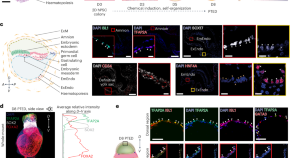
一个无转基因的人原肠胚周围胚胎模型呈现三层胚盘状、羊膜状和卵黄囊状结构
人类原肠胚周是一个重要的发育阶段,但直接研究具有挑战性。基于干细胞的胚胎模型已经成为探索早期人类胚胎发生的有前途的工具。在这里,我们报道了一个无转基因的人类胚胎模型,即原肠胚周三层胚胎盘(PTED)胚胎样,它完全来源于人类多能干细胞,再现了人类原肠胚周发育的某些特征,包括位于羊膜背侧和腹侧最终卵黄囊之间的三层胚胎层的形成,以及原始造血。我们的谱系追踪表明,在PTED胚状细胞中,胚胎和胚外中胚层以及胚胎和胚外内胚层都是由原胚形成的类外胚层细胞产生的,这为原胚周围人类外胚层的胚胎外谱系潜力提供了支持。值得注意的是,活跃的造血和血细胞生成发生在PTED胚状体的确定卵黄囊状结构内。总之,PTED胚状体为研究人类原肠胚周围发育的自组织特性提供了一个易于处理且伦理上不那么复杂的模型。
本文章由计算机程序翻译,如有差异,请以英文原文为准。
求助全文
约1分钟内获得全文
求助全文
来源期刊
Nature Cell Biology
生物-细胞生物学
CiteScore
28.40
自引率
0.90%
发文量
219
审稿时长
3 months
期刊介绍:
Nature Cell Biology, a prestigious journal, upholds a commitment to publishing papers of the highest quality across all areas of cell biology, with a particular focus on elucidating mechanisms underlying fundamental cell biological processes. The journal's broad scope encompasses various areas of interest, including but not limited to:
-Autophagy
-Cancer biology
-Cell adhesion and migration
-Cell cycle and growth
-Cell death
-Chromatin and epigenetics
-Cytoskeletal dynamics
-Developmental biology
-DNA replication and repair
-Mechanisms of human disease
-Mechanobiology
-Membrane traffic and dynamics
-Metabolism
-Nuclear organization and dynamics
-Organelle biology
-Proteolysis and quality control
-RNA biology
-Signal transduction
-Stem cell biology
 求助内容:
求助内容: 应助结果提醒方式:

 京公网安备 11010802042870号


