
A scalable, biopolymer-based microenvironment for electrochemical CO2 conversion to multicarbon products with current densities over 2 A cm−2
IF 60.1
1区 材料科学
Q1 ENERGY & FUELS
引用次数: 0
Abstract
The electrochemical CO2 reduction reaction (CO2RR) relies heavily on the surrounding microenvironment to promote formation of desirable multicarbon (C2+) products. However, microenvironment control to achieve high C2+ yields at industrially relevant current densities remains a crucial challenge. We report that chitosan, cellulose and chitin biopolymer coatings on CO2RR electrocatalysts enhance the microenvironment by increasing local CO2/CO concentration, reducing local water activity and providing suitable ion conductivity and local pH. This facile approach achieves C2+ Faradaic efficiencies of 90 ± 1.7% at 1.6 A cm−2 and C2+ Faradaic efficiency = 83 ± 3.2% at 2.2 A cm−2 with a formation rate of 5,926 μmol h−1 cm−2. Importantly, within the cathode, these ion-conductive hydrophilic biopolymers can fully substitute traditional hydrophobic ionomers/binders, such as Nafion, challenging previous assumptions about the non-viability of hydrophilic materials for selective CO2RR due to excess interfacial H2O. These findings unveil key insights into microenvironment design to enhance C–C coupling through a simple method.
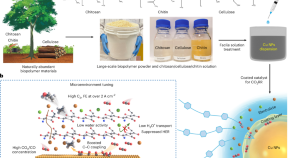
一个可扩展的,基于生物聚合物的微环境,用于电化学二氧化碳转化为多碳产品,电流密度超过2 A cm - 2
电化学CO2还原反应(CO2RR)在很大程度上依赖于周围微环境来促进所需多碳(C2+)产物的形成。然而,在工业相关电流密度下实现高C2+产率的微环境控制仍然是一个关键挑战。我们报道了壳聚糖、纤维素和几丁质生物聚合物涂层在CO2RR电催化剂上通过增加局部CO2/CO浓度、降低局部水活度和提供合适的离子电导率和局部ph来改善微环境。这种简单的方法在1.6 A cm−2下获得了90±1.7%的C2+法拉第效率,在2.2 A cm−2下获得了83±3.2%的C2+法拉第效率,形成速率为5,926 μmol h−1 cm−2。重要的是,在阴极内,这些离子导电的亲水生物聚合物可以完全取代传统的疏水离子单体/粘合剂,如Nafion,这挑战了之前关于由于界面过量的H2O而导致亲水材料不具有选择性CO2RR的假设。这些发现揭示了微环境设计的关键见解,通过一个简单的方法来增强C-C耦合。
本文章由计算机程序翻译,如有差异,请以英文原文为准。
求助全文
约1分钟内获得全文
求助全文
来源期刊
Nature Energy
Energy-Energy Engineering and Power Technology
CiteScore
75.10
自引率
1.10%
发文量
193
期刊介绍:
Nature Energy is a monthly, online-only journal committed to showcasing the most impactful research on energy, covering everything from its generation and distribution to the societal implications of energy technologies and policies.
With a focus on exploring all facets of the ongoing energy discourse, Nature Energy delves into topics such as energy generation, storage, distribution, management, and the societal impacts of energy technologies and policies. Emphasizing studies that push the boundaries of knowledge and contribute to the development of next-generation solutions, the journal serves as a platform for the exchange of ideas among stakeholders at the forefront of the energy sector.
Maintaining the hallmark standards of the Nature brand, Nature Energy boasts a dedicated team of professional editors, a rigorous peer-review process, meticulous copy-editing and production, rapid publication times, and editorial independence.
In addition to original research articles, Nature Energy also publishes a range of content types, including Comments, Perspectives, Reviews, News & Views, Features, and Correspondence, covering a diverse array of disciplines relevant to the field of energy.
 求助内容:
求助内容: 应助结果提醒方式:

 京公网安备 11010802042870号


