
Bimetallic synergistic catalysis in MOFs toward transforming CO2 into carbonates with a record turnover number
IF 19.1
1区 化学
Q1 CHEMISTRY, MULTIDISCIPLINARY
引用次数: 0
Abstract
- •CuIn-CPT sets a record turnover number for asymmetric carbonate synthesis from CO2
- •Synergistic catalysis ensures high efficiency and stability in multicomponent reactions
- •Bimetallic [Cu4] and [In3] clusters in MOFs drive tandem catalysis for CO2 conversion
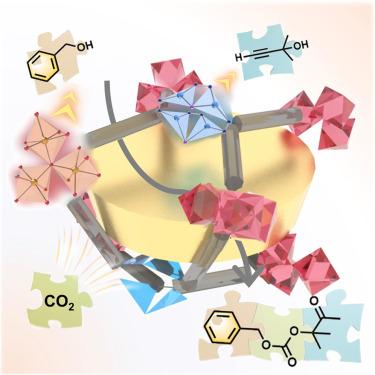
Transforming CO2 into valuable asymmetric carbonates is crucial for green chemistry but remains challenging. This work presents a copper-indium framework that achieves record efficiency in synthesizing these compounds from CO2 and alcohols under mild, solvent-free conditions. It maintains high stability, and the turnover number is much higher than that of reported noble metal catalysts. As the first metal-organic framework (MOF) catalyst for this reaction, it demonstrates the potential of non-precious metal systems in carbon utilization technologies.
The synthesis of asymmetric carbonates from renewable CO2 is important for sustainable chemistry but often suffers from low efficiency, harsh reaction conditions, and noble metal catalysts. Achieving this efficient transformation under mild conditions by non-noble metal catalysts remains a great challenge. Herein, a framework {[In3(μ3-O)(H2O)Cu4(CPT)4I2]⋅(NO3)⋅1.5H2O⋅3DMF}n (CuIn-CPT, CPT = 3,5-bis(4′-carboxyphenyl)-1,2,4-triazole) was synthesized, assembled from a [Cu12In18] nanocage with multiple CuI and InIII Lewis acid sites, and it exhibits good thermal and chemical stabilities. It achieves up to 98% yield in multicomponent reactions of CO2, propargyl alcohols, and primary alcohols without solvent under mild conditions, with a record turnover number of 4,844—ten times higher than top Ag-based catalysts—and excellent recyclability over 10 cycles. Density functional theory (DFT) calculations and mechanistic studies confirm that the synergistic effect between [Cu4] and [In3] clusters enhances catalytic efficiency. This work provides an inspiration for developing efficient non-noble metal heterogeneous catalysts in CO2 conversion.
The synthesis of asymmetric carbonates from renewable CO2 is important for sustainable chemistry but often suffers from low efficiency, harsh reaction conditions, and noble metal catalysts. Achieving this efficient transformation under mild conditions by non-noble metal catalysts remains a great challenge. Herein, a framework {[In3(μ3-O)(H2O)Cu4(CPT)4I2]⋅(NO3)⋅1.5H2O⋅3DMF}n (CuIn-CPT, CPT = 3,5-bis(4′-carboxyphenyl)-1,2,4-triazole) was synthesized, assembled from a [Cu12In18] nanocage with multiple CuI and InIII Lewis acid sites, and it exhibits good thermal and chemical stabilities. It achieves up to 98% yield in multicomponent reactions of CO2, propargyl alcohols, and primary alcohols without solvent under mild conditions, with a record turnover number of 4,844—ten times higher than top Ag-based catalysts—and excellent recyclability over 10 cycles. Density functional theory (DFT) calculations and mechanistic studies confirm that the synergistic effect between [Cu4] and [In3] clusters enhances catalytic efficiency. This work provides an inspiration for developing efficient non-noble metal heterogeneous catalysts in CO2 conversion.
- Download: Download high-res image (180KB)
- Download: Download full-size image
mof中双金属协同催化将CO2转化为碳酸盐,其周转量创记录
利用可再生二氧化碳合成不对称碳酸盐对可持续化学具有重要意义,但通常存在效率低、反应条件苛刻和贵金属催化剂等问题。用非贵金属催化剂在温和条件下实现这种高效转化仍然是一个巨大的挑战。在具有多个CuI和InIII Lewis酸位点的[Cu12In18]纳米笼中,合成了一个骨架{[In3(μ3-O)(H2O)Cu4(CPT)4I2]⋅(NO3)⋅1.5H2O⋅3DMF}n (cu -CPT, CPT = 3,5-双(4′-羧基苯基)-1,2,4-三唑),具有良好的热稳定性和化学稳定性。在温和条件下,在无溶剂的情况下,二氧化碳、丙炔醇和伯醇的多组分反应中,它的收率高达98%,周转率达到创纪录的4,844——比顶级银基催化剂高10倍——并且在10次循环中具有出色的可回收性。密度泛函理论(DFT)计算和机理研究证实了[Cu4]和[In3]团簇之间的协同效应提高了催化效率。本研究为开发高效的非贵金属非均相催化剂在CO2转化中的应用提供了启示。
本文章由计算机程序翻译,如有差异,请以英文原文为准。
求助全文
约1分钟内获得全文
求助全文
来源期刊
Chem
Environmental Science-Environmental Chemistry
CiteScore
32.40
自引率
1.30%
发文量
281
期刊介绍:
Chem, affiliated with Cell as its sister journal, serves as a platform for groundbreaking research and illustrates how fundamental inquiries in chemistry and its related fields can contribute to addressing future global challenges. It was established in 2016, and is currently edited by Robert Eagling.
 求助内容:
求助内容: 应助结果提醒方式:

 京公网安备 11010802042870号


