
Chasing nature’s anion binders
IF 19.6
1区 化学
Q1 CHEMISTRY, MULTIDISCIPLINARY
引用次数: 0
Abstract
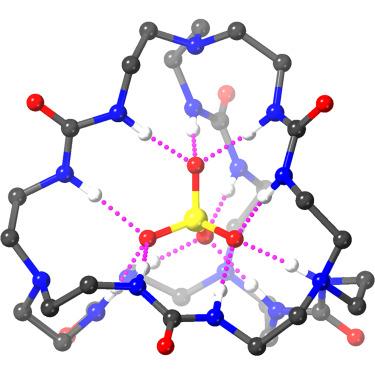
In water, hydrogen bonds between solute molecules are disfavored because they must compete with the overwhelming abundance of water forming hydrogen bonds with solutes. Thus, molecular recognition by hydrogen bonds in water has long been considered challenging, often requiring auxiliary interactions such as ion pairing and hydrophobic contacts. Yet through evolved structural sophistication, certain biological receptors such as sulfate-binding proteins use hydrogen bonds alone to bind hydrophilic anions with remarkable (sub)micromolar affinities. Here, we report highly pre-organized, uncharged hydrogen-bonding molecular cages that match the micromolar affinities of nature’s anion receptors in water. Contrasting large biological receptors that bury polar binding sites within hydrophobic cores, these synthetic hosts have just 52 heavy atoms with polar binding sites exposed to water. These results establish the capabilities of unshielded polar hydrogen bonds in aqueous supramolecular chemistry, providing new opportunities for biological interventions and molecular separations.
追逐大自然的阴离子粘合剂
在水中,溶质分子之间的氢键是不受欢迎的,因为它们必须与大量与溶质形成氢键的水竞争。因此,水中氢键的分子识别一直被认为是具有挑战性的,通常需要离子配对和疏水接触等辅助相互作用。然而,通过进化的复杂结构,某些生物受体,如硫酸盐结合蛋白,仅使用氢键结合具有显著(亚)微摩尔亲和的亲水性阴离子。在这里,我们报道了高度预组织的、不带电的氢键分子笼,它与水中自然阴离子受体的微摩尔亲和力相匹配。与大型生物受体将极性结合位点埋在疏水核心中相比,这些合成宿主只有52个带极性结合位点的重原子暴露在水中。这些结果建立了非屏蔽极性氢键在水超分子化学中的能力,为生物干预和分子分离提供了新的机会。
本文章由计算机程序翻译,如有差异,请以英文原文为准。
求助全文
约1分钟内获得全文
求助全文
来源期刊
Chem
Environmental Science-Environmental Chemistry
CiteScore
32.40
自引率
1.30%
发文量
281
期刊介绍:
Chem, affiliated with Cell as its sister journal, serves as a platform for groundbreaking research and illustrates how fundamental inquiries in chemistry and its related fields can contribute to addressing future global challenges. It was established in 2016, and is currently edited by Robert Eagling.
 求助内容:
求助内容: 应助结果提醒方式:

 京公网安备 11010802042870号


