
A Gravity-Driven Full-Scale Digital Lung Modeling Aerosol Deposition Hotspots and Localized Exposure Risks
IF 11.3
1区 环境科学与生态学
Q1 ENGINEERING, ENVIRONMENTAL
引用次数: 0
Abstract
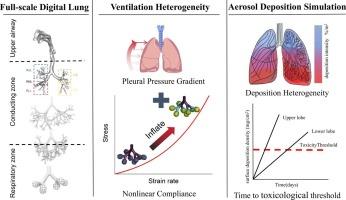
Exposure to hazardous aerosol represent critical driver of chronic and acute pulmonary diseases. Conventional inhalation risk assessments frequently rely on mean deposition indices and simplified mechanical models, failing to reproduce ventilatory heterogeneity, thereby masking regional difference in aerosol deposition. To elucidate the correlation between regional airflow dynamics and tissue vulnerability, we developed an anatomically full-scale digital lung model that incorporates nonlinear compliance and gravity-driven pleural pressure gradients to simulate particle deposition during quiet, up-right breathing in healthy adults. Numerical simulations of aerosol particles (0.1–10 µm) over a complete respiratory cycle revealed a distinct gravity-dependent heterogenous deposition pattern: The highest deposition intensity was observed in the right lower lobe and left lower lobe, while the lowest occurred in the right upper lobe. Three deposition hotspots were identified: two in the right lower lobe (0.53%/m2) and left lower lobe (0.51%/m2), spanning generations G21-G23 and enriched with particles of 3 µm in diameter, and one in the right lower lobe (0.48%/m2), spanning generations G7-G10 and enriched with particles of 10 µm in diameter. Additionally, we use wielding fume as an example to demonstrate how to quantitatively calculate the regional surface deposition density and exposure time required to reach cytotoxicity thresholds, highlighting the model’s ability to translate regional deposition patterns into biologically meaningful risk metrics. In conclusion, our full-scale digital lung model replicates human-specific airway branching and ventilation dynamics, offering a non-invasive digital platform for temporospatial evaluation of inhalation risks from hazardous aerosol.
重力驱动全尺寸数字肺模拟气溶胶沉积热点和局部暴露风险
暴露于有害气溶胶是慢性和急性肺部疾病的关键驱动因素。传统的吸入风险评估常常依赖于平均沉积指数和简化的力学模型,无法再现通气的异质性,从而掩盖了气溶胶沉积的区域差异。为了阐明区域气流动力学与组织脆弱性之间的相关性,我们开发了一个解剖学全尺寸的数字肺模型,该模型包含非线性顺应性和重力驱动的胸膜压力梯度,以模拟健康成人在安静、向上呼吸时的颗粒沉积。气溶胶颗粒(0.1-10µm)在一个完整呼吸周期内的数值模拟显示出明显的重力依赖性非均质沉积模式:沉积强度最高的是右下肺叶和左下肺叶,而最低的发生在右上肺叶。发现3个沉积热点:2个位于右下叶(0.53%/m2)和2个位于左下叶(0.51%/m2),跨越g21 ~ g23代,富集直径3µm的颗粒;1个位于右下叶(0.48%/m2),跨越g7 ~ g10代,富集直径10µm的颗粒。此外,我们以挥舞烟雾为例,展示了如何定量计算达到细胞毒性阈值所需的区域表面沉积密度和暴露时间,突出了该模型将区域沉积模式转化为具有生物学意义的风险指标的能力。总之,我们的全尺寸数字肺模型复制了人类特定的气道分支和通气动力学,为有害气溶胶吸入风险的时空评估提供了一个无创数字平台。
本文章由计算机程序翻译,如有差异,请以英文原文为准。
求助全文
约1分钟内获得全文
求助全文
来源期刊
Journal of Hazardous Materials
工程技术-工程:环境
CiteScore
25.40
自引率
5.90%
发文量
3059
审稿时长
58 days
期刊介绍:
The Journal of Hazardous Materials serves as a global platform for promoting cutting-edge research in the field of Environmental Science and Engineering. Our publication features a wide range of articles, including full-length research papers, review articles, and perspectives, with the aim of enhancing our understanding of the dangers and risks associated with various materials concerning public health and the environment. It is important to note that the term "environmental contaminants" refers specifically to substances that pose hazardous effects through contamination, while excluding those that do not have such impacts on the environment or human health. Moreover, we emphasize the distinction between wastes and hazardous materials in order to provide further clarity on the scope of the journal. We have a keen interest in exploring specific compounds and microbial agents that have adverse effects on the environment.
 求助内容:
求助内容: 应助结果提醒方式:

 京公网安备 11010802042870号


