
A physics-informed dual-electrode equivalent circuit model for lithium iron phosphate battery cells

IF 5.6 3区 材料科学 Q1 ELECTROCHEMISTRY
Jonas A. Braun, David Schmider, Wolfgang G. Bessler
{"title":"A physics-informed dual-electrode equivalent circuit model for lithium iron phosphate battery cells","authors":"Jonas A. Braun, David Schmider, Wolfgang G. Bessler","doi":"10.1016/j.electacta.2026.148884","DOIUrl":null,"url":null,"abstract":"Lithium-ion batteries with lithium iron phosphate (LiFePO₄, LFP) positive electrodes and graphite negative electrodes exhibit complex voltage behavior, including flat, staged voltage curves at low C-rates, open-circuit voltage hysteresis, and asymmetric overpotentials, which challenges established modeling approaches. To address these complexities, six commercial LFP/graphite cells (nominal capacities between 3.4 Ah and 180 Ah) were experimentally characterized using constant current constant voltage cycling and pulse tests. Consistent self-similar voltage behaviors were observed across all cells. To capture these behaviors, a series of five physics-informed dual-electrode equivalent circuit models was developed, progressively increasing in complexity. These models integrate electrode-specific voltage sources, hysteresis, and stoichiometry-dependent resistances based on Butler-Volmer kinetics. For the first time, multi-particle phase-change behavior of LFP is integrated into a resistor element. Slow dynamic effects were modeled via either core-shell Fickian diffusion or additional resistor-capacitor (RC) elements. Models were parameterized and validated against experimental results over a range of C-rates (0.02-1 C) and temperatures (5-35°C). Results demonstrate that including physicochemical insights is critical to reproducing low-current behavior and asymmetric overpotentials. The most advanced model, featuring hysteresis and three RC elements, successfully captures behavior across all conditions. The physics-informed modeling introduced here allows higher fidelity at a reduced number of parameters compared to state-of-the-art equivalent circuit models.","PeriodicalId":305,"journal":{"name":"Electrochimica Acta","volume":"23 1","pages":""},"PeriodicalIF":5.6000,"publicationDate":"2026-04-19","publicationTypes":"Journal Article","fieldsOfStudy":null,"isOpenAccess":false,"openAccessPdf":"","citationCount":"0","resultStr":null,"platform":"Semanticscholar","paperid":null,"PeriodicalName":"Electrochimica Acta","FirstCategoryId":"88","ListUrlMain":"https://doi.org/10.1016/j.electacta.2026.148884","RegionNum":3,"RegionCategory":"材料科学","ArticlePicture":[],"TitleCN":null,"AbstractTextCN":null,"PMCID":null,"EPubDate":"","PubModel":"","JCR":"Q1","JCRName":"ELECTROCHEMISTRY","Score":null,"Total":0}
引用次数: 0

Abstract

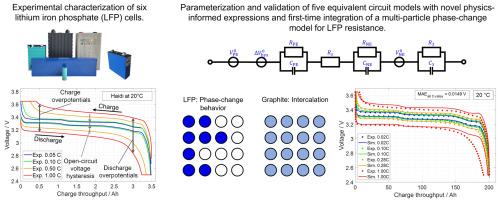
Lithium-ion batteries with lithium iron phosphate (LiFePO₄, LFP) positive electrodes and graphite negative electrodes exhibit complex voltage behavior, including flat, staged voltage curves at low C-rates, open-circuit voltage hysteresis, and asymmetric overpotentials, which challenges established modeling approaches. To address these complexities, six commercial LFP/graphite cells (nominal capacities between 3.4 Ah and 180 Ah) were experimentally characterized using constant current constant voltage cycling and pulse tests. Consistent self-similar voltage behaviors were observed across all cells. To capture these behaviors, a series of five physics-informed dual-electrode equivalent circuit models was developed, progressively increasing in complexity. These models integrate electrode-specific voltage sources, hysteresis, and stoichiometry-dependent resistances based on Butler-Volmer kinetics. For the first time, multi-particle phase-change behavior of LFP is integrated into a resistor element. Slow dynamic effects were modeled via either core-shell Fickian diffusion or additional resistor-capacitor (RC) elements. Models were parameterized and validated against experimental results over a range of C-rates (0.02-1 C) and temperatures (5-35°C). Results demonstrate that including physicochemical insights is critical to reproducing low-current behavior and asymmetric overpotentials. The most advanced model, featuring hysteresis and three RC elements, successfully captures behavior across all conditions. The physics-informed modeling introduced here allows higher fidelity at a reduced number of parameters compared to state-of-the-art equivalent circuit models.
Abstract Image

磷酸铁锂电池的双电极等效电路模型
磷酸铁锂(LiFePO₄,LFP)正极和石墨负极的锂离子电池表现出复杂的电压行为,包括低c率下平坦的分段电压曲线、开路电压滞后和不对称过电位,这些都对现有的建模方法提出了挑战。为了解决这些复杂问题,使用恒流恒压循环和脉冲测试对6个商用LFP/石墨电池(标称容量在3.4 Ah至180 Ah之间)进行了实验表征。在所有细胞中观察到一致的自相似电压行为。为了捕捉这些行为,开发了一系列五种物理信息的双电极等效电路模型,其复杂性逐渐增加。这些模型集成了电极特定电压源,滞后和基于巴特勒-沃尔默动力学的化学计量学相关电阻。首次将LFP的多粒子相变行为集成到电阻元件中。慢动态效应通过核-壳菲克扩散或附加电阻-电容(RC)元件进行建模。模型在升温速率(0.02-1℃)和温度(5-35℃)范围内进行了参数化,并根据实验结果进行了验证。结果表明,包括物理化学见解对于再现低电流行为和不对称过电位至关重要。最先进的模型,具有迟滞和三个RC元素,成功地捕获了所有条件下的行为。与最先进的等效电路模型相比,这里介绍的物理建模可以在减少参数数量的情况下实现更高的保真度。
本文章由计算机程序翻译,如有差异,请以英文原文为准。
求助全文
约1分钟内获得全文 求助全文
来源期刊

Electrochimica Acta
Electrochimica Acta 工程技术-电化学
CiteScore
11.30
自引率
6.10%
发文量
1634
审稿时长
41 days
期刊介绍: Electrochimica Acta is an international journal. It is intended for the publication of both original work and reviews in the field of electrochemistry. Electrochemistry should be interpreted to mean any of the research fields covered by the Divisions of the International Society of Electrochemistry listed below, as well as emerging scientific domains covered by ISE New Topics Committee.

×
引用
GB/T 7714-2015
复制
MLA
复制
APA
复制
导出至
BibTeX EndNote RefMan NoteFirst NoteExpress
×
提示
您的信息不完整,为了账户安全,请先补充。
现在去补充
×
提示
您因"违规操作"
具体请查看互助需知
我知道了
×
提示
确定
请完成安全验证×
copy
已复制链接
快去分享给好友吧!
我知道了
右上角分享
点击右上角分享
0
联系我们:info@booksci.cn Book学术提供免费学术资源搜索服务,方便国内外学者检索中英文文献。致力于提供最便捷和优质的服务体验。 Copyright © 2023 布克学术 All rights reserved.
京ICP备2023020795号-1
ghs 京公网安备 11010802042870号
Book学术文献互助
Book学术文献互助群
群 号:604180095
Book学术官方微信
小红书


