
A phytoscreen identifies a garlic compound as a deterrent of mating and egg laying in Drosophila and mosquitoes
IF 42.5
1区 生物学
Q1 BIOCHEMISTRY & MOLECULAR BIOLOGY
引用次数: 0
Abstract
One means of controlling insect disease vectors and pests is with compounds that manipulate their behavior. An extraordinary variety of phytochemicals, i.e., compounds produced by plants, activate insect chemosensory systems. Fruits and vegetables present a source of compounds that are inexpensive and safe. A “phytoscreen” of 43 fruits and vegetables identified garlic as a potent deterrent of mating and egg laying in Drosophila. Diallyl disulfide, a garlic compound, deters both behaviors. Mating and egg-laying effects depend on taste and the TrpA1 channel. Garlic inhibits mating and egg laying in Aedes vector mosquitoes and mating of the tsetse fly Glossina morsitans. Garlic exposure increases expression of Drosophila head genes, including female-specific independent of transformer (fit), which encodes a satiety hormone that is essential for the effect of garlic on egg-laying preference.
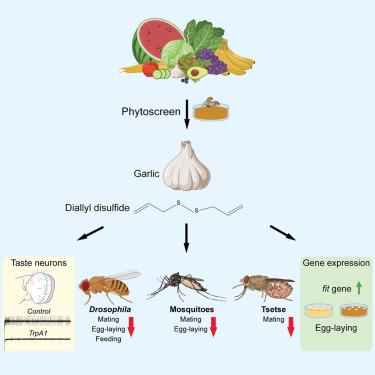
植物筛选发现,一种大蒜化合物可以阻止果蝇和蚊子交配和产卵
控制昆虫病媒和害虫的一种方法是使用操纵其行为的化合物。种类繁多的植物化学物质,即植物产生的化合物,能激活昆虫的化学感觉系统。水果和蔬菜提供了廉价和安全的化合物来源。一项针对43种水果和蔬菜的“植物筛选”发现,大蒜对果蝇的交配和产卵具有强大的威慑作用。二烯丙基二硫,一种大蒜化合物,阻止了这两种行为。交配和产卵的影响取决于味觉和TrpA1通道。大蒜抑制伊蚊媒介蚊的交配产卵和舌蝇的交配。大蒜增加了果蝇头部基因的表达,包括雌性特异性的独立于变压器(fit)的基因,它编码一种饱腹感激素,这种激素对大蒜对产卵偏好的影响至关重要。
本文章由计算机程序翻译,如有差异,请以英文原文为准。
求助全文
约1分钟内获得全文
求助全文
来源期刊
Cell
生物-生化与分子生物学
CiteScore
110.00
自引率
0.80%
发文量
396
审稿时长
2 months
期刊介绍:
Cells is an international, peer-reviewed, open access journal that focuses on cell biology, molecular biology, and biophysics. It is affiliated with several societies, including the Spanish Society for Biochemistry and Molecular Biology (SEBBM), Nordic Autophagy Society (NAS), Spanish Society of Hematology and Hemotherapy (SEHH), and Society for Regenerative Medicine (Russian Federation) (RPO).
The journal publishes research findings of significant importance in various areas of experimental biology, such as cell biology, molecular biology, neuroscience, immunology, virology, microbiology, cancer, human genetics, systems biology, signaling, and disease mechanisms and therapeutics. The primary criterion for considering papers is whether the results contribute to significant conceptual advances or raise thought-provoking questions and hypotheses related to interesting and important biological inquiries.
In addition to primary research articles presented in four formats, Cells also features review and opinion articles in its "leading edge" section, discussing recent research advancements and topics of interest to its wide readership.
 求助内容:
求助内容: 应助结果提醒方式:

 京公网安备 11010802042870号


