{"title":"Mathematical modeling of direct electron transfer and mediated electron transfer mechanisms in enzymatic glucose fuel cells under substrate inhibition","authors":"Samuel Reji, Balaji Krishnamurthy","doi":"10.1007/s10008-026-06528-w","DOIUrl":null,"url":null,"abstract":"<div>\n \n <p>Kinetic and transport factors are of crucial importance for the performance of enzymatic glucose fuel cells, EGFCs, particularly under conditions of substrate inhibition. This study focuses on the development, implementation, and comparison of Direct Electron Transfer (DET) and Mediated Electron Transfer(MET) mechanisms, with the aim of investigating substrate inhibition effects. Explicitly, it accounts for substrate inhibition, enzyme concentration, mediator dynamics, and electrochemical reactions to determine optimal working conditions. In the MET model, the Nernst Ping-pong model is used to account for mediator-dependent electron transfer and overpotential effects. Simulation results show that the DET current peaks at 1.2 mol m⁻³ substrate with 1.05 mA, whereas the MET current peaks at 1.25 mA for a lower concentration of 0.94 mol m⁻³. Furthermore, a 50% and 45% degradation of the catalytic current is observed at a 5 mol m⁻³ substrate concentration for both. The model identifies an optimal mediator concentration of 77 mM and shows that increasing mediator loading from 50 to 100 mM enhances the catalytic current by ~ 30–35%, whereas increasing the overpotential from 0.05 to 0.2 V results in a comparatively smaller improvement of ~ 10–15%. This indicates that EGFC performance is significantly more sensitive to mediator loading than to overpotential within the investigated range. Validation against experimental data demonstrates excellent agreement, with an R² value of 0.92. The models developed in this work provide guidelines for optimizing enzyme and mediator loading to mitigate substrate inhibition and enhance the efficiency of EGFC.</p>\n </div>","PeriodicalId":665,"journal":{"name":"Journal of Solid State Electrochemistry","volume":"30 5","pages":"1997 - 2008"},"PeriodicalIF":2.6000,"publicationDate":"2026-03-02","publicationTypes":"Journal Article","fieldsOfStudy":null,"isOpenAccess":false,"openAccessPdf":"","citationCount":"0","resultStr":null,"platform":"Semanticscholar","paperid":null,"PeriodicalName":"Journal of Solid State Electrochemistry","FirstCategoryId":"5","ListUrlMain":"https://link.springer.com/article/10.1007/s10008-026-06528-w","RegionNum":4,"RegionCategory":"化学","ArticlePicture":[],"TitleCN":null,"AbstractTextCN":null,"PMCID":null,"EPubDate":"","PubModel":"","JCR":"Q3","JCRName":"ELECTROCHEMISTRY","Score":null,"Total":0}
引用次数: 0
Abstract
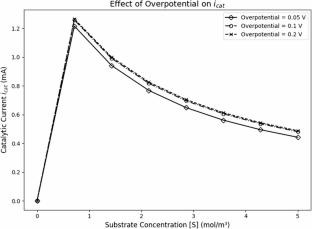
Kinetic and transport factors are of crucial importance for the performance of enzymatic glucose fuel cells, EGFCs, particularly under conditions of substrate inhibition. This study focuses on the development, implementation, and comparison of Direct Electron Transfer (DET) and Mediated Electron Transfer(MET) mechanisms, with the aim of investigating substrate inhibition effects. Explicitly, it accounts for substrate inhibition, enzyme concentration, mediator dynamics, and electrochemical reactions to determine optimal working conditions. In the MET model, the Nernst Ping-pong model is used to account for mediator-dependent electron transfer and overpotential effects. Simulation results show that the DET current peaks at 1.2 mol m⁻³ substrate with 1.05 mA, whereas the MET current peaks at 1.25 mA for a lower concentration of 0.94 mol m⁻³. Furthermore, a 50% and 45% degradation of the catalytic current is observed at a 5 mol m⁻³ substrate concentration for both. The model identifies an optimal mediator concentration of 77 mM and shows that increasing mediator loading from 50 to 100 mM enhances the catalytic current by ~ 30–35%, whereas increasing the overpotential from 0.05 to 0.2 V results in a comparatively smaller improvement of ~ 10–15%. This indicates that EGFC performance is significantly more sensitive to mediator loading than to overpotential within the investigated range. Validation against experimental data demonstrates excellent agreement, with an R² value of 0.92. The models developed in this work provide guidelines for optimizing enzyme and mediator loading to mitigate substrate inhibition and enhance the efficiency of EGFC.
期刊介绍:
The Journal of Solid State Electrochemistry is devoted to all aspects of solid-state chemistry and solid-state physics in electrochemistry.
The Journal of Solid State Electrochemistry publishes papers on all aspects of electrochemistry of solid compounds, including experimental and theoretical, basic and applied work. It equally publishes papers on the thermodynamics and kinetics of electrochemical reactions if at least one actively participating phase is solid. Also of interest are articles on the transport of ions and electrons in solids whenever these processes are relevant to electrochemical reactions and on the use of solid-state electrochemical reactions in the analysis of solids and their surfaces.
The journal covers solid-state electrochemistry and focusses on the following fields: mechanisms of solid-state electrochemical reactions, semiconductor electrochemistry, electrochemical batteries, accumulators and fuel cells, electrochemical mineral leaching, galvanic metal plating, electrochemical potential memory devices, solid-state electrochemical sensors, ion and electron transport in solid materials and polymers, electrocatalysis, photoelectrochemistry, corrosion of solid materials, solid-state electroanalysis, electrochemical machining of materials, electrochromism and electrochromic devices, new electrochemical solid-state synthesis.
The Journal of Solid State Electrochemistry makes the professional in research and industry aware of this swift progress and its importance for future developments and success in the above-mentioned fields.

 求助内容:
求助内容: 应助结果提醒方式:

 京公网安备 11010802042870号


