Tiphaine Voisin, Nadine Gheziel, Céline El Samrout, Jérémy Martin, Amyaouch Bradaia, Mircea Iftinca, Manon Defaye, Aude Charron, Nasser S Abdullah, Celia Changenot, Anne-Alicia Gonzalez, Antoine Depluech, Elodie Labit, Nathalie Saint-Laurent, Larissa Staurengo-Ferrari, Ozge Erdogan, Marie Tauber, Alexia Loste, Nadine Serhan, Sara Villa-Hernandez, Isaac M Chiu, Aziz Moqrich, Christophe Altier, Lilian Basso, Nicolas Gaudenzio
{"title":"Skin inflammation and itch response are independently regulated by distinct nociceptor subsets.","authors":"Tiphaine Voisin, Nadine Gheziel, Céline El Samrout, Jérémy Martin, Amyaouch Bradaia, Mircea Iftinca, Manon Defaye, Aude Charron, Nasser S Abdullah, Celia Changenot, Anne-Alicia Gonzalez, Antoine Depluech, Elodie Labit, Nathalie Saint-Laurent, Larissa Staurengo-Ferrari, Ozge Erdogan, Marie Tauber, Alexia Loste, Nadine Serhan, Sara Villa-Hernandez, Isaac M Chiu, Aziz Moqrich, Christophe Altier, Lilian Basso, Nicolas Gaudenzio","doi":"10.1016/j.immuni.2026.03.020","DOIUrl":null,"url":null,"abstract":"<p><p>Common dermatological disorders are characterized by inflammation and severe itching, which represent a significant clinical challenge. The mechanisms by which nociceptive sensory neurons (nociceptors) integrate peripheral signals to modulate inflammation and itch remain unclear. Here, we showed that two subsets of nociceptors had distinct and nonredundant biological functions in a model of allergic contact dermatitis (ACD). Retrograde axonal tracing of skin-projecting neurons combined with single-cell profiling identified a subset of MrgprD<sup>+</sup> nonpeptidergic neurons that adopted a transitory regenerative program in response to skin inflammation. Selective ablation of reprogrammed MrgprD<sup>+</sup> nonpeptidergic neurons during ACD-like inflammation abolished itch-evoked behavior but did not affect skin inflammation. Conversely, selective depletion of Trpv1<sup>+</sup> peptidergic neurons exacerbated inflammation through increased neutrophilic infiltration without impacting itch-evoked behavior. This study reveals the presence of two distinct and adaptive neuronal circuits that independently regulate allergic inflammation and itch in the skin.</p>","PeriodicalId":13269,"journal":{"name":"Immunity","volume":" ","pages":""},"PeriodicalIF":26.3000,"publicationDate":"2026-04-15","publicationTypes":"Journal Article","fieldsOfStudy":null,"isOpenAccess":false,"openAccessPdf":"","citationCount":"0","resultStr":null,"platform":"Semanticscholar","paperid":null,"PeriodicalName":"Immunity","FirstCategoryId":"3","ListUrlMain":"https://doi.org/10.1016/j.immuni.2026.03.020","RegionNum":1,"RegionCategory":"医学","ArticlePicture":[],"TitleCN":null,"AbstractTextCN":null,"PMCID":null,"EPubDate":"","PubModel":"","JCR":"Q1","JCRName":"IMMUNOLOGY","Score":null,"Total":0}
引用次数: 0
Abstract
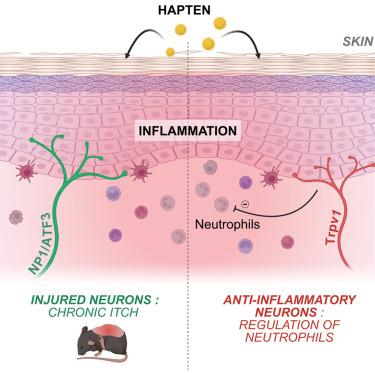
Common dermatological disorders are characterized by inflammation and severe itching, which represent a significant clinical challenge. The mechanisms by which nociceptive sensory neurons (nociceptors) integrate peripheral signals to modulate inflammation and itch remain unclear. Here, we showed that two subsets of nociceptors had distinct and nonredundant biological functions in a model of allergic contact dermatitis (ACD). Retrograde axonal tracing of skin-projecting neurons combined with single-cell profiling identified a subset of MrgprD+ nonpeptidergic neurons that adopted a transitory regenerative program in response to skin inflammation. Selective ablation of reprogrammed MrgprD+ nonpeptidergic neurons during ACD-like inflammation abolished itch-evoked behavior but did not affect skin inflammation. Conversely, selective depletion of Trpv1+ peptidergic neurons exacerbated inflammation through increased neutrophilic infiltration without impacting itch-evoked behavior. This study reveals the presence of two distinct and adaptive neuronal circuits that independently regulate allergic inflammation and itch in the skin.
期刊介绍:
Immunity is a publication that focuses on publishing significant advancements in research related to immunology. We encourage the submission of studies that offer groundbreaking immunological discoveries, whether at the molecular, cellular, or whole organism level. Topics of interest encompass a wide range, such as cancer, infectious diseases, neuroimmunology, autoimmune diseases, allergies, mucosal immunity, metabolic diseases, and homeostasis.

 求助内容:
求助内容: 应助结果提醒方式:

 京公网安备 11010802042870号


