
Platelet factors 4 produces an antidepressant effect in mice via inhibition of neuroinflammation
IF 13
1区 综合性期刊
Q1 MULTIDISCIPLINARY SCIENCES
引用次数: 0
Abstract
Introduction
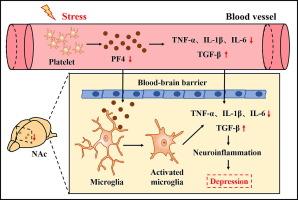
Platelet factor 4 (PF4) is secreted by platelets and can cross blood–brain barrier (BBB) to affect brain function, including regulations of neuroinflammation and synaptic plasticity, which are involved in the pathophysiology of depression. Nevertheless, whether PF4 participates in the development of depression has yet to be determined.Objectives
The aim of this study was to investigate the role and the underlying mechanisms of PF4 in the pathophysiology of depression.Methods
Mouse models of depression were established using chronic social defeat stress (CSDS) and lipopolysaccharide (LPS) paradigms. Plasma levels of PF4 and inflammatory cytokines were quantified by enzyme-linked immunosorbent assay (ELISA). A battery of behavioral tests were conducted to evaluate the effects of systemic and intra-nucleus accumbens (NAc) administration of PF4 siRNA or PF4 on depressive-like behaviors. RNA sequencing (RNA-seq) for transcriptomic analysis and immunofluorescence staining were performed to assess neuroinflammatory status and microglial activation.Results
Plasma PF4 was significantly reduced in patients with major depression. Similarly, CSDS mice exhibited decreased PF4 levels in both plasma and the NAc. Systemic PF4 administration produced an antidepressant-like effect in naive mice and rescued depressive-like behaviors in both CSDS and LPS-treated mice. In CSDS mice, intravenous administration of PF4 suppressed peripheral inflammatory response and increased PF4 levels in the NAc. Knockdown of PF4 in the NAc induced depressive-like behaviors in mice and markedly elevated inflammatory levels in this region. Correspondingly, infusion of PF4 into the NAc mitigated neuroinflammation, inhibited microglial activation, and alleviated depressive-like behaviors in CSDS mice. RNA-seq analysis also confirmed the suppressive effect of PF4 on neuroinflammatory pathways in the NAc.Conclusion
Our findings demonstrate that PF4 exert an antidepressant effect, at least in part, by suppressing neuroinflammatory responses within the NAc. This work identifies PF4 as a novel and promising therapeutic target for the treatment of major depression.
血小板因子4通过抑制神经炎症在小鼠中产生抗抑郁作用
血小板因子4 (platelet factor 4, PF4)由血小板分泌,可穿越血脑屏障(blood-brain barrier, BBB)影响脑功能,包括调节神经炎症和突触可塑性,参与抑郁症的病理生理。然而,PF4是否参与抑郁症的发展尚未确定。目的探讨PF4在抑郁症病理生理中的作用及其机制。方法采用慢性社会失败应激(CSDS)模型和脂多糖(LPS)模型建立抑郁小鼠模型。采用酶联免疫吸附法(ELISA)测定血浆中PF4和炎症因子水平。进行了一系列行为测试,以评估全身和伏隔核内(NAc)给药PF4 siRNA或PF4对抑郁样行为的影响。通过RNA测序(RNA-seq)进行转录组学分析和免疫荧光染色来评估神经炎症状态和小胶质细胞激活。结果重度抑郁症患者血浆PF4水平明显降低。同样,CSDS小鼠血浆和NAc中PF4水平均下降。全身给药PF4在未成熟小鼠中产生抗抑郁样作用,并在CSDS和lps治疗小鼠中恢复抑郁样行为。在CSDS小鼠中,静脉注射PF4可抑制外周炎症反应并增加NAc中PF4的水平。NAc中PF4的敲低诱导小鼠抑郁样行为,并显著升高该区域的炎症水平。相应的,在NAc中注入PF4可以减轻CSDS小鼠的神经炎症,抑制小胶质细胞的激活,并减轻抑郁样行为。RNA-seq分析也证实了PF4对NAc神经炎症通路的抑制作用。结论:我们的研究结果表明,PF4至少在一定程度上通过抑制NAc内的神经炎症反应来发挥抗抑郁作用。这项工作确定了PF4作为治疗重度抑郁症的一个新的和有前途的治疗靶点。
本文章由计算机程序翻译,如有差异,请以英文原文为准。
求助全文
约1分钟内获得全文
求助全文
来源期刊
Journal of Advanced Research
Multidisciplinary-Multidisciplinary
CiteScore
21.60
自引率
0.90%
发文量
280
审稿时长
12 weeks
期刊介绍:
Journal of Advanced Research (J. Adv. Res.) is an applied/natural sciences, peer-reviewed journal that focuses on interdisciplinary research. The journal aims to contribute to applied research and knowledge worldwide through the publication of original and high-quality research articles in the fields of Medicine, Pharmaceutical Sciences, Dentistry, Physical Therapy, Veterinary Medicine, and Basic and Biological Sciences.
The following abstracting and indexing services cover the Journal of Advanced Research: PubMed/Medline, Essential Science Indicators, Web of Science, Scopus, PubMed Central, PubMed, Science Citation Index Expanded, Directory of Open Access Journals (DOAJ), and INSPEC.
 求助内容:
求助内容: 应助结果提醒方式:

 京公网安备 11010802042870号


