
Nafamostat mesilate improves sepsis outcomes by modulating complement and coagulation pathways
IF 13
1区 综合性期刊
Q1 MULTIDISCIPLINARY SCIENCES
引用次数: 0
Abstract
Introduction
Sepsis is a leading cause of mortality in critically ill patients, characterized by dysregulation of multiple biological systems, including the complement, coagulation and contact pathways Nafamostat (NM), a serine protease inhibitor, has shown potential in modulating these systems.Objectives
We investigated the potential therapeutic role of NM in sepsis and its mechanism.Methods
High-throughput mass spectrometry proteomics analysis was conducted to investigate changes in protein levels among sepsis patients. Leveraging the chemical structure of NM, multiple drug-target prediction databases were employed to forecast potential targets. In septic mice, evaluation of complement, coagulation, and contact system activation were conducted after NM administration. Plasma Kininogen 1 (KNG1) was overexpressed to validate roles in the occurrence and development of sepsis. A retrospective study was conducted to evaluate the impact of NM as an anticoagulant for continuous renal replacement therapy (CRRT) on the prognosis of septic patients.Results
107 differentially expressed proteins (DEPs) were identified in sepsis patients with varying prognosis. 622 predicted targets for NM and 184 DEPs in sepsis were identified, with 16 overlapped genes enriching in complement and coagulation cascades. NM reduced plasma KNG1 cleavage and downstream products, alleviating organ damage in septic mice. In a small pilot cohort, NM reduced SOFA scores and platelet consumption while prolonging APTT compared to unfractionated heparin.Conclusion
NM may offer a novel therapeutic approach by modulating dysregulated pathways, thus improving organ function and clinical outcomes in sepsis.
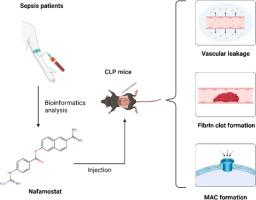
甲磺酸那莫他通过调节补体和凝血途径改善脓毒症的预后
脓毒症是危重症患者死亡的主要原因,其特点是多种生物系统失调,包括补体、凝血和接触途径,纳莫司他(NM)是一种丝氨酸蛋白酶抑制剂,已显示出调节这些系统的潜力。目的探讨NM在脓毒症中的潜在治疗作用及其机制。方法采用高通量质谱蛋白质组学方法研究脓毒症患者血清蛋白水平的变化。利用NM的化学结构,利用多个药物靶点预测数据库预测潜在靶点。在脓毒症小鼠中,NM给药后对补体、凝血和接触系统激活进行了评估。血浆激肽原1 (KNG1)过表达以验证其在脓毒症发生和发展中的作用。我们进行了一项回顾性研究,以评估NM作为抗凝剂用于持续肾替代治疗(CRRT)对脓毒症患者预后的影响。结果在不同预后的脓毒症患者中检测到107种差异表达蛋白(DEPs)。确定了脓毒症中NM的622个预测靶点和dep的184个预测靶点,其中16个重叠基因富集于补体和凝血级联。NM降低了血浆KNG1的裂解和下游产物,减轻了脓毒症小鼠的器官损伤。在一个小型试点队列中,与未分离肝素相比,NM降低了SOFA评分和血小板消耗,同时延长了APTT。结论nm可能通过调节失调通路,为脓毒症患者提供新的治疗途径,从而改善器官功能和临床结果。
本文章由计算机程序翻译,如有差异,请以英文原文为准。
求助全文
约1分钟内获得全文
求助全文
来源期刊
Journal of Advanced Research
Multidisciplinary-Multidisciplinary
CiteScore
21.60
自引率
0.90%
发文量
280
审稿时长
12 weeks
期刊介绍:
Journal of Advanced Research (J. Adv. Res.) is an applied/natural sciences, peer-reviewed journal that focuses on interdisciplinary research. The journal aims to contribute to applied research and knowledge worldwide through the publication of original and high-quality research articles in the fields of Medicine, Pharmaceutical Sciences, Dentistry, Physical Therapy, Veterinary Medicine, and Basic and Biological Sciences.
The following abstracting and indexing services cover the Journal of Advanced Research: PubMed/Medline, Essential Science Indicators, Web of Science, Scopus, PubMed Central, PubMed, Science Citation Index Expanded, Directory of Open Access Journals (DOAJ), and INSPEC.
 求助内容:
求助内容: 应助结果提醒方式:

 京公网安备 11010802042870号


