
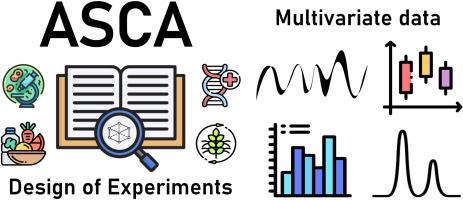
Twenty years of ASCA: a systematic review of applications for ANOVA-Simultaneous Component Analysis
IF 6
2区 化学
Q1 CHEMISTRY, ANALYTICAL
引用次数: 0
Abstract
Background
ANOVA–simultaneous component analysis (ASCA) integrates ANOVA-based variance decomposition with latent variable modelling to quantify, validate and interpret factor-related variation in high-dimensional analytical signals. Over the past two decades, ASCA has expanded through methodological variants (e.g., ASCA+ and mixed-model extensions) and has been adopted across analytical chemistry, agrifood science, biology and metabolomics. Despite this growth, practical use and reporting remain heterogeneous. The key problem is the lack of a consolidated, evidence-based picture of how ASCA is actually implemented and interpreted in the applied literature.Results
Following PRISMA guidelines, we systematically screened the literature and identified 158 peer-reviewed ASCA application studies published since the original formulation of the method. Each article was annotated for application domain, data type and analytical technique, experimental design complexity, factorisation choices, validation strategies (including permutation testing), treatment of residuals, and the way component models and effect sizes were reported. The corpus is dominated by agrifood, biological and metabolomics applications, and most studies involve two or more factors, often including a time component that does not necessarily imply a longitudinal design. Across domains, we observe substantial inconsistency in how unbalanced designs and interactions are encoded, how effect magnitudes are quantified and normalised, how permutation schemes are specified and justified, and whether residual structure is examined to support conclusions or to detect confounding variation.Significance
This review maps where and how ASCA is used in real experiments and pinpoints recurring pitfalls that limit transparency and reproducibility. By synthesising current practice into recommendations for design specification, effect-size reporting, validation and residual interpretation, it provides a practical basis for more robust and comparable ASCA studies and helps guide future applications and methodological development.
二十年的ASCA: anova -同步成分分析应用的系统回顾
danova - simultaneous component analysis (ASCA)将基于anova的方差分解与潜在变量建模相结合,对高维分析信号中与因素相关的变化进行量化、验证和解释。在过去的二十年中,ASCA通过方法变体(例如,ASCA+和混合模型扩展)进行了扩展,并已被分析化学,农业食品科学,生物学和代谢组学所采用。尽管这种增长,但实际使用和报告仍然不一致。关键问题是缺乏一个统一的、基于证据的ASCA是如何在应用文献中实际实施和解释的。遵循PRISMA指南,我们系统地筛选了文献,并确定了自该方法最初制定以来发表的158篇同行评议的ASCA应用研究。每篇文章都对应用领域、数据类型和分析技术、实验设计复杂性、因子选择、验证策略(包括排列测试)、残差处理以及成分模型和效应大小的报告方式进行了注释。语料库以农业食品、生物和代谢组学应用为主,大多数研究涉及两个或更多因素,通常包括不一定意味着纵向设计的时间成分。在各个领域,我们观察到不平衡设计和相互作用如何编码,影响大小如何量化和规范化,排列方案如何指定和证明,以及是否检查剩余结构以支持结论或检测混淆变化等方面存在实质性的不一致。这篇综述描绘了ASCA在真实实验中的使用位置和方式,并指出了限制透明度和可重复性的反复出现的陷阱。通过将当前的实践综合为设计规范、效应大小报告、验证和剩余解释的建议,它为更稳健和可比较的ASCA研究提供了实践基础,并有助于指导未来的应用和方法开发。
本文章由计算机程序翻译,如有差异,请以英文原文为准。
求助全文
约1分钟内获得全文
求助全文
来源期刊
Analytica Chimica Acta
化学-分析化学
CiteScore
10.40
自引率
6.50%
发文量
1081
审稿时长
38 days
期刊介绍:
Analytica Chimica Acta has an open access mirror journal Analytica Chimica Acta: X, sharing the same aims and scope, editorial team, submission system and rigorous peer review.
Analytica Chimica Acta provides a forum for the rapid publication of original research, and critical, comprehensive reviews dealing with all aspects of fundamental and applied modern analytical chemistry. The journal welcomes the submission of research papers which report studies concerning the development of new and significant analytical methodologies. In determining the suitability of submitted articles for publication, particular scrutiny will be placed on the degree of novelty and impact of the research and the extent to which it adds to the existing body of knowledge in analytical chemistry.
 求助内容:
求助内容: 应助结果提醒方式:

 京公网安备 11010802042870号


