
Compositionally tunable Néel temperature in Mn1−xCoxN: A route to enhance magneto-ionic exchange bias control
IF 14.3
1区 材料科学
Q1 MATERIALS SCIENCE, MULTIDISCIPLINARY
引用次数: 0
Abstract
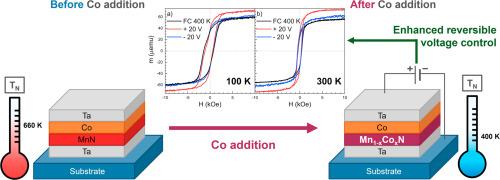
To address growing computational demands, energy-efficient hardware technologies such as spintronics and neuromorphic computing have attracted significant interest. In particular, magneto-ionics offers a low-power, non-volatile approach to control magnetic properties, making it particularly suitable for manipulating antiferromagnetic (AFM) materials. In this work, we report magneto-ionic control of exchange bias (EB) in Mn1−xCoxN/Co with a compositionally tunable Néel temperature, TN. The high TN in MnN (> 650 K) typically necessitates high-temperature annealing, which triggers uncontrolled thermally induced ion-motion effects. Co addition to MnN reduces TN, enabling robust EB to be established after field cooling from 400 K, while preserving structural integrity. Importantly, EB can be subsequently tuned by voltage, up to a 30% enhancement observed at 100 K alongside an increase in saturation magnetization (up to ≈ 250 emu cm−3). Unlike previous works on similar single-layer nitrides, incorporating an additional ferromagnetic Co layer to form an AFM/ferromagnetic bilayer amplifies the voltage-induced effects. This work highlights the dual role of Co addition to MnN: (i) reducing the thermal requirements for setting EB by lowering TN, and (ii) enhancing electrical control of EB. These results represent a step forward towards the development of low-power voltage-controlled spintronic devices.
Mn1 - xCoxN中组成可调的nsamel温度:一种增强磁离子交换偏置控制的途径
为了满足日益增长的计算需求,自旋电子学和神经形态计算等节能硬件技术引起了人们的极大兴趣。特别是,磁离子学提供了一种低功耗,非易失性的方法来控制磁性,使其特别适合于操纵反铁磁(AFM)材料。在这项工作中,我们报告了磁离子控制Mn1 - xcon /Co中交换偏压(EB)的组成可调的n温度(TN)。MnN中的高TN (> 650 K)通常需要高温退火,这引发了不受控制的热诱导离子运动效应。Co添加到MnN中可以减少TN,使400 K的现场冷却后建立坚固的EB,同时保持结构完整性。重要的是,EB随后可以通过电压调谐,在100 K时观察到高达30%的增强,同时饱和磁化强度增加(高达≈250 emu cm−3)。与以往类似单层氮化物的研究不同,结合一个额外的铁磁Co层来形成AFM/铁磁双层可以放大电压诱导效应。这项工作强调了Co加入MnN的双重作用:(i)通过降低TN降低设置EB的热要求,以及(ii)增强EB的电气控制。这些结果代表了低功率电压控制自旋电子器件的发展向前迈进了一步。
本文章由计算机程序翻译,如有差异,请以英文原文为准。
求助全文
约1分钟内获得全文
求助全文
来源期刊
Journal of Materials Science & Technology
工程技术-材料科学:综合
CiteScore
20.00
自引率
11.00%
发文量
995
审稿时长
13 days
期刊介绍:
Journal of Materials Science & Technology strives to promote global collaboration in the field of materials science and technology. It primarily publishes original research papers, invited review articles, letters, research notes, and summaries of scientific achievements. The journal covers a wide range of materials science and technology topics, including metallic materials, inorganic nonmetallic materials, and composite materials.
 求助内容:
求助内容: 应助结果提醒方式:

 京公网安备 11010802042870号


