
Mitochondrial metabolism regulates the immunogenic responsiveness of dendritic cells
IF 37
1区 生物学
Q1 CELL BIOLOGY
引用次数: 0
Abstract
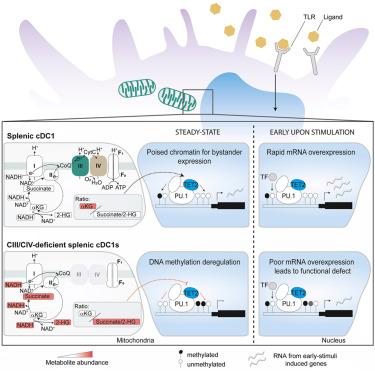
Activation of conventional dendritic cells (cDCs) favors increased glycolysis-driven lactic fermentation, while oxidative phosphorylation (OXPHOS) links to tolerance. Here, selective targeting of the mitochondrial electron transport chain (ETC) in cDCs uncovers a critical role for OXPHOS in regulating their immunogenicity. Disruption of ETC complex III dampens adjuvant-triggered primary human and mouse cDC1 activation and their capability to prime T cells for anti-cancer immunity, while it has a milder effect on cDC2s. Mechanistically, complex III impairment in cDC1s leads to a dysregulated redox and metabolite balance, altering DNA methylation of PU.1 and activator-protein-1 (AP-1) binding regions. These epigenetic changes hinder the rapid induction of immediate-early stimulus-induced genes in cDC1s upon stimulation. The reduced immunogenic responsiveness of ETC-impaired cDC1s can be rescued by ectopic expression of alternative oxidase and phenocopied by Tet2 deficiency. Our findings reveal that electron flow through the ETC maintains a poised activation state in cDC1s, essential for effective anti-tumor immunity.
线粒体代谢调节树突状细胞的免疫原性反应
传统树突状细胞(cdc)的激活有利于糖酵解驱动的乳酸发酵的增加,而氧化磷酸化(OXPHOS)与耐受性有关。在这里,选择性靶向cDCs中的线粒体电子传递链(ETC)揭示了OXPHOS在调节其免疫原性中的关键作用。ETC复合物III的破坏会抑制佐剂引发的人类和小鼠cDC1的原代激活及其对T细胞进行抗癌免疫的能力,而对cDC2s的影响较温和。机制上,cDC1s的复合物III损伤导致氧化还原和代谢物平衡失调,改变PU.1和激活蛋白-1 (AP-1)结合区域的DNA甲基化。这些表观遗传变化阻碍了cDC1s在刺激后立即早期刺激诱导基因的快速诱导。etc损伤的cDC1s的免疫原性降低可以通过异位表达替代氧化酶和Tet2缺乏的表型来挽救。我们的研究结果表明,通过ETC的电子流在cDC1s中保持了一种平衡的激活状态,这对于有效的抗肿瘤免疫至关重要。
本文章由计算机程序翻译,如有差异,请以英文原文为准。
求助全文
约1分钟内获得全文
求助全文
来源期刊
Cell metabolism
生物-内分泌学与代谢
CiteScore
48.60
自引率
1.40%
发文量
173
审稿时长
2.5 months
期刊介绍:
Cell Metabolism is a top research journal established in 2005 that focuses on publishing original and impactful papers in the field of metabolic research.It covers a wide range of topics including diabetes, obesity, cardiovascular biology, aging and stress responses, circadian biology, and many others.
Cell Metabolism aims to contribute to the advancement of metabolic research by providing a platform for the publication and dissemination of high-quality research and thought-provoking articles.
 求助内容:
求助内容: 应助结果提醒方式:

 京公网安备 11010802042870号


