Kai Li, Shuyang Sun, Yunhe Gao, Yixun Lu, Xinxin Xu, Lin Chen, Zhi Qiao, Zhanyu Yang
{"title":"SLC38A7 promotes gastric cancer progression through activating Wnt/β-catenin signaling via interaction with MYH9.","authors":"Kai Li, Shuyang Sun, Yunhe Gao, Yixun Lu, Xinxin Xu, Lin Chen, Zhi Qiao, Zhanyu Yang","doi":"10.1097/CM9.0000000000004090","DOIUrl":null,"url":null,"abstract":"<p><strong>Background: </strong>Gastric cancer (GC) remains a leading cause of cancer-related mortality worldwide. Solute carrier family 38 member 7 (SLC38A7), a lysosome-localized glutamine transporter, has been implicated in poor cancer prognosis and chemoresistance, but its biological role in GC is not well understood. This study aimed to investigate the biological function of SLC38A7 in GC progression and to elucidate the underlying signaling mechanism.</p><p><strong>Methods: </strong>The expression pattern and clinical relevance of SLC38A7 were analyzed using public datasets from The Cancer Genome Atlas (TCGA) and the Genotype-Tissue Expression (GTEx) project, and validated in 60 paired GC tissues collected at the Chinese People's Liberation Army General Hospital. Gain- and loss-of-function experiments were conducted in MKN-28 and MGC-803 to evaluate the effects of SLC38A7 on cell proliferation, migration, and invasion under glutamine-replete and glutamine-deprived conditions. Protein-protein interactions were assessed by co-immunoprecipitation and mass spectrometry. Site-directed mutagenesis was performed to identify key residues mediating SLC38A7 function. Downstream signaling was analyzed by western blotting and ubiquitination assays. A xenograft mouse model was established to determine the role of SLC38A7 in tumor growth in vivo .</p><p><strong>Results: </strong>SLC38A7 expression was significantly upregulated in GC tissues and cell lines and was associated with poor patient prognosis. Functional assays demonstrated that SLC38A7 promoted GC cell proliferation, migration, and invasion, particularly under glutamine-deprived conditions. Mechanistically, SLC38A7 interacted with myosin heavy chain 9 (MYH9), facilitating glycogen synthase kinase-3β (GSK-3β) ubiquitination and degradation, which led to activation of the wingless/int-1 (Wnt)/β-catenin signaling pathway. Mutation of key SLC38A7 residues (E12 and Q3) disrupted its interaction with MYH9 and attenuated downstream signaling. Pharmacological inhibition of GSK-3β partially rescued the effects of SLC38A7 silencing in vitro . In vivo , SLC38A7 knockdown significantly suppressed tumor growth.</p><p><strong>Conclusion: </strong>SLC38A7 promotes gastric cancer progression by activating the Wnt/β-catenin signaling pathway through MYH9-dependent regulation of GSK-3β ubiquitination.</p>","PeriodicalId":10183,"journal":{"name":"Chinese Medical Journal","volume":" ","pages":"3133-3145"},"PeriodicalIF":9.1000,"publicationDate":"2026-10-20","publicationTypes":"Journal Article","fieldsOfStudy":null,"isOpenAccess":false,"openAccessPdf":"https://www.ncbi.nlm.nih.gov/pmc/articles/PMC13682831/pdf/","citationCount":"0","resultStr":null,"platform":"Semanticscholar","paperid":null,"PeriodicalName":"Chinese Medical Journal","FirstCategoryId":"3","ListUrlMain":"https://doi.org/10.1097/CM9.0000000000004090","RegionNum":3,"RegionCategory":"医学","ArticlePicture":[],"TitleCN":null,"AbstractTextCN":null,"PMCID":null,"EPubDate":"2026/4/14 0:00:00","PubModel":"Epub","JCR":"Q1","JCRName":"MEDICINE, GENERAL & INTERNAL","Score":null,"Total":0}
引用次数: 0
Abstract
Background: Gastric cancer (GC) remains a leading cause of cancer-related mortality worldwide. Solute carrier family 38 member 7 (SLC38A7), a lysosome-localized glutamine transporter, has been implicated in poor cancer prognosis and chemoresistance, but its biological role in GC is not well understood. This study aimed to investigate the biological function of SLC38A7 in GC progression and to elucidate the underlying signaling mechanism.
Methods: The expression pattern and clinical relevance of SLC38A7 were analyzed using public datasets from The Cancer Genome Atlas (TCGA) and the Genotype-Tissue Expression (GTEx) project, and validated in 60 paired GC tissues collected at the Chinese People's Liberation Army General Hospital. Gain- and loss-of-function experiments were conducted in MKN-28 and MGC-803 to evaluate the effects of SLC38A7 on cell proliferation, migration, and invasion under glutamine-replete and glutamine-deprived conditions. Protein-protein interactions were assessed by co-immunoprecipitation and mass spectrometry. Site-directed mutagenesis was performed to identify key residues mediating SLC38A7 function. Downstream signaling was analyzed by western blotting and ubiquitination assays. A xenograft mouse model was established to determine the role of SLC38A7 in tumor growth in vivo .
Results: SLC38A7 expression was significantly upregulated in GC tissues and cell lines and was associated with poor patient prognosis. Functional assays demonstrated that SLC38A7 promoted GC cell proliferation, migration, and invasion, particularly under glutamine-deprived conditions. Mechanistically, SLC38A7 interacted with myosin heavy chain 9 (MYH9), facilitating glycogen synthase kinase-3β (GSK-3β) ubiquitination and degradation, which led to activation of the wingless/int-1 (Wnt)/β-catenin signaling pathway. Mutation of key SLC38A7 residues (E12 and Q3) disrupted its interaction with MYH9 and attenuated downstream signaling. Pharmacological inhibition of GSK-3β partially rescued the effects of SLC38A7 silencing in vitro . In vivo , SLC38A7 knockdown significantly suppressed tumor growth.
Conclusion: SLC38A7 promotes gastric cancer progression by activating the Wnt/β-catenin signaling pathway through MYH9-dependent regulation of GSK-3β ubiquitination.
期刊介绍:
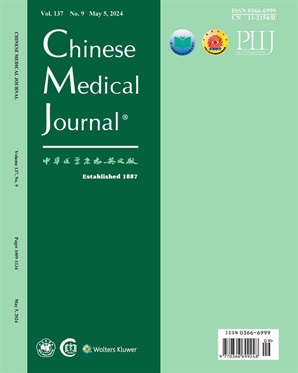
The Chinese Medical Journal (CMJ) is published semimonthly in English by the Chinese Medical Association, and is a peer reviewed general medical journal for all doctors, researchers, and health workers regardless of their medical specialty or type of employment. Established in 1887, it is the oldest medical periodical in China and is distributed worldwide. The journal functions as a window into China’s medical sciences and reflects the advances and progress in China’s medical sciences and technology. It serves the objective of international academic exchange. The journal includes Original Articles, Editorial, Review Articles, Medical Progress, Brief Reports, Case Reports, Viewpoint, Clinical Exchange, Letter,and News,etc. CMJ is abstracted or indexed in many databases including Biological Abstracts, Chemical Abstracts, Index Medicus/Medline, Science Citation Index (SCI), Current Contents, Cancerlit, Health Plan & Administration, Embase, Social Scisearch, Aidsline, Toxline, Biocommercial Abstracts, Arts and Humanities Search, Nuclear Science Abstracts, Water Resources Abstracts, Cab Abstracts, Occupation Safety & Health, etc. In 2007, the impact factor of the journal by SCI is 0.636, and the total citation is 2315.

 求助内容:
 应助结果提醒方式:


 京公网安备 11010802042870号


