Noura Touahri, Amel Benadda-kordjani, Fouzia Touahra, Djahida Lerari, Redouane Chebout, Juan Pedro Holgado, Kheldoun Bachari
{"title":"Novel core–shell NiO@CuFeO2 and NiO@CuFe2O4 nanocatalysts prepared via ultrasound-microwave with high-performance in dry reforming of methane","authors":"Noura Touahri, Amel Benadda-kordjani, Fouzia Touahra, Djahida Lerari, Redouane Chebout, Juan Pedro Holgado, Kheldoun Bachari","doi":"10.1007/s11164-026-05963-8","DOIUrl":null,"url":null,"abstract":"<div><p>Copper-iron mixed oxides with different Fe/Cu molar ratios, along with NiO, NiO@CuFe<sub>2</sub>O<sub>4</sub>, and NiO@CuFeO<sub>2</sub> nanocatalysts, were synthesized via hydrothermal treatment assisted by ultrasonic and microwave irradiation. Comprehensive characterization using XRF, N<sub>2</sub> physisorption, XRD, FTIR, H<sub>2</sub>-TPR, TGA, and TEM-EDS confirmed the formation of mesoporous materials and well-defined core–shell architectures, consisting of Ni-rich cores encapsulated by CuFe oxide shells. TEM analysis revealed average shell thicknesses of approximately 22 nm for NiO@CuFe<sub>2</sub>O<sub>4</sub> and 15 nm for NiO@CuFeO<sub>2</sub>. The catalytic performance in the dry reforming of methane (CH<sub>4</sub>/CO<sub>2</sub> = 1, atmospheric pressure) showed that bare NiO, although initially highly active, underwent rapid deactivation due to sintering and severe carbon deposition. In contrast, post-reaction analyses demonstrated negligible carbon formation on the NiO@CuFe<sub>2</sub>O<sub>4</sub> and NiO@CuFeO<sub>2</sub> catalysts. XRD analysis after reduction evidenced the formation of a Ni-Cu alloy, which modulates the electronic structure and catalytic behavior of Ni. The presence of the Ni-Cu alloy suppresses carbon deposition by reducing the intrinsic tendency of Ni to promote methane cracking, while simultaneously preventing the reoxidation of metallic Ni into inactive NiO species under DRM conditions. Consequently, the strong synergistic interaction between Ni and Cu enhances structural stability, preserves high catalytic activity, and provides excellent resistance to coking.</p></div>","PeriodicalId":753,"journal":{"name":"Research on Chemical Intermediates","volume":"52 5","pages":"3087 - 3110"},"PeriodicalIF":3.5000,"publicationDate":"2026-03-11","publicationTypes":"Journal Article","fieldsOfStudy":null,"isOpenAccess":false,"openAccessPdf":"","citationCount":"0","resultStr":null,"platform":"Semanticscholar","paperid":null,"PeriodicalName":"Research on Chemical Intermediates","FirstCategoryId":"92","ListUrlMain":"https://link.springer.com/article/10.1007/s11164-026-05963-8","RegionNum":3,"RegionCategory":"化学","ArticlePicture":[],"TitleCN":null,"AbstractTextCN":null,"PMCID":null,"EPubDate":"","PubModel":"","JCR":"Q2","JCRName":"CHEMISTRY, MULTIDISCIPLINARY","Score":null,"Total":0}
引用次数: 0
Abstract
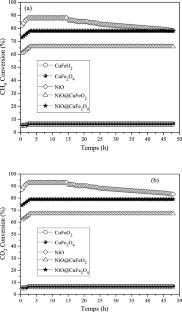
Copper-iron mixed oxides with different Fe/Cu molar ratios, along with NiO, NiO@CuFe2O4, and NiO@CuFeO2 nanocatalysts, were synthesized via hydrothermal treatment assisted by ultrasonic and microwave irradiation. Comprehensive characterization using XRF, N2 physisorption, XRD, FTIR, H2-TPR, TGA, and TEM-EDS confirmed the formation of mesoporous materials and well-defined core–shell architectures, consisting of Ni-rich cores encapsulated by CuFe oxide shells. TEM analysis revealed average shell thicknesses of approximately 22 nm for NiO@CuFe2O4 and 15 nm for NiO@CuFeO2. The catalytic performance in the dry reforming of methane (CH4/CO2 = 1, atmospheric pressure) showed that bare NiO, although initially highly active, underwent rapid deactivation due to sintering and severe carbon deposition. In contrast, post-reaction analyses demonstrated negligible carbon formation on the NiO@CuFe2O4 and NiO@CuFeO2 catalysts. XRD analysis after reduction evidenced the formation of a Ni-Cu alloy, which modulates the electronic structure and catalytic behavior of Ni. The presence of the Ni-Cu alloy suppresses carbon deposition by reducing the intrinsic tendency of Ni to promote methane cracking, while simultaneously preventing the reoxidation of metallic Ni into inactive NiO species under DRM conditions. Consequently, the strong synergistic interaction between Ni and Cu enhances structural stability, preserves high catalytic activity, and provides excellent resistance to coking.
期刊介绍:
Research on Chemical Intermediates publishes current research articles and concise dynamic reviews on the properties, structures and reactivities of intermediate species in all the various domains of chemistry.
The journal also contains articles in related disciplines such as spectroscopy, molecular biology and biochemistry, atmospheric and environmental sciences, catalysis, photochemistry and photophysics. In addition, special issues dedicated to specific topics in the field are regularly published.

 求助内容:
求助内容: 应助结果提醒方式:

 京公网安备 11010802042870号


