{"title":"Multifaceted Impacts of Organic Matter on Hydroxyl Radical Production upon Oxidation of Reduced Ferrihydrite-Organic Matter Coprecipitates","authors":"Qiang Zeng*, , , Yifei Wu, , , Dafu Hu, , and , Hailiang Dong*, ","doi":"10.1021/acs.est.5c17138","DOIUrl":null,"url":null,"abstract":"<p >Ferrihydrite-organic matter (Fh-OM) coprecipitates, long regarded as key reservoirs for OM in redox-dynamic environments, are now recognized to transform OM through hydroxyl radical (•OH) generation during iron redox cycling. This study systematically examines •OH production mechanisms during the abiotic oxidation of reduced Fh-OM coprecipitates at different C/Fe ratios by using three representative OM types: citrate (organic acid), polygalacturonic acid (polysaccharide), and lignin, spanning a spectrum of chemical properties and origins of OM. We observed a two-stage oxidation pattern with distinct •OH production efficiencies, corresponding to heterogeneous and homogeneous Fe(II)-dominated oxidation pathways, respectively. At a low C/Fe ratio, OM increased •OH production by 48.9–98.1% through its Fe-chelating capacity. At a high C/Fe ratio, citrate and polygalacturonic acid suppressed •OH production by 22.2–28.6% through their •OH scavenging capacity; however, lignin increased •OH production by 36.8% due to its strong electron-donating capacity. Collectively, our results demonstrate that the C/Fe ratio and the chemical properties of OM, including Fe-chelating, electron-donating, and •OH scavenging capacities, are key controls of •OH yield during the abiotic oxidation of reduced Fh-OM coprecipitates. These findings underscore the critical role of OM in understanding •OH-mediated processes such as organic carbon turnover and contaminant degradation in redox-fluctuating environments.</p>","PeriodicalId":36,"journal":{"name":"环境科学与技术","volume":"60 20","pages":"14563–14576"},"PeriodicalIF":12.2000,"publicationDate":"2026-05-26","publicationTypes":"Journal Article","fieldsOfStudy":null,"isOpenAccess":false,"openAccessPdf":"","citationCount":"0","resultStr":null,"platform":"Semanticscholar","paperid":null,"PeriodicalName":"环境科学与技术","FirstCategoryId":"1","ListUrlMain":"https://pubs.acs.org/doi/10.1021/acs.est.5c17138","RegionNum":1,"RegionCategory":"环境科学与生态学","ArticlePicture":[],"TitleCN":null,"AbstractTextCN":null,"PMCID":null,"EPubDate":"2026/4/16 0:00:00","PubModel":"Epub","JCR":"Q1","JCRName":"ENGINEERING, ENVIRONMENTAL","Score":null,"Total":0}
引用次数: 0
Abstract
Ferrihydrite-organic matter (Fh-OM) coprecipitates, long regarded as key reservoirs for OM in redox-dynamic environments, are now recognized to transform OM through hydroxyl radical (•OH) generation during iron redox cycling. This study systematically examines •OH production mechanisms during the abiotic oxidation of reduced Fh-OM coprecipitates at different C/Fe ratios by using three representative OM types: citrate (organic acid), polygalacturonic acid (polysaccharide), and lignin, spanning a spectrum of chemical properties and origins of OM. We observed a two-stage oxidation pattern with distinct •OH production efficiencies, corresponding to heterogeneous and homogeneous Fe(II)-dominated oxidation pathways, respectively. At a low C/Fe ratio, OM increased •OH production by 48.9–98.1% through its Fe-chelating capacity. At a high C/Fe ratio, citrate and polygalacturonic acid suppressed •OH production by 22.2–28.6% through their •OH scavenging capacity; however, lignin increased •OH production by 36.8% due to its strong electron-donating capacity. Collectively, our results demonstrate that the C/Fe ratio and the chemical properties of OM, including Fe-chelating, electron-donating, and •OH scavenging capacities, are key controls of •OH yield during the abiotic oxidation of reduced Fh-OM coprecipitates. These findings underscore the critical role of OM in understanding •OH-mediated processes such as organic carbon turnover and contaminant degradation in redox-fluctuating environments.
期刊介绍:
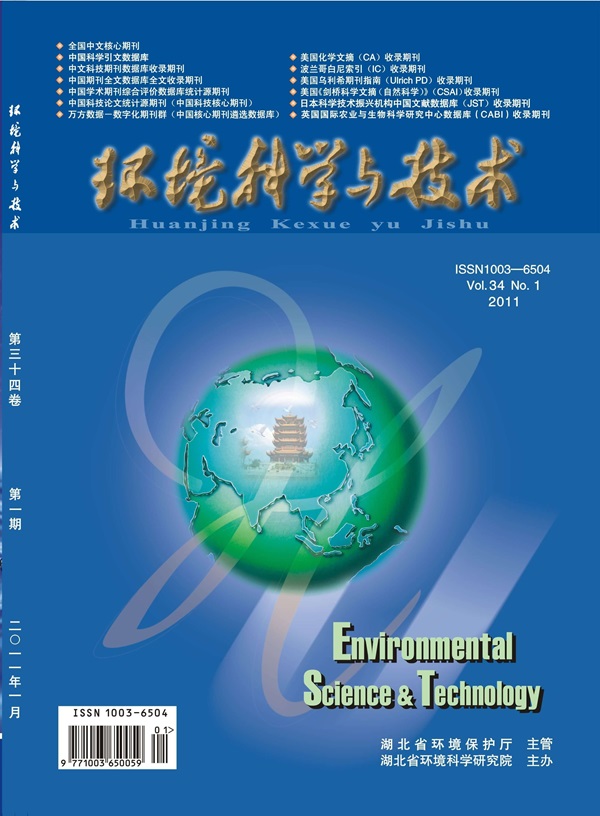
Environmental Science & Technology (ES&T) is a co-sponsored academic and technical magazine by the Hubei Provincial Environmental Protection Bureau and the Hubei Provincial Academy of Environmental Sciences.
Environmental Science & Technology (ES&T) holds the status of Chinese core journals, scientific papers source journals of China, Chinese Science Citation Database source journals, and Chinese Academic Journal Comprehensive Evaluation Database source journals. This publication focuses on the academic field of environmental protection, featuring articles related to environmental protection and technical advancements.



 求助内容:
 应助结果提醒方式:


 京公网安备 11010802042870号


