
Peaks and pitfalls of electrocatalytic CO2 reduction descriptor models
IF 44.6
1区 化学
Q1 CHEMISTRY, PHYSICAL
引用次数: 0
Abstract
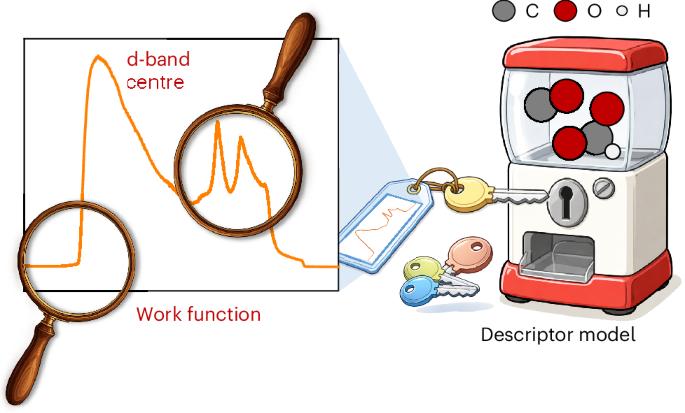
Identifying activity descriptors is critical for the development of efficient electrocatalysts. Here we systematically investigate the effect of electronic structure variations of metal alloys on the electrochemical CO2 reduction. For this, we prepare gold, silver and palladium alloys of various compositions, allowing to continuously tune the d-band centre and work function. Our results indicate that while the d-band centre is the decisive factor for CO production, the work function is needed additionally to explain the production rate of HCOO− and H2. By contrast, non-metal alloys with matching copper-like descriptor values showed no C2+ product formation. This breakdown of the descriptor model is explained from first-principles calculations by the heterogeneity and coverage distribution of the surface, which affects the multi-step reaction pathways for C2+ product formation. Our results highlight the problems in transferring conventional descriptor models to more complex, heterogeneous materials and multi-step reaction pathways. Descriptors have been used to predict product selectivity in electrocatalytic CO2 reduction on metals. This Analysis confirms that CO adsorption energy is suitable for predicting CO, but the work function is also needed to predict HCOO− and H2 selectivity. By contrast, the mechanism for C–C coupled products is too complex to predict using these simple descriptors.
电催化CO2还原描述符模型的峰值和陷阱
确定活性描述符对于开发高效电催化剂至关重要。本文系统地研究了金属合金的电子结构变化对电化学还原CO2的影响。为此,我们制备了各种成分的金,银和钯合金,允许连续调整d波段中心和工作功能。我们的研究结果表明,虽然d波段中心是CO生成的决定性因素,但还需要功函数来解释HCOO−和H2的生成速率。相比之下,具有匹配类铜描述符值的非金属合金没有C2+产物形成。描述符模型的这种破坏可以从第一性原理计算中解释,因为表面的非均质性和覆盖分布影响了C2+产物形成的多步反应途径。我们的研究结果强调了将传统的描述子模型转移到更复杂的非均质材料和多步骤反应途径中的问题。
本文章由计算机程序翻译,如有差异,请以英文原文为准。
求助全文
约1分钟内获得全文
求助全文
来源期刊
Nature Catalysis
Chemical Engineering-Bioengineering
CiteScore
52.10
自引率
1.10%
发文量
140
期刊介绍:
Nature Catalysis serves as a platform for researchers across chemistry and related fields, focusing on homogeneous catalysis, heterogeneous catalysis, and biocatalysts, encompassing both fundamental and applied studies. With a particular emphasis on advancing sustainable industries and processes, the journal provides comprehensive coverage of catalysis research, appealing to scientists, engineers, and researchers in academia and industry.
Maintaining the high standards of the Nature brand, Nature Catalysis boasts a dedicated team of professional editors, rigorous peer-review processes, and swift publication times, ensuring editorial independence and quality. The journal publishes work spanning heterogeneous catalysis, homogeneous catalysis, and biocatalysis, covering areas such as catalytic synthesis, mechanisms, characterization, computational studies, nanoparticle catalysis, electrocatalysis, photocatalysis, environmental catalysis, asymmetric catalysis, and various forms of organocatalysis.
 求助内容:
求助内容: 应助结果提醒方式:

 京公网安备 11010802042870号


