
Implications of the solar rebound effect for the European energy transition
IF 60.1
1区 材料科学
Q1 ENERGY & FUELS
引用次数: 0
Abstract
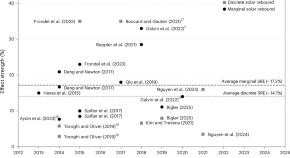
The solar rebound effect (SRE) occurs when rooftop photovoltaic adoption increases household electricity consumption, driven by the perception of solar energy as a free resource. Although empirically observed, the SRE has not yet been accounted for in energy system modelling or abatement scenarios. This study integrates empirically derived SRE intensities into an open-source optimization model of the European energy system, translating behavioural effects into temporally distinct demand profiles. The results show that not only the magnitude but also the timing of the rebound determines its system impact. Additional demand leads to increases in renewable investment needs, flexibility requirements and overall system costs while inducing regressive effects, as households driving the rebound do not bear its full costs. The findings call for explicit inclusion of SRE in abatement scenarios and grid planning and highlight load-shifting incentives and energy efficiency policies as key tools to mitigate rebound effects and align demand with renewable generation.
太阳反弹效应对欧洲能源转型的影响
当屋顶光伏的采用增加了家庭用电量时,太阳能反弹效应(SRE)就会发生,因为人们认为太阳能是一种免费资源。虽然经经验观察,但SRE尚未在能源系统建模或减排情景中得到考虑。本研究将经验推导的SRE强度整合到欧洲能源系统的开源优化模型中,将行为效应转化为时间上不同的需求概况。结果表明,反弹的幅度和时机决定了其对系统的影响。额外的需求导致可再生能源投资需求、灵活性要求和整体系统成本的增加,同时引发了递减效应,因为推动反弹的家庭不承担全部成本。研究结果呼吁将SRE明确纳入减排方案和电网规划,并强调负荷转移激励措施和能源效率政策是缓解反弹效应和使需求与可再生能源发电保持一致的关键工具。
本文章由计算机程序翻译,如有差异,请以英文原文为准。
求助全文
约1分钟内获得全文
求助全文
来源期刊
Nature Energy
Energy-Energy Engineering and Power Technology
CiteScore
75.10
自引率
1.10%
发文量
193
期刊介绍:
Nature Energy is a monthly, online-only journal committed to showcasing the most impactful research on energy, covering everything from its generation and distribution to the societal implications of energy technologies and policies.
With a focus on exploring all facets of the ongoing energy discourse, Nature Energy delves into topics such as energy generation, storage, distribution, management, and the societal impacts of energy technologies and policies. Emphasizing studies that push the boundaries of knowledge and contribute to the development of next-generation solutions, the journal serves as a platform for the exchange of ideas among stakeholders at the forefront of the energy sector.
Maintaining the hallmark standards of the Nature brand, Nature Energy boasts a dedicated team of professional editors, a rigorous peer-review process, meticulous copy-editing and production, rapid publication times, and editorial independence.
In addition to original research articles, Nature Energy also publishes a range of content types, including Comments, Perspectives, Reviews, News & Views, Features, and Correspondence, covering a diverse array of disciplines relevant to the field of energy.
 求助内容:
求助内容: 应助结果提醒方式:

 京公网安备 11010802042870号


