
Water isotope–temperature relationship variability across Antarctica set by atmospheric circulation

IF 16.1 1区 地球科学 Q1 GEOSCIENCES, MULTIDISCIPLINARY
Mathieu Casado, Adriana Bailey, Christophe Leroy-Dos Santos, Elise Fourré, Vincent Favier, Cécile Agosta, Niels Dutrievoz, Christoph Kittel, Laurent Arnaud, Frédéric Prié, Pete D. Akers, Alexandre Cauquoin, Martin Werner, Leoni Janssen, Barbara Stenni, Giuliano Dreossi, Andrea Spolaor, Agnese Petteni, Joel Savarino, Amaelle Landais
{"title":"Water isotope–temperature relationship variability across Antarctica set by atmospheric circulation","authors":"Mathieu Casado, Adriana Bailey, Christophe Leroy-Dos Santos, Elise Fourré, Vincent Favier, Cécile Agosta, Niels Dutrievoz, Christoph Kittel, Laurent Arnaud, Frédéric Prié, Pete D. Akers, Alexandre Cauquoin, Martin Werner, Leoni Janssen, Barbara Stenni, Giuliano Dreossi, Andrea Spolaor, Agnese Petteni, Joel Savarino, Amaelle Landais","doi":"10.1038/s41561-026-01961-y","DOIUrl":null,"url":null,"abstract":"Water isotopes serve as tracers of hydrological processes and as proxies for past climates archived in ice cores. The isotopic signal is acquired throughout the hydrological cycle—through evaporation over the oceans, precipitation, which occurs as moisture is transported from lower to higher latitudes, and during post-depositional processes in which isotopic exchange between snow and atmospheric moisture occurs. Owing to these multiple influences, the relationship between isotope ratios in ice and local temperature varies across Antarctica, and distinct relationships are found when evaluating isotope ratios and temperature across space (for example, in surface snow) compared with temporal correlations at the same site (for example, in precipitation). Here we report measurements of water vapour isotopic compositions from a traverse across East Antarctica, as well as at two fixed sites: the coastal station Dumont D’Urville and Dome C on the plateau. Combining snow and vapour isotopic data, we demonstrate that the temporal and spatial isotope–temperature relationships are distinct because of differences in how the rainout fraction varies across time and space. Our findings support a shift from thinking about the isotope–temperature relationship in terms of distinct temporal and spatial slopes to recognizing that the relationship varies along a continuum based on known dependencies between circulation dynamics and mean climate state. By distilling moisture along moist isentropic transport paths, we can predict the isotope–temperature relationship across either time or space using a physical understanding of large-scale moisture transport under different climatic conditions.","PeriodicalId":19053,"journal":{"name":"Nature Geoscience","volume":"56 1","pages":""},"PeriodicalIF":16.1000,"publicationDate":"2026-04-13","publicationTypes":"Journal Article","fieldsOfStudy":null,"isOpenAccess":false,"openAccessPdf":"","citationCount":"0","resultStr":null,"platform":"Semanticscholar","paperid":null,"PeriodicalName":"Nature Geoscience","FirstCategoryId":"89","ListUrlMain":"https://doi.org/10.1038/s41561-026-01961-y","RegionNum":1,"RegionCategory":"地球科学","ArticlePicture":[],"TitleCN":null,"AbstractTextCN":null,"PMCID":null,"EPubDate":"","PubModel":"","JCR":"Q1","JCRName":"GEOSCIENCES, MULTIDISCIPLINARY","Score":null,"Total":0}
引用次数: 0

Abstract

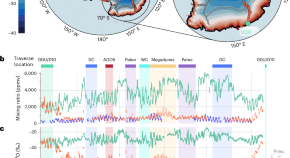
Water isotopes serve as tracers of hydrological processes and as proxies for past climates archived in ice cores. The isotopic signal is acquired throughout the hydrological cycle—through evaporation over the oceans, precipitation, which occurs as moisture is transported from lower to higher latitudes, and during post-depositional processes in which isotopic exchange between snow and atmospheric moisture occurs. Owing to these multiple influences, the relationship between isotope ratios in ice and local temperature varies across Antarctica, and distinct relationships are found when evaluating isotope ratios and temperature across space (for example, in surface snow) compared with temporal correlations at the same site (for example, in precipitation). Here we report measurements of water vapour isotopic compositions from a traverse across East Antarctica, as well as at two fixed sites: the coastal station Dumont D’Urville and Dome C on the plateau. Combining snow and vapour isotopic data, we demonstrate that the temporal and spatial isotope–temperature relationships are distinct because of differences in how the rainout fraction varies across time and space. Our findings support a shift from thinking about the isotope–temperature relationship in terms of distinct temporal and spatial slopes to recognizing that the relationship varies along a continuum based on known dependencies between circulation dynamics and mean climate state. By distilling moisture along moist isentropic transport paths, we can predict the isotope–temperature relationship across either time or space using a physical understanding of large-scale moisture transport under different climatic conditions.
Abstract Image

大气环流设定的南极洲水同位素-温度关系变率
水同位素是水文过程的示踪剂,也是冰芯中记录的过去气候的代用物。同位素信号是在整个水文循环过程中获得的——通过海洋蒸发、降水(水分从低纬度向高纬度输送时发生),以及在雪和大气水分发生同位素交换的沉积后过程。由于这些多重影响,冰中的同位素比率与当地温度之间的关系在南极洲各地有所不同,在评估跨空间(例如,在地表雪中)的同位素比率和温度时,与在同一地点(例如,在降水中)的时间相关性相比,发现了明显的关系。在这里,我们报告了穿越东南极洲的水蒸气同位素组成的测量结果,以及两个固定地点的测量结果:杜蒙德维尔沿海站和高原上的Dome C。结合雪和蒸汽同位素数据,我们证明了由于降雨分数在时间和空间上的变化差异,时空同位素-温度关系是不同的。我们的发现支持了一种转变,即从不同的时空斜率角度考虑同位素-温度关系,到认识到基于已知的环流动力学和平均气候状态之间的依赖关系,这种关系沿着一个连续体变化。通过对湿等熵输运路径上的水分进行蒸馏,我们可以利用对不同气候条件下大尺度水分输运的物理理解来预测同位素-温度在时间或空间上的关系。
本文章由计算机程序翻译,如有差异,请以英文原文为准。
求助全文
约1分钟内获得全文 求助全文
来源期刊
Nature Geoscience
Nature Geoscience 地学-地球科学综合
CiteScore
26.70
自引率
1.60%
发文量
187
审稿时长
3.3 months
期刊介绍: Nature Geoscience is a monthly interdisciplinary journal that gathers top-tier research spanning Earth Sciences and related fields. The journal covers all geoscience disciplines, including fieldwork, modeling, and theoretical studies. Topics include atmospheric science, biogeochemistry, climate science, geobiology, geochemistry, geoinformatics, remote sensing, geology, geomagnetism, paleomagnetism, geomorphology, geophysics, glaciology, hydrology, limnology, mineralogy, oceanography, paleontology, paleoclimatology, paleoceanography, petrology, planetary science, seismology, space physics, tectonics, and volcanology. Nature Geoscience upholds its commitment to publishing significant, high-quality Earth Sciences research through fair, rapid, and rigorous peer review, overseen by a team of full-time professional editors.

×
引用
GB/T 7714-2015
复制
MLA
复制
APA
复制
导出至
BibTeX EndNote RefMan NoteFirst NoteExpress
×
提示
您的信息不完整,为了账户安全,请先补充。
现在去补充
×
提示
您因"违规操作"
具体请查看互助需知
我知道了
×
提示
确定
请完成安全验证×
copy
已复制链接
快去分享给好友吧!
我知道了
右上角分享
点击右上角分享
0
联系我们:info@booksci.cn Book学术提供免费学术资源搜索服务,方便国内外学者检索中英文文献。致力于提供最便捷和优质的服务体验。 Copyright © 2023 布克学术 All rights reserved.
京ICP备2023020795号-1
ghs 京公网安备 11010802042870号
Book学术文献互助
Book学术文献互助群
群 号:604180095
Book学术官方微信
小红书


