
An unprecedented view of ocean currents from geostationary satellites
IF 16.1
1区 地球科学
Q1 GEOSCIENCES, MULTIDISCIPLINARY
引用次数: 0
Abstract
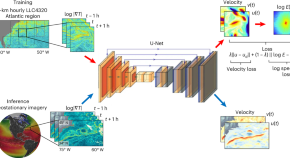
Oceanic submesoscale currents dominate the vertical exchanges of heat, biological nutrients and carbon between the shallow and the deep ocean and strongly influence the lateral dispersion of biogeochemical tracers and pollutants. Observing these surface intensified currents, however, has been a long-standing challenge due to their small scales and rapid evolution. Here we introduce Geostationary Ocean Flow (GOFLOW), a deep learning framework that takes advantage of geostationary satellites’ contiguous sequences of thermal imagery to produce hourly, high-resolution surface velocity fields that capture submesoscale circulations. Our approach does not assume simplified dynamical balances and inherently filters internal wave noise, both of which limit state-of-the-art satellite altimetry. Applying GOFLOW to the Gulf Stream, we provide satellite-based measurements of submesoscale current statistics, revealing characteristic asymmetries in vorticity and divergence previously documented only in high-resolution circulation models. This ability to routinely map the ocean’s energetic submesoscale currents provides a transformative data source to advance Earth system forecasting, to mitigate ocean pollution, to monitor marine ecosystems and to reduce climate model uncertainties.
地球同步卫星对洋流的前所未有的观察
海洋亚中尺度海流主导着浅海和深海之间的热量、生物营养物和碳的垂直交换,并强烈影响着生物地球化学示踪剂和污染物的横向扩散。然而,由于其规模小且演变迅速,观测这些表面强化电流一直是一个长期的挑战。在这里,我们介绍地球静止洋流(GOFLOW),这是一个深度学习框架,它利用地球静止卫星的连续热图像序列来生成每小时、高分辨率的表面速度场,捕获亚中尺度环流。我们的方法不假设简化的动态平衡和固有的过滤内部波噪声,这两者都限制了最先进的卫星测高。将GOFLOW应用于墨西哥湾流,我们提供了基于卫星的亚中尺度电流统计数据,揭示了涡度和辐散的特征不对称性,以前只有在高分辨率环流模型中才有记录。这种常规绘制海洋高能亚中尺度洋流的能力,为推进地球系统预报、减轻海洋污染、监测海洋生态系统和减少气候模式的不确定性提供了一种变革性的数据源。
本文章由计算机程序翻译,如有差异,请以英文原文为准。
求助全文
约1分钟内获得全文
求助全文
来源期刊
Nature Geoscience
地学-地球科学综合
CiteScore
26.70
自引率
1.60%
发文量
187
审稿时长
3.3 months
期刊介绍:
Nature Geoscience is a monthly interdisciplinary journal that gathers top-tier research spanning Earth Sciences and related fields.
The journal covers all geoscience disciplines, including fieldwork, modeling, and theoretical studies.
Topics include atmospheric science, biogeochemistry, climate science, geobiology, geochemistry, geoinformatics, remote sensing, geology, geomagnetism, paleomagnetism, geomorphology, geophysics, glaciology, hydrology, limnology, mineralogy, oceanography, paleontology, paleoclimatology, paleoceanography, petrology, planetary science, seismology, space physics, tectonics, and volcanology.
Nature Geoscience upholds its commitment to publishing significant, high-quality Earth Sciences research through fair, rapid, and rigorous peer review, overseen by a team of full-time professional editors.
 求助内容:
求助内容: 应助结果提醒方式:

 京公网安备 11010802042870号


