
An implantable epiretinal device for near-infrared light perception
IF 40.9
1区 工程技术
Q1 ENGINEERING, ELECTRICAL & ELECTRONIC
引用次数: 0
Abstract
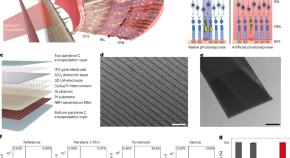
Human vision relies on photoreceptor cells in the outer retina that are sensitive to visible light. However, many people suffer from blindness due to retinal diseases that cause photoreceptor degeneration. Electrical stimulation of retinal neurons can recreate the action potentials associated with seeing that are generated by these cells. Here we report a thin artificial retina that can be adhered to the epiretinal surface and can convert near-infrared (NIR) light into electrical stimuli that selectively stimulate ganglion cells. The artificial retina consists of a NIR-sensitive phototransistor array and three-dimensional liquid metal micropillar electrodes. The liquid metal electrodes enhance proximity to retinal ganglion cells, providing effective charge injection while minimizing tissue damage, owing to their low Young’s modulus. Ex vivo studies demonstrate its biocompatibility, and in vivo studies using healthy and blind mice demonstrate perception of both visible and NIR light, as indicated by cortical recordings and behavioural tests. The retina could, in the future, be used to create a NIR visual channel in patients with photoreceptor degenerative blindness without interfering with their remaining natural vision.
一种用于近红外光感知的植入式视网膜前装置
人类的视觉依赖于外层视网膜上对可见光敏感的感光细胞。然而,许多人由于视网膜疾病导致光感受器变性而失明。对视网膜神经元的电刺激可以重现由这些细胞产生的与视觉相关的动作电位。在这里,我们报告了一种薄的人工视网膜,它可以粘附在视网膜表面,并可以将近红外(NIR)光转化为选择性刺激神经节细胞的电刺激。人造视网膜由近红外敏感光电晶体管阵列和三维液态金属微柱电极组成。液态金属电极增强了与视网膜神经节细胞的接近性,提供有效的电荷注射,同时最大限度地减少组织损伤,因为它们的杨氏模量低。离体研究证明了其生物相容性,而使用健康和失明小鼠进行的体内研究表明,皮层记录和行为测试表明,它们对可见光和近红外光都有感知。在未来,视网膜可以用来为患有光感受器退行性失明的患者创建近红外视觉通道,而不会干扰他们剩余的自然视力。
本文章由计算机程序翻译,如有差异,请以英文原文为准。
求助全文
约1分钟内获得全文
求助全文
来源期刊
Nature Electronics
Engineering-Electrical and Electronic Engineering
CiteScore
47.50
自引率
2.30%
发文量
159
期刊介绍:
Nature Electronics is a comprehensive journal that publishes both fundamental and applied research in the field of electronics. It encompasses a wide range of topics, including the study of new phenomena and devices, the design and construction of electronic circuits, and the practical applications of electronics. In addition, the journal explores the commercial and industrial aspects of electronics research.
The primary focus of Nature Electronics is on the development of technology and its potential impact on society. The journal incorporates the contributions of scientists, engineers, and industry professionals, offering a platform for their research findings. Moreover, Nature Electronics provides insightful commentary, thorough reviews, and analysis of the key issues that shape the field, as well as the technologies that are reshaping society.
Like all journals within the prestigious Nature brand, Nature Electronics upholds the highest standards of quality. It maintains a dedicated team of professional editors and follows a fair and rigorous peer-review process. The journal also ensures impeccable copy-editing and production, enabling swift publication. Additionally, Nature Electronics prides itself on its editorial independence, ensuring unbiased and impartial reporting.
In summary, Nature Electronics is a leading journal that publishes cutting-edge research in electronics. With its multidisciplinary approach and commitment to excellence, the journal serves as a valuable resource for scientists, engineers, and industry professionals seeking to stay at the forefront of advancements in the field.
 求助内容:
求助内容: 应助结果提醒方式:

 京公网安备 11010802042870号


