
A cosmic origin of Venus’ lower haze
IF 14.3
1区 物理与天体物理
Q1 ASTRONOMY & ASTROPHYSICS
引用次数: 0
Abstract
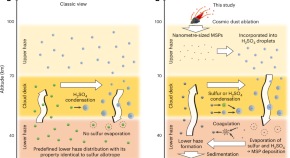
Entry probes have revealed a layer containing involatile submicrometre particles—the lower haze—between Venus’ surface and the main cloud deck. However, its origin is still unclear, and atmospheric models have mostly treated it as a lower boundary condition, despite the known role of its particles as condensation nuclei when they are transported to the main cloud deck. Here we incorporate a self-consistent particle formation framework into a Venus cloud microphysics model and show that the continuous influx of cosmic dust is sufficient to sustain this lower haze layer with the particle size distribution observed by the entry probes. These haze particles of cosmic origin act as efficient condensation nuclei, promoting cloud formation in the main cloud deck even far from their initial source. Furthermore, these particles are enriched in metallic species, specifically magnesium and iron; the latter represents a plausible source for the planet’s long-unidentified ultraviolet absorber. Collectively, our findings establish cosmic dust as an essential component of Venus’ climate. These insights are also crucial for understanding the climates of planets with thick atmospheres, such as gas giants and exoplanets, where accumulating cosmic dust can similarly affect the cloud structure and composition.
金星低处雾霾的宇宙起源
进入金星的探测器发现,在金星表面和主要云层之间有一层含有亚微米粒子的层,即较低的薄雾。然而,它的起源仍然不清楚,大气模式大多将其视为下边界条件,尽管已知其粒子在被运送到主云层时作为凝结核的作用。在这里,我们将一个自一致的粒子形成框架纳入到金星云微物理模型中,并表明宇宙尘埃的持续涌入足以维持这个较低的雾霾层,与进入探测器观察到的颗粒大小分布一致。这些来自宇宙的雾霾粒子充当了有效的凝结核,即使在远离其初始来源的地方,也能在主云层促进云的形成。此外,这些颗粒富含金属物质,特别是镁和铁;后者代表了地球上长期未被识别的紫外线吸收剂的合理来源。总的来说,我们的发现确定了宇宙尘埃是金星气候的重要组成部分。这些洞见对于理解有厚厚的大气层的行星的气候也至关重要,比如气态巨行星和系外行星,在这些行星上,宇宙尘埃的积累同样会影响云的结构和组成。
本文章由计算机程序翻译,如有差异,请以英文原文为准。
求助全文
约1分钟内获得全文
求助全文
来源期刊
Nature Astronomy
Physics and Astronomy-Astronomy and Astrophysics
CiteScore
19.50
自引率
2.80%
发文量
252
期刊介绍:
Nature Astronomy, the oldest science, has played a significant role in the history of Nature. Throughout the years, pioneering discoveries such as the first quasar, exoplanet, and understanding of spiral nebulae have been reported in the journal. With the introduction of Nature Astronomy, the field now receives expanded coverage, welcoming research in astronomy, astrophysics, and planetary science. The primary objective is to encourage closer collaboration among researchers in these related areas.
Similar to other journals under the Nature brand, Nature Astronomy boasts a devoted team of professional editors, ensuring fairness and rigorous peer-review processes. The journal maintains high standards in copy-editing and production, ensuring timely publication and editorial independence.
In addition to original research, Nature Astronomy publishes a wide range of content, including Comments, Reviews, News and Views, Features, and Correspondence. This diverse collection covers various disciplines within astronomy and includes contributions from a diverse range of voices.
 求助内容:
求助内容: 应助结果提醒方式:

 京公网安备 11010802042870号


