
An extreme particle accelerator powered by pulsar PSR J1849−0001
IF 14.3
1区 物理与天体物理
Q1 ASTRONOMY & ASTROPHYSICS
引用次数: 0
Abstract
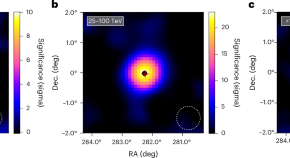
Pulsar wind nebulae (PWNe) are bubbles of relativistic particles, powered by the rotational energy loss of the central pulsars. The Crab Nebula, powered by the Milky Way’s most energetic pulsar, was discovered by the Large High Altitude Air Shower Observatory (LHAASO) as a PeV gamma-ray emitter, thereby establishing it as an extreme particle accelerator along with multiwavelength observations. Here we report LHAASO’s detection of a point-like ultrahigh-energy (UHE, photon energy E > 100 TeV) gamma-ray source associated with the PWN powered by PSR J1849-0001, a pulsar of spindown power 50 times lower than the Crab pulsar. The measured gamma-ray spectrum extends to PeV energies following a power-law distribution, with the PeV luminosity a few times higher than that of the Crab Nebula. Combined X-ray observations constrain the average magnetic field within the source to about 3 μG, and reveal an extreme particle acceleration efficiency approaching or even exceeding unity in the PWN, which we refer to as the ‘Aquila Booster’. The result challenges the particle acceleration theory in PWN and implies non-ideal magnetohydrodynamics (MHD) conditions within the accelerator, potentially involving magnetic reconnection upstream of the termination shock.
由脉冲星PSR J1849−0001驱动的极端粒子加速器
脉冲星风星云(PWNe)是由相对粒子组成的气泡,由中心脉冲星的旋转能量损失提供动力。蟹状星云由银河系最具能量的脉冲星提供动力,是由大型高空空气阵雨天文台(LHAASO)发现的PeV伽玛射线发射器,从而使其成为多波长观测的极端粒子加速器。在这里,我们报告了LHAASO探测到与PWN相关的点状超高能(UHE,光子能量E bbbb100 TeV)伽玛射线源,该伽玛射线源由PSR J1849-0001提供能量,这是一颗自旋功率比蟹状脉冲星低50倍的脉冲星。测量到的伽玛射线光谱延伸到PeV能量,遵循幂律分布,PeV的光度比蟹状星云的光度高几倍。联合x射线观测将源内的平均磁场限制在约3 μG,并揭示了PWN中接近甚至超过1的极端粒子加速效率,我们将其称为“Aquila助推器”。该结果挑战了PWN中的粒子加速理论,并暗示加速器内部存在非理想磁流体动力学(MHD)条件,可能涉及终端激波上游的磁重联。
本文章由计算机程序翻译,如有差异,请以英文原文为准。
求助全文
约1分钟内获得全文
求助全文
来源期刊
Nature Astronomy
Physics and Astronomy-Astronomy and Astrophysics
CiteScore
19.50
自引率
2.80%
发文量
252
期刊介绍:
Nature Astronomy, the oldest science, has played a significant role in the history of Nature. Throughout the years, pioneering discoveries such as the first quasar, exoplanet, and understanding of spiral nebulae have been reported in the journal. With the introduction of Nature Astronomy, the field now receives expanded coverage, welcoming research in astronomy, astrophysics, and planetary science. The primary objective is to encourage closer collaboration among researchers in these related areas.
Similar to other journals under the Nature brand, Nature Astronomy boasts a devoted team of professional editors, ensuring fairness and rigorous peer-review processes. The journal maintains high standards in copy-editing and production, ensuring timely publication and editorial independence.
In addition to original research, Nature Astronomy publishes a wide range of content, including Comments, Reviews, News and Views, Features, and Correspondence. This diverse collection covers various disciplines within astronomy and includes contributions from a diverse range of voices.
 求助内容:
求助内容: 应助结果提醒方式:

 京公网安备 11010802042870号


