Francis O. Okoye, Maya Glasgow, Alamgir M. Haque, Pravin Babar, Christian E. Alvarez-Pugliese, Gerardine G. Botte
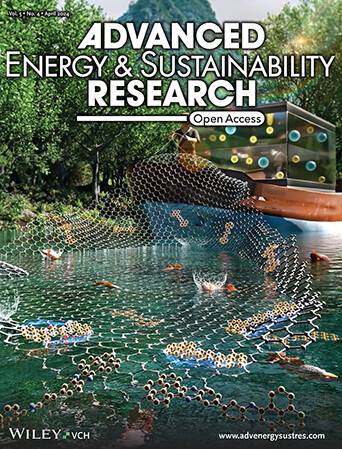
{"title":"Thermally Codeposited Bimetallic Copper–Cobalt Oxide Electrode for Electrocatalytic Nitrate Reduction to Ammonia","authors":"Francis O. Okoye, Maya Glasgow, Alamgir M. Haque, Pravin Babar, Christian E. Alvarez-Pugliese, Gerardine G. Botte","doi":"10.1002/aesr.70176","DOIUrl":null,"url":null,"abstract":"<p>The electrocatalytic reduction of nitrate (NO<sub>3</sub>RR) to ammonia presents a promising avenue for both wastewater treatment and nitrogen cycle restoration while simultaneously producing valuable renewable energy carriers. Despite recent advances, the development of stable and scalable catalysts that can bridge the gap between laboratory demonstrations and practical applications remains challenging. This study reports the synthesis of bimetallic copper–cobalt oxide catalyst supported on nickel sheet (referred to as CuCo<sub>2</sub>O<sub>4</sub>/Ni) via thermal treatment, demonstrating exceptional NO<sub>3</sub>RR performance. The bimetallic CuCo<sub>2</sub>O<sub>4</sub>/Ni catalyst, distinguished by its high surface area (10.94 mF cm<sup>−2</sup>) and abundant active sites, demonstrated superior catalytic activity compared to the monometallic counterparts, cobalt oxide (Co<sub>3</sub>O<sub>4</sub>/Ni), and copper oxide (CuO/Ni), positioning it among recently reported state-of-the-art catalytic materials. The as-prepared CuCo<sub>2</sub>O<sub>4</sub>/Ni achieved a remarkable ammonia (NH<sub>3</sub>) yield rate of 2.14 mmol cm<sup>2</sup> h<sup>−1</sup> with a Faradaic efficiency (FE) of 98.2% at a low potential of −0.37 V versus reversible hydrogen electrode (RHE) with an excellent 103-h stability performance (90% retention of FE), demonstrated at high nitrate concentrations (ANSOL), a critical aspect for addressing heavily polluted industrial and wastewater streams. This study establishes a promising synthetic route for stable bimetallic catalysts with superior electrocatalytic activity, potentially advancing the field toward sustainable ammonia production at a large scale.</p>","PeriodicalId":29794,"journal":{"name":"Advanced Energy and Sustainability Research","volume":"7 4","pages":""},"PeriodicalIF":5.7000,"publicationDate":"2026-04-07","publicationTypes":"Journal Article","fieldsOfStudy":null,"isOpenAccess":false,"openAccessPdf":"https://advanced.onlinelibrary.wiley.com/doi/epdf/10.1002/aesr.70176","citationCount":"0","resultStr":null,"platform":"Semanticscholar","paperid":null,"PeriodicalName":"Advanced Energy and Sustainability Research","FirstCategoryId":"1085","ListUrlMain":"https://onlinelibrary.wiley.com/doi/10.1002/aesr.70176","RegionNum":0,"RegionCategory":null,"ArticlePicture":[],"TitleCN":null,"AbstractTextCN":null,"PMCID":null,"EPubDate":"","PubModel":"","JCR":"Q2","JCRName":"ENERGY & FUELS","Score":null,"Total":0}
引用次数: 0
Abstract
The electrocatalytic reduction of nitrate (NO3RR) to ammonia presents a promising avenue for both wastewater treatment and nitrogen cycle restoration while simultaneously producing valuable renewable energy carriers. Despite recent advances, the development of stable and scalable catalysts that can bridge the gap between laboratory demonstrations and practical applications remains challenging. This study reports the synthesis of bimetallic copper–cobalt oxide catalyst supported on nickel sheet (referred to as CuCo2O4/Ni) via thermal treatment, demonstrating exceptional NO3RR performance. The bimetallic CuCo2O4/Ni catalyst, distinguished by its high surface area (10.94 mF cm−2) and abundant active sites, demonstrated superior catalytic activity compared to the monometallic counterparts, cobalt oxide (Co3O4/Ni), and copper oxide (CuO/Ni), positioning it among recently reported state-of-the-art catalytic materials. The as-prepared CuCo2O4/Ni achieved a remarkable ammonia (NH3) yield rate of 2.14 mmol cm2 h−1 with a Faradaic efficiency (FE) of 98.2% at a low potential of −0.37 V versus reversible hydrogen electrode (RHE) with an excellent 103-h stability performance (90% retention of FE), demonstrated at high nitrate concentrations (ANSOL), a critical aspect for addressing heavily polluted industrial and wastewater streams. This study establishes a promising synthetic route for stable bimetallic catalysts with superior electrocatalytic activity, potentially advancing the field toward sustainable ammonia production at a large scale.
期刊介绍:
Advanced Energy and Sustainability Research is an open access academic journal that focuses on publishing high-quality peer-reviewed research articles in the areas of energy harvesting, conversion, storage, distribution, applications, ecology, climate change, water and environmental sciences, and related societal impacts. The journal provides readers with free access to influential scientific research that has undergone rigorous peer review, a common feature of all journals in the Advanced series. In addition to original research articles, the journal publishes opinion, editorial and review articles designed to meet the needs of a broad readership interested in energy and sustainability science and related fields.
In addition, Advanced Energy and Sustainability Research is indexed in several abstracting and indexing services, including:
CAS: Chemical Abstracts Service (ACS)
Directory of Open Access Journals (DOAJ)
Emerging Sources Citation Index (Clarivate Analytics)
INSPEC (IET)
Web of Science (Clarivate Analytics).



 求助内容:
求助内容: 应助结果提醒方式:

 京公网安备 11010802042870号


