{"title":"Integration of clinical and cellular lipidomics identifies a serum metabolite signature predictive of oxaliplatin resistance in colorectal cancer","authors":"Xue-fei Wu, Li-ye Xie, Fu-wei Lian, Hao-tang Wei, Shu-fang Ning, Bang-li Hu","doi":"10.1007/s10142-026-01868-2","DOIUrl":null,"url":null,"abstract":"<div><h3>Background</h3><p>Oxaliplatin resistance remains a major obstacle in colorectal cancer (CRC) treatment. Lipid metabolism reprogramming is increasingly implicated in chemoresistance, but the clinically applicable lipid biomarkers are lacking.</p><h3>Methods</h3><p>We performed untargeted lipidomic profiling using LC–MS/MS on serum from 60 CRC patients (30 chemotherapy-sensitive, 30 -resistant) and an CRC cell (oxaliplatin-sensitive vs. -resistant). Differentially expressed metabolites (DEMs) were screened, and overlapping DEMs were prioritized using Random Forest and LASSO regression. A predictive signature was developed and validated in an independent cohort of 80 patients. Oxaliplatin was used to treat the CRC cells and validate the metabolite levels.</p><h3>Results</h3><p>We identified 238 and 79 DEMs in serum and cells, respectively. Intersection and machine learning selected three metabolites, including: docosapentaenoic acid (DA), 7-(1-imidazolyl) heptanoic acid (IHA), and dihydroxyacetone phosphate (DHAP). The predictive signature achieved AUC of 0.806 (discovery) and 0.838 (validation), with excellent calibration and positive net benefit on decision curve analysis. The signature scores were significantly higher in patients with distant metastasis or advanced tumor stage, suggesting a link between metabolic dysregulation and disease progression. The signature was independent of conventional tumor markers. The experiment of oxaliplatin- resistant cells revealed that these three metabolites exhibited little influence by treatment of oxaliplatin.</p><h3>Conclusion</h3><p>This integrative lipidomics approach yields a robust serum signature for predicting oxaliplatin resistance in CRC, with potential to reflect both therapeutic response and tumor aggressiveness.</p></div>","PeriodicalId":574,"journal":{"name":"Functional & Integrative Genomics","volume":"26 1","pages":""},"PeriodicalIF":3.1000,"publicationDate":"2026-04-14","publicationTypes":"Journal Article","fieldsOfStudy":null,"isOpenAccess":false,"openAccessPdf":"","citationCount":"0","resultStr":null,"platform":"Semanticscholar","paperid":null,"PeriodicalName":"Functional & Integrative Genomics","FirstCategoryId":"99","ListUrlMain":"https://link.springer.com/article/10.1007/s10142-026-01868-2","RegionNum":4,"RegionCategory":"生物学","ArticlePicture":[],"TitleCN":null,"AbstractTextCN":null,"PMCID":null,"EPubDate":"","PubModel":"","JCR":"Q1","JCRName":"GENETICS & HEREDITY","Score":null,"Total":0}
引用次数: 0
Abstract
Background
Oxaliplatin resistance remains a major obstacle in colorectal cancer (CRC) treatment. Lipid metabolism reprogramming is increasingly implicated in chemoresistance, but the clinically applicable lipid biomarkers are lacking.
Methods
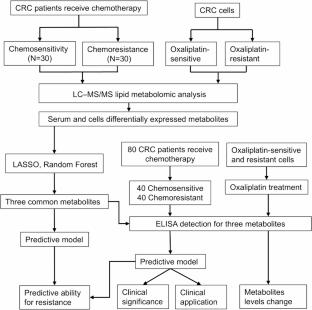
We performed untargeted lipidomic profiling using LC–MS/MS on serum from 60 CRC patients (30 chemotherapy-sensitive, 30 -resistant) and an CRC cell (oxaliplatin-sensitive vs. -resistant). Differentially expressed metabolites (DEMs) were screened, and overlapping DEMs were prioritized using Random Forest and LASSO regression. A predictive signature was developed and validated in an independent cohort of 80 patients. Oxaliplatin was used to treat the CRC cells and validate the metabolite levels.
Results
We identified 238 and 79 DEMs in serum and cells, respectively. Intersection and machine learning selected three metabolites, including: docosapentaenoic acid (DA), 7-(1-imidazolyl) heptanoic acid (IHA), and dihydroxyacetone phosphate (DHAP). The predictive signature achieved AUC of 0.806 (discovery) and 0.838 (validation), with excellent calibration and positive net benefit on decision curve analysis. The signature scores were significantly higher in patients with distant metastasis or advanced tumor stage, suggesting a link between metabolic dysregulation and disease progression. The signature was independent of conventional tumor markers. The experiment of oxaliplatin- resistant cells revealed that these three metabolites exhibited little influence by treatment of oxaliplatin.
Conclusion
This integrative lipidomics approach yields a robust serum signature for predicting oxaliplatin resistance in CRC, with potential to reflect both therapeutic response and tumor aggressiveness.
期刊介绍:
Functional & Integrative Genomics is devoted to large-scale studies of genomes and their functions, including systems analyses of biological processes. The journal will provide the research community an integrated platform where researchers can share, review and discuss their findings on important biological questions that will ultimately enable us to answer the fundamental question: How do genomes work?

 求助内容:
求助内容: 应助结果提醒方式:

 京公网安备 11010802042870号


