{"title":"Modulating Metal–Oxygen Bond Energy by Valence State Engineering in 2D High Entropy Oxides for Enhanced Water Electrolysis","authors":"Tian Wu, Shasha Gao, Runlin Ma, Rui Zhang, Chaolong Wang, Dong Guo, Die Lu, Zhihong Tian, Menggai Jiao, Zhen Zhou, Gonglei Shao","doi":"10.1002/cey2.70151","DOIUrl":null,"url":null,"abstract":"<p>Valence state engineering has emerged as a powerful strategy to optimize catalytic performance by modulating the electronic structure of metal active sites. However, the valence state regulation in high-entropy compounds (HECs) remains elusive due to their complex multi-element components and electronic interactions. Here, the valence states of different metals in two-dimensional (2D) high entropy oxide (HEO) (FeNiMoRuV)O<sub>2−<i>x</i></sub> are precisely modulated through controlled pyrolysis of corresponding 2D high entropy hydroxide (HEHO) (FeNiMoRuV)(OH)<sub>2</sub> under varying temperatures. Temperature-controlled pyrolysis selectively reduces the oxidation state of Ru, while simultaneously increasing the valence state of other constituent metals (Fe, Ni, Mo, and V), suggesting a competitive redox equilibrium. Notably, these low-valence Ru sites with oxygen vacancy in 2D HEO significantly reduce Ru–O bond energy and promote the generation of O–*O intermediates, thereby enabling oxygen evolution with a lattice oxygen mediated-oxygen vacancy site mechanism. 2D HEO with low-valence Ru exhibits superior electrolytic water performance (HER/OER) compared to HEHO and other HEO with high-valence Ru, achieving a current density of 1000 mA cm<sup>−2</sup> at 1.923 V, which exceeds the commercial Pt/C||RuO<sub>2</sub> system. Therefore, this study reveals the valence state regulatory mechanism of HECs and provides a solid hammer for the catalytic mechanism of valence state engineering.</p>","PeriodicalId":33706,"journal":{"name":"Carbon Energy","volume":"8 3","pages":""},"PeriodicalIF":24.2000,"publicationDate":"2026-03-29","publicationTypes":"Journal Article","fieldsOfStudy":null,"isOpenAccess":false,"openAccessPdf":"https://onlinelibrary.wiley.com/doi/epdf/10.1002/cey2.70151","citationCount":"0","resultStr":null,"platform":"Semanticscholar","paperid":null,"PeriodicalName":"Carbon Energy","FirstCategoryId":"88","ListUrlMain":"https://onlinelibrary.wiley.com/doi/10.1002/cey2.70151","RegionNum":1,"RegionCategory":"材料科学","ArticlePicture":[],"TitleCN":null,"AbstractTextCN":null,"PMCID":null,"EPubDate":"2025/12/18 0:00:00","PubModel":"Epub","JCR":"Q1","JCRName":"CHEMISTRY, PHYSICAL","Score":null,"Total":0}
引用次数: 0
Abstract
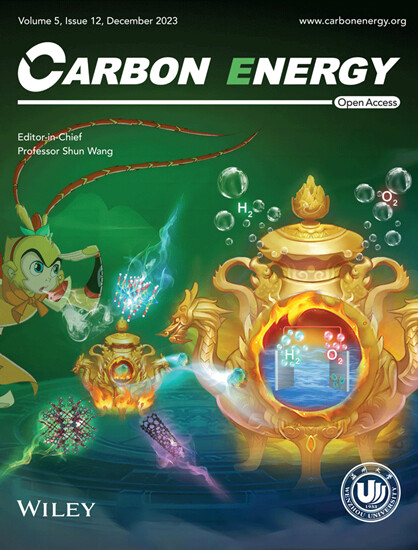
Valence state engineering has emerged as a powerful strategy to optimize catalytic performance by modulating the electronic structure of metal active sites. However, the valence state regulation in high-entropy compounds (HECs) remains elusive due to their complex multi-element components and electronic interactions. Here, the valence states of different metals in two-dimensional (2D) high entropy oxide (HEO) (FeNiMoRuV)O2−x are precisely modulated through controlled pyrolysis of corresponding 2D high entropy hydroxide (HEHO) (FeNiMoRuV)(OH)2 under varying temperatures. Temperature-controlled pyrolysis selectively reduces the oxidation state of Ru, while simultaneously increasing the valence state of other constituent metals (Fe, Ni, Mo, and V), suggesting a competitive redox equilibrium. Notably, these low-valence Ru sites with oxygen vacancy in 2D HEO significantly reduce Ru–O bond energy and promote the generation of O–*O intermediates, thereby enabling oxygen evolution with a lattice oxygen mediated-oxygen vacancy site mechanism. 2D HEO with low-valence Ru exhibits superior electrolytic water performance (HER/OER) compared to HEHO and other HEO with high-valence Ru, achieving a current density of 1000 mA cm−2 at 1.923 V, which exceeds the commercial Pt/C||RuO2 system. Therefore, this study reveals the valence state regulatory mechanism of HECs and provides a solid hammer for the catalytic mechanism of valence state engineering.
期刊介绍:
Carbon Energy is an international journal that focuses on cutting-edge energy technology involving carbon utilization and carbon emission control. It provides a platform for researchers to communicate their findings and critical opinions and aims to bring together the communities of advanced material and energy. The journal covers a broad range of energy technologies, including energy storage, photocatalysis, electrocatalysis, photoelectrocatalysis, and thermocatalysis. It covers all forms of energy, from conventional electric and thermal energy to those that catalyze chemical and biological transformations. Additionally, Carbon Energy promotes new technologies for controlling carbon emissions and the green production of carbon materials. The journal welcomes innovative interdisciplinary research with wide impact. It is indexed in various databases, including Advanced Technologies & Aerospace Collection/Database, Biological Science Collection/Database, CAS, DOAJ, Environmental Science Collection/Database, Web of Science and Technology Collection.



 求助内容:
求助内容: 应助结果提醒方式:

 京公网安备 11010802042870号


