{"title":"Silkworm Cocoon-Templated Hierarchical Co3O4 for Non-Enzymatic Electrochemical Detection of H2O2","authors":"Long Zhao, Xue Yu, Shuai Zheng, Kai Zhang","doi":"10.1002/elan.70140","DOIUrl":null,"url":null,"abstract":"<p>Hydrogen peroxide (H<sub>2</sub>O<sub>2</sub>) is ubiquitous in food disinfection, environmental matrices, and biological systems. Therefore, rapid, sensitive, and reliable determination of H<sub>2</sub>O<sub>2</sub> is essential for risk surveillance and quality control. Herein, spinel Co<sub>3</sub>O<sub>4</sub> with a hierarchical porous architecture was prepared via a biomass-templated impregnation-calcination strategy using natural silkworm cocoons and subsequently employed to fabricate an enzyme-free electrochemical H<sub>2</sub>O<sub>2</sub> sensing electrode (Co<sub>3</sub>O<sub>4</sub>/glassy carbon electrode (GCE)). Morphological and structural characterizations confirm the formation of phase-pure, polycrystalline Co<sub>3</sub>O<sub>4</sub> with a uniform nanoscale texture, which provides abundant accessible active sites and efficient mass-transport pathways. Under the optimized working potential of −0.4 V, chronoamperometric measurements reveal fast, stable, and highly reproducible stepwise current responses toward H<sub>2</sub>O<sub>2</sub>. The steady-state current exhibits a good linear relationship with H<sub>2</sub>O<sub>2</sub> concentration over 4–3160 μM, delivering a sensitivity of 0.284 μA μM<sup>−1</sup>·cm<sup>−2</sup> and a detection limit of 1.6 μM. The sensor shows strong tolerance to common inorganic salts and biologically relevant interferents, retaining 90.34% of its initial response after 18 d. Excellent repeatability and electrode-to-electrode reproducibility are achieved with relative standard deviations (RSDs) of 4.11% and 3.64%, respectively, and satisfactory recoveries of 99.7%–104.6% (RSD < 2.5%) are obtained in spiked tap-water samples. Kinetic analysis yields an apparent diffusion coefficient (<i>D</i><sub>app</sub>) of 1.2 × 10<sup>−5</sup> cm<sup>2</sup>·s<sup>−1</sup> and an apparent catalytic rate constant (<i>k</i><sub>cat</sub>) of 3.2 × 10<sup>5</sup> M<sup>−1</sup>·s<sup>−1</sup>, indicating favorable mass transfer coupled with fast interfacial reaction kinetics. Overall, the biomass-templated Co<sub>3</sub>O<sub>4</sub>/GCE achieves a balanced performance in terms of a wide linear range, low detection limit, and high reliability without resorting to complicated compositing or conductive additives, offering a green and straightforward enzyme-free electrochemical platform for H<sub>2</sub>O<sub>2</sub> monitoring in food safety and water analysis.</p>","PeriodicalId":162,"journal":{"name":"Electroanalysis","volume":"38 4","pages":""},"PeriodicalIF":2.3000,"publicationDate":"2026-04-13","publicationTypes":"Journal Article","fieldsOfStudy":null,"isOpenAccess":false,"openAccessPdf":"","citationCount":"0","resultStr":null,"platform":"Semanticscholar","paperid":null,"PeriodicalName":"Electroanalysis","FirstCategoryId":"92","ListUrlMain":"https://analyticalsciencejournals.onlinelibrary.wiley.com/doi/10.1002/elan.70140","RegionNum":3,"RegionCategory":"化学","ArticlePicture":[],"TitleCN":null,"AbstractTextCN":null,"PMCID":null,"EPubDate":"","PubModel":"","JCR":"Q2","JCRName":"CHEMISTRY, ANALYTICAL","Score":null,"Total":0}
引用次数: 0
Abstract
Hydrogen peroxide (H2O2) is ubiquitous in food disinfection, environmental matrices, and biological systems. Therefore, rapid, sensitive, and reliable determination of H2O2 is essential for risk surveillance and quality control. Herein, spinel Co3O4 with a hierarchical porous architecture was prepared via a biomass-templated impregnation-calcination strategy using natural silkworm cocoons and subsequently employed to fabricate an enzyme-free electrochemical H2O2 sensing electrode (Co3O4/glassy carbon electrode (GCE)). Morphological and structural characterizations confirm the formation of phase-pure, polycrystalline Co3O4 with a uniform nanoscale texture, which provides abundant accessible active sites and efficient mass-transport pathways. Under the optimized working potential of −0.4 V, chronoamperometric measurements reveal fast, stable, and highly reproducible stepwise current responses toward H2O2. The steady-state current exhibits a good linear relationship with H2O2 concentration over 4–3160 μM, delivering a sensitivity of 0.284 μA μM−1·cm−2 and a detection limit of 1.6 μM. The sensor shows strong tolerance to common inorganic salts and biologically relevant interferents, retaining 90.34% of its initial response after 18 d. Excellent repeatability and electrode-to-electrode reproducibility are achieved with relative standard deviations (RSDs) of 4.11% and 3.64%, respectively, and satisfactory recoveries of 99.7%–104.6% (RSD < 2.5%) are obtained in spiked tap-water samples. Kinetic analysis yields an apparent diffusion coefficient (Dapp) of 1.2 × 10⁻⁵ cm2·s−1 and an apparent catalytic rate constant (kcat) of 3.2 × 10⁵ M−1·s−1, indicating favorable mass transfer coupled with fast interfacial reaction kinetics. Overall, the biomass-templated Co3O4/GCE achieves a balanced performance in terms of a wide linear range, low detection limit, and high reliability without resorting to complicated compositing or conductive additives, offering a green and straightforward enzyme-free electrochemical platform for H2O2 monitoring in food safety and water analysis.
期刊介绍:
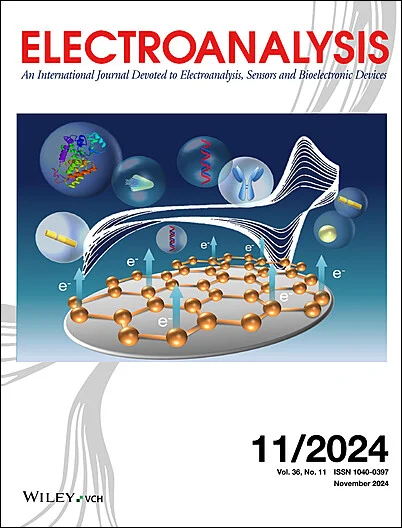
Electroanalysis is an international, peer-reviewed journal covering all branches of electroanalytical chemistry, including both fundamental and application papers as well as reviews dealing with new electrochemical sensors and biosensors, nanobioelectronics devices, analytical voltammetry, potentiometry, new electrochemical detection schemes based on novel nanomaterials, fuel cells and biofuel cells, and important practical applications.
Serving as a vital communication link between the research labs and the field, Electroanalysis helps you to quickly adapt the latest innovations into practical clinical, environmental, food analysis, industrial and energy-related applications. Electroanalysis provides the most comprehensive coverage of the field and is the number one source for information on electroanalytical chemistry, electrochemical sensors and biosensors and fuel/biofuel cells.

 求助内容:
求助内容: 应助结果提醒方式:

 京公网安备 11010802042870号


