{"title":"Nonlocal Velocity-Dependent Optical Potential and the Perey Effect: The Incident Proton Case","authors":"Mohammad Fatehi Hasan","doi":"10.1134/S1547477125702164","DOIUrl":null,"url":null,"abstract":"<p>In the nucleus interior, the presence of a nonlocal potential leads to suppression or enhancement of the wave functions that differ from the corresponding wave functions obtained by a local potential. This is known as the Perey effect. In this work, we utilize the calculated Perey damping factor to demonstrate that the nonlocal velocity-dependent optical potential simulates a source of nonlocality. In that regard, we considered proton scattering from <sup>12</sup>C, <sup>16</sup>O, <sup>40</sup>Ca, <sup>58</sup>Ni, and <sup>120</sup>Sn in the energy range between 10–40 MeV. The Perey damping factor is calculated for each nucleus at each incident proton energy and for different angular momentum quantum numbers to assess the nonlocality strength resulting from the velocity-dependent nonlocal optical potential. The potential parameters required to determine the local and the nonlocal wave functions, and therefore the Perey damping factors, are obtained from different articles. In one case, the required potential parameters were obtained by fitting these parameters to the experimental angular distributions using a least-square fit analysis. Our results demonstrate that the effect of the nonlocal potential is dependent on the target and is dependent on both energy and orbital angular momentum for each target.</p>","PeriodicalId":730,"journal":{"name":"Physics of Particles and Nuclei Letters","volume":"23 2","pages":"226 - 239"},"PeriodicalIF":0.5000,"publicationDate":"2026-04-14","publicationTypes":"Journal Article","fieldsOfStudy":null,"isOpenAccess":false,"openAccessPdf":"","citationCount":"0","resultStr":null,"platform":"Semanticscholar","paperid":null,"PeriodicalName":"Physics of Particles and Nuclei Letters","FirstCategoryId":"1085","ListUrlMain":"https://link.springer.com/article/10.1134/S1547477125702164","RegionNum":0,"RegionCategory":null,"ArticlePicture":[],"TitleCN":null,"AbstractTextCN":null,"PMCID":null,"EPubDate":"","PubModel":"","JCR":"Q4","JCRName":"PHYSICS, PARTICLES & FIELDS","Score":null,"Total":0}
引用次数: 0
Abstract
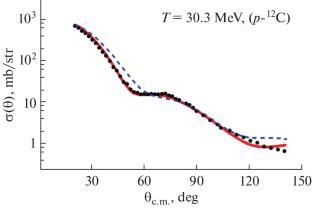
In the nucleus interior, the presence of a nonlocal potential leads to suppression or enhancement of the wave functions that differ from the corresponding wave functions obtained by a local potential. This is known as the Perey effect. In this work, we utilize the calculated Perey damping factor to demonstrate that the nonlocal velocity-dependent optical potential simulates a source of nonlocality. In that regard, we considered proton scattering from 12C, 16O, 40Ca, 58Ni, and 120Sn in the energy range between 10–40 MeV. The Perey damping factor is calculated for each nucleus at each incident proton energy and for different angular momentum quantum numbers to assess the nonlocality strength resulting from the velocity-dependent nonlocal optical potential. The potential parameters required to determine the local and the nonlocal wave functions, and therefore the Perey damping factors, are obtained from different articles. In one case, the required potential parameters were obtained by fitting these parameters to the experimental angular distributions using a least-square fit analysis. Our results demonstrate that the effect of the nonlocal potential is dependent on the target and is dependent on both energy and orbital angular momentum for each target.
期刊介绍:
The journal Physics of Particles and Nuclei Letters, brief name Particles and Nuclei Letters, publishes the articles with results of the original theoretical, experimental, scientific-technical, methodological and applied research. Subject matter of articles covers: theoretical physics, elementary particle physics, relativistic nuclear physics, nuclear physics and related problems in other branches of physics, neutron physics, condensed matter physics, physics and engineering at low temperatures, physics and engineering of accelerators, physical experimental instruments and methods, physical computation experiments, applied research in these branches of physics and radiology, ecology and nuclear medicine.

 求助内容:
求助内容: 应助结果提醒方式:

 京公网安备 11010802042870号


