
Glycinate Complexes and Models of Their Formation

IF 0.5 Q4 CHEMISTRY, MULTIDISCIPLINARY
Bobonazarzoda Gulrukhsor Bobonazar
{"title":"Glycinate Complexes and Models of Their Formation","authors":"Bobonazarzoda Gulrukhsor Bobonazar","doi":"10.3103/S0027131426700070","DOIUrl":null,"url":null,"abstract":"<p>The complex formation in a Fe(II)–Fe(III)–Gly–Na(H)ClO<sub>4</sub>–H<sub>2</sub>O system is studied by the method of Clark–Nikolsky oxidation potential at 308.15 K, <i>I</i> = 0.50, <i>C</i><sub>Fe(II)</sub> = <i>C</i><sub>Fe(III)</sub> = 1 × 10<sup>–3</sup>, and <i>C</i><sub>Gly</sub> = 2 × 10<sup>–3</sup> mol/L in a range of pH of 0.5–8.5. The experimental curves of the dependence of the EMF of the system on the concentration parameters such as pH, p<i>C</i><sub>Fe(III)</sub>, p<i>C</i><sub>Fe(II)</sub>, and p<i>C</i><sub>L</sub> are obtained. A method of successive approximations of theoretical and experimental oxidative functions is used for the calculation of the formation constants of the complexes with the use of the Excel program.</p>","PeriodicalId":709,"journal":{"name":"Moscow University Chemistry Bulletin","volume":"81 2","pages":"107 - 110"},"PeriodicalIF":0.5000,"publicationDate":"2026-04-15","publicationTypes":"Journal Article","fieldsOfStudy":null,"isOpenAccess":false,"openAccessPdf":"","citationCount":"0","resultStr":null,"platform":"Semanticscholar","paperid":null,"PeriodicalName":"Moscow University Chemistry Bulletin","FirstCategoryId":"1085","ListUrlMain":"https://link.springer.com/article/10.3103/S0027131426700070","RegionNum":0,"RegionCategory":null,"ArticlePicture":[],"TitleCN":null,"AbstractTextCN":null,"PMCID":null,"EPubDate":"","PubModel":"","JCR":"Q4","JCRName":"CHEMISTRY, MULTIDISCIPLINARY","Score":null,"Total":0}
引用次数: 0

Abstract

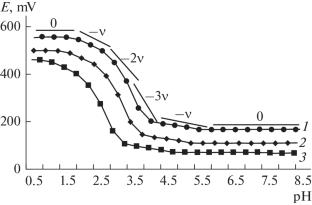
The complex formation in a Fe(II)–Fe(III)–Gly–Na(H)ClO4–H2O system is studied by the method of Clark–Nikolsky oxidation potential at 308.15 K, I = 0.50, CFe(II) = CFe(III) = 1 × 10⁻³, and CGly = 2 × 10⁻³ mol/L in a range of pH of 0.5–8.5. The experimental curves of the dependence of the EMF of the system on the concentration parameters such as pH, pCFe(III), pCFe(II), and pCL are obtained. A method of successive approximations of theoretical and experimental oxidative functions is used for the calculation of the formation constants of the complexes with the use of the Excel program.
Abstract Image

甘氨酸配合物及其形成模型
采用Clark-Nikolsky氧化电位法研究了Fe(II) -Fe (III) -Gly-Na (H) ClO4-H2O体系在308.15 K、I = 0.50、CFe(II) = CFe(III) = 1 × 10⁻³、CGly = 2 × 10⁻³ mol/L、pH为0.5 ~ 8.5条件下络合物的形成。得到了体系电动势随pH、pCFe(III)、pCFe(II)、pCL等浓度参数变化的实验曲线。采用理论氧化函数和实验氧化函数逐次逼近的方法,利用Excel程序计算了配合物的形成常数。
本文章由计算机程序翻译,如有差异,请以英文原文为准。
求助全文
约1分钟内获得全文 求助全文
来源期刊
Moscow University Chemistry Bulletin
Moscow University Chemistry Bulletin CHEMISTRY, MULTIDISCIPLINARY-
CiteScore
1.30
自引率
14.30%
发文量
38
期刊介绍: Moscow University Chemistry Bulletin is a journal that publishes review articles, original research articles, and short communications on various areas of basic and applied research in chemistry, including medical chemistry and pharmacology.

×
引用
GB/T 7714-2015
复制
MLA
复制
APA
复制
导出至
BibTeX EndNote RefMan NoteFirst NoteExpress
×
提示
您的信息不完整,为了账户安全,请先补充。
现在去补充
×
提示
您因"违规操作"
具体请查看互助需知
我知道了
×
提示
确定
请完成安全验证×
copy
已复制链接
快去分享给好友吧!
我知道了
右上角分享
点击右上角分享
0
联系我们:info@booksci.cn Book学术提供免费学术资源搜索服务,方便国内外学者检索中英文文献。致力于提供最便捷和优质的服务体验。 Copyright © 2023 布克学术 All rights reserved.
京ICP备2023020795号-1
ghs 京公网安备 11010802042870号
Book学术文献互助
Book学术文献互助群
群 号:604180095
Book学术官方微信
小红书


