
Postmitotic transcription and 3D regulation show locus-specific and differentiation-specific sensitivity to cohesin depletion
IF 29
1区 生物学
Q1 GENETICS & HEREDITY
引用次数: 0
Abstract
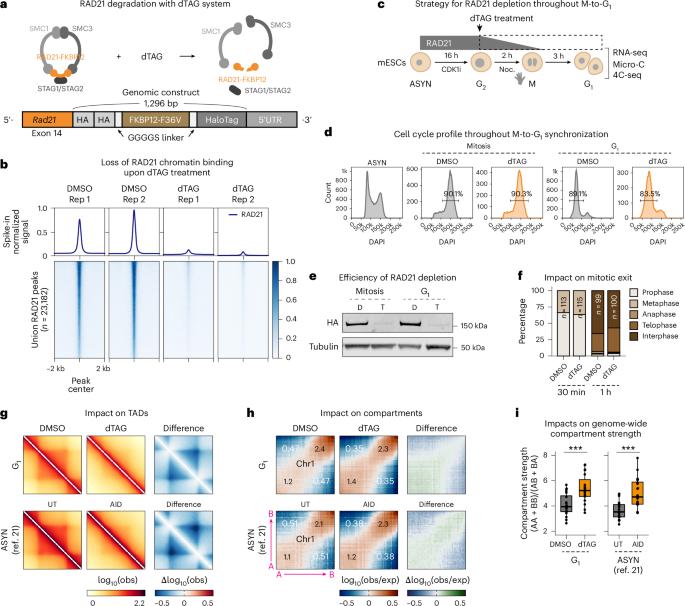
Acute cohesin loss causes widespread reorganization of three-dimensional (3D) chromatin architecture but has relatively minor effects on steady-state transcription. It remains unclear whether its role in gene regulation becomes more critical during mitotic exit, when 3D chromatin architecture and transcription are globally re-established. To address this, we acutely depleted RAD21 in mouse embryonic stem cells during mitotic exit under self-renewal or differentiation conditions. Here we show that, although most loops failed to reform without cohesin, the few cohesin-independent loops were linked to active promoters, strong enhancers and H3K27ac mitotic bookmarking. Transcriptional changes were only modest, indicating that gene reactivation largely bypasses cohesin. Sensitive genes showed RAD21 promoter binding, a higher number of structural loops and positioning within well-insulated, gene-poor topologically associating domains. During differentiation, cohesin loss impaired activation of a broader set of developmental genes, partly due to defective de novo regulatory interactions. Together, these findings demonstrate context-specific requirements for cohesin in gene activation. Lee et al. deplete the cohesin component RAD21 in mouse embryonic stem cells. Most but not all chromatin loops fail to reform after mitosis, and transcriptional changes were minor, except during differentiation, where cohesin seems to have a more important role.
有丝分裂后转录和3D调控显示出位点特异性和分化特异性对内聚蛋白耗竭的敏感性。
急性内聚蛋白损失导致三维染色质结构的广泛重组,但对稳态转录的影响相对较小。在有丝分裂结束时,当三维染色质结构和转录在全球范围内重新建立时,其在基因调控中的作用是否变得更加关键,目前尚不清楚。为了解决这个问题,我们在自我更新或分化条件下,在小鼠胚胎干细胞有丝分裂退出过程中急剧耗尽RAD21。本研究表明,尽管大多数环在没有内聚蛋白的情况下无法重组,但少数内聚蛋白无关的环与活性启动子、强增强子和H3K27ac有丝分裂书签相关。转录变化只是适度的,这表明基因再激活在很大程度上绕过了内聚蛋白。敏感基因显示RAD21启动子结合,更多的结构环和定位在良好的绝缘,基因缺乏拓扑相关域。在分化过程中,内聚蛋白的丢失损害了一组更广泛的发育基因的激活,部分原因是由于有缺陷的新生调节相互作用。综上所述,这些发现证明了基因激活中黏结蛋白的环境特异性要求。
本文章由计算机程序翻译,如有差异,请以英文原文为准。
求助全文
约1分钟内获得全文
求助全文
来源期刊
Nature genetics
生物-遗传学
CiteScore
43.00
自引率
2.60%
发文量
241
审稿时长
3 months
期刊介绍:
Nature Genetics publishes the very highest quality research in genetics. It encompasses genetic and functional genomic studies on human and plant traits and on other model organisms. Current emphasis is on the genetic basis for common and complex diseases and on the functional mechanism, architecture and evolution of gene networks, studied by experimental perturbation.
Integrative genetic topics comprise, but are not limited to:
-Genes in the pathology of human disease
-Molecular analysis of simple and complex genetic traits
-Cancer genetics
-Agricultural genomics
-Developmental genetics
-Regulatory variation in gene expression
-Strategies and technologies for extracting function from genomic data
-Pharmacological genomics
-Genome evolution
 求助内容:
求助内容: 应助结果提醒方式:

 京公网安备 11010802042870号


