Flavia Venetucci Gouveia, Gavin J. B. Elias, Emily H. Y. Wong, Andrew Yang, Michelle Beyn, Amelia Mesich, Uyiosa Omere, Sarah A. Iskin, Yutong Bai, Chao-Kai Hu, Alexandre Boutet, Andres M. Lozano, Jürgen Germann
{"title":"Neuromodulation for treatment-resistant obsessive–compulsive disorder: a systematic review, meta-analysis and network analysis","authors":"Flavia Venetucci Gouveia, Gavin J. B. Elias, Emily H. Y. Wong, Andrew Yang, Michelle Beyn, Amelia Mesich, Uyiosa Omere, Sarah A. Iskin, Yutong Bai, Chao-Kai Hu, Alexandre Boutet, Andres M. Lozano, Jürgen Germann","doi":"10.1038/s44220-026-00586-9","DOIUrl":null,"url":null,"abstract":"Obsessive–compulsive disorder (OCD) is a chronic and disabling condition for which neuromodulation has emerged as a key therapeutic strategy for severe cases. This systematic review and meta-analysis evaluated invasive and non-invasive neuromodulation for OCD using studies identified from PubMed, Embase and Cochrane (inception to December 2024) that reported pre- and post-treatment severity scores in at least two patients. We assessed risk of bias, estimated pooled mean differences (MD) using random-effects models and investigated stimulation targets using network analysis. Across 142 studies (n = 2,960), neuromodulation reduced symptoms by 35.3% (95% confidence interval (CI) 32.6–38.0). Invasive interventions showed the largest effects (MD 39.7–45.1), whereas non-invasive modalities yielded more modest benefits (MD 26.4–28.8). Sham-controlled (MD 15.4, 95% CI 10.9–20.0) and low-bias analyses (MD 10.7, 95% CI 5.5–16.0) confirmed efficacy beyond placebo. These findings demonstrate robust symptom improvement with neuromodulation, with invasive approaches yielding the greatest benefit. In this study, the authors analyze data from 143 studies involving 2,743 patients to compare the efficacy of neuromodulatory invasive and non-invasive interventions in the treatment of obsessive–compulsive disorder.","PeriodicalId":74247,"journal":{"name":"Nature mental health","volume":"4 4","pages":"615-633"},"PeriodicalIF":8.7000,"publicationDate":"2026-04-13","publicationTypes":"Journal Article","fieldsOfStudy":null,"isOpenAccess":false,"openAccessPdf":"","citationCount":"0","resultStr":null,"platform":"Semanticscholar","paperid":null,"PeriodicalName":"Nature mental health","FirstCategoryId":"1085","ListUrlMain":"https://www.nature.com/articles/s44220-026-00586-9","RegionNum":0,"RegionCategory":null,"ArticlePicture":[],"TitleCN":null,"AbstractTextCN":null,"PMCID":null,"EPubDate":"","PubModel":"","JCR":"","JCRName":"","Score":null,"Total":0}
引用次数: 0
Abstract
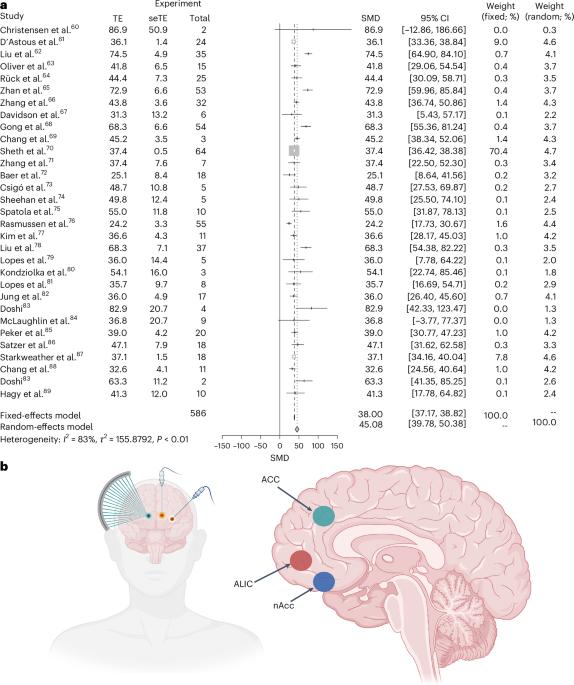
Obsessive–compulsive disorder (OCD) is a chronic and disabling condition for which neuromodulation has emerged as a key therapeutic strategy for severe cases. This systematic review and meta-analysis evaluated invasive and non-invasive neuromodulation for OCD using studies identified from PubMed, Embase and Cochrane (inception to December 2024) that reported pre- and post-treatment severity scores in at least two patients. We assessed risk of bias, estimated pooled mean differences (MD) using random-effects models and investigated stimulation targets using network analysis. Across 142 studies (n = 2,960), neuromodulation reduced symptoms by 35.3% (95% confidence interval (CI) 32.6–38.0). Invasive interventions showed the largest effects (MD 39.7–45.1), whereas non-invasive modalities yielded more modest benefits (MD 26.4–28.8). Sham-controlled (MD 15.4, 95% CI 10.9–20.0) and low-bias analyses (MD 10.7, 95% CI 5.5–16.0) confirmed efficacy beyond placebo. These findings demonstrate robust symptom improvement with neuromodulation, with invasive approaches yielding the greatest benefit. In this study, the authors analyze data from 143 studies involving 2,743 patients to compare the efficacy of neuromodulatory invasive and non-invasive interventions in the treatment of obsessive–compulsive disorder.


 求助内容:
求助内容: 应助结果提醒方式:

 京公网安备 11010802042870号


