
Revamping neuroimaging analysis to reveal biomarkers of adolescent mental health
IF 8.7
引用次数: 0
Abstract
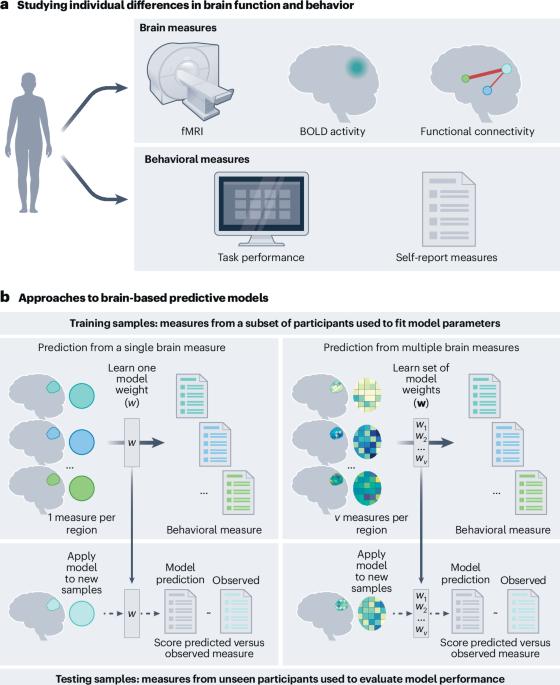
Advances in neuroscience research provide an unprecedented opportunity to identify the etiopathogenesis of mental health disorders. Yet it has proven difficult to find reliable associations between neurobiological phenotypes and real-world mental health experiences, particularly among youth. This Perspective addresses two pervasive assumptions inherent to many functional neuroimaging studies that diminish the predictivity of the data. First, studies assume that aligning data across individuals on the basis of the anatomy of the brain is sufficient to align their brain function. Individual brains vary meaningfully in the localization of functions, particularly across development and in clinical populations; neglecting this variability in functional neuroanatomy risks washing out rich and reliable patterns of individual-specific information. Second, studies assume that the underlying signal embedded in brain measurements over space and time can be modeled with simple transformations from high dimensions (that is, voxels) to low or single dimensions (that is, regional averages). However, the latent structure of brain activity and behavior is often complex and nonlinear. To overcome these assumptions, we suggest alternative methodological approaches that have yielded novel insights into the neurobiology of cognition and mental health symptoms in adolescence. Building robust predictive models of psychiatric problems requires methodology that can capture the richness and complexity of the brain and behavior. Neuroscience research struggles to link neurobiological phenotypes with real-world mental health experiences, especially in youth. Here the authors challenge assumptions in functional neuroimaging studies, proposing alternative methods that reveal complex, individual-specific brain patterns, enhancing predictive models of psychiatric issues and advancing the understanding of adolescent mental health.
改进神经影像学分析,揭示青少年心理健康的生物标志物
神经科学研究的进步为确定精神健康障碍的发病机制提供了前所未有的机会。然而,事实证明很难在神经生物学表型和现实世界的心理健康经历之间找到可靠的联系,尤其是在年轻人中。这一观点解决了两个普遍存在的假设,固有的许多功能神经影像学研究削弱了数据的预测性。首先,研究假设在大脑解剖的基础上调整个体之间的数据足以调整他们的大脑功能。个体大脑在功能定位方面存在显著差异,特别是在整个发育过程和临床人群中;在功能神经解剖学中忽视这种可变性,可能会使个体特定信息的丰富和可靠模式消失。其次,研究假设大脑测量中嵌入的潜在信号可以通过从高维(即体素)到低维或单维(即区域平均值)的简单转换来建模。然而,大脑活动和行为的潜在结构往往是复杂和非线性的。为了克服这些假设,我们提出了另一种方法方法,这些方法已经对青少年认知和心理健康症状的神经生物学产生了新的见解。建立健全的精神疾病预测模型需要能够捕捉大脑和行为的丰富性和复杂性的方法。神经科学研究努力将神经生物学表型与现实世界的心理健康经历联系起来,尤其是在年轻人中。在这里,作者挑战了功能性神经成像研究中的假设,提出了揭示复杂的、个体特定的大脑模式的替代方法,增强了精神疾病的预测模型,并促进了对青少年心理健康的理解。
本文章由计算机程序翻译,如有差异,请以英文原文为准。
求助全文
约1分钟内获得全文
求助全文

 求助内容:
求助内容: 应助结果提醒方式:

 京公网安备 11010802042870号


