
Manufacturer’s Pricing and Consumer Behavior With Peer-to-Peer Marketplace and Collection Platform
IF 5.2
3区 管理学
Q1 BUSINESS
IEEE Transactions on Engineering Management
Pub Date : 2026-01-01
Epub Date: 2026-03-23
DOI:10.1109/TEM.2026.3676460
引用次数: 0
Abstract
In the context of the growing secondhand economy, this article examines a supply chain involving a monopolistic manufacturer of durable products operating under three configurations: no secondhand market (Scenario N), participation in a peer-to-peer (P2P) marketplace (Scenario P2P), and collaboration with a collection platform (Scenario PL). We develop three game-theoretic models to characterize the manufacturer’s pricing decisions and consumers’ purchase and replacement behaviors across these scenarios. Our main findings are as follows. First, in Scenario P2P, the manufacturer can induce all, some, or none of the replacement consumers (i.e., consumers holding a used product) to repurchase new products, depending on the production cost of the new product, whereas in Scenario PL, the manufacturer can induce only some or none of them to do so. Second, when production costs are low, a P2P marketplace benefits the manufacturer but it becomes detrimental as production costs increase. By contrast, partnering with a collection platform weakly increases the manufacturer’s profit (i.e., it either improves profit or leaves it unchanged). Third, relative to Scenario PL, Scenario P2P yields higher consumer surplus in most cases, except when both the upgrade level of the new product and its production cost are high. Counterintuitively, when production costs are high, higher transaction costs in secondhand markets can benefit consumers. For robustness, we extend the model to allow for the manufacturer’s dynamic pricing, replacement consumers’ repurchase in Scenario N, and new-product upgrades.基于点对点市场和收集平台的制造商定价与消费者行为
在二手经济不断增长的背景下,本文研究了一个涉及垄断耐用产品制造商的供应链,该供应链在三种配置下运行:没有二手市场(场景N),参与点对点(P2P)市场(场景P2P),以及与收集平台合作(场景PL)。我们建立了三个博弈论模型来描述制造商的定价决策和消费者在这些场景下的购买和更换行为。我们的主要发现如下。首先,在场景P2P中,制造商可以根据新产品的生产成本,诱导全部、部分或全部替代消费者(即持有旧产品的消费者)重新购买新产品,而在场景PL中,制造商只能诱导部分或全部消费者这样做。其次,当生产成本较低时,P2P市场对制造商有利,但随着生产成本的增加,它变得有害。相比之下,与收款平台合作对制造商利润的增加作用微弱(即要么提高利润,要么保持不变)。第三,相对于场景PL,场景P2P在大多数情况下产生更高的消费者剩余,除非新产品的升级水平和生产成本都很高。与直觉相反的是,当生产成本高时,二手市场上较高的交易成本对消费者有利。为了增强鲁棒性,我们扩展了模型,允许制造商的动态定价、替换消费者在场景N中的再购买和新产品升级。
本文章由计算机程序翻译,如有差异,请以英文原文为准。
求助全文
约1分钟内获得全文
求助全文
来源期刊
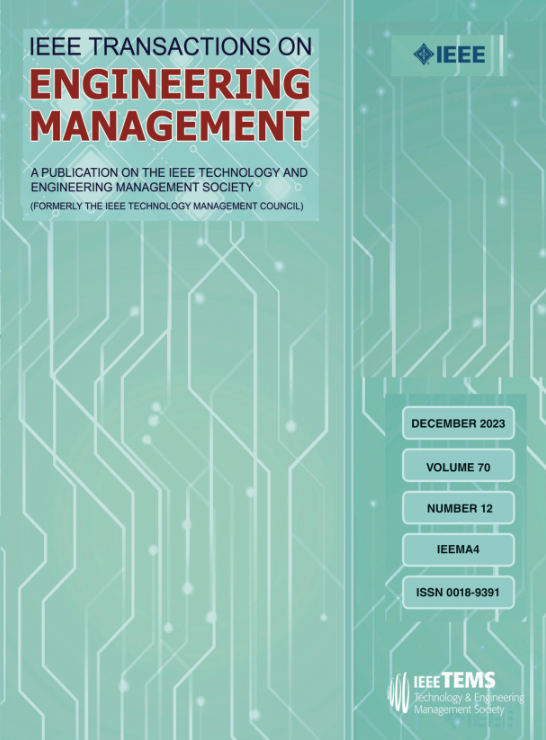
IEEE Transactions on Engineering Management
管理科学-工程:工业
CiteScore
10.30
自引率
19.00%
发文量
604
审稿时长
5.3 months
期刊介绍:
Management of technical functions such as research, development, and engineering in industry, government, university, and other settings. Emphasis is on studies carried on within an organization to help in decision making or policy formation for RD&E.
 求助内容:
求助内容: 应助结果提醒方式:

 京公网安备 11010802042870号


